
DGTG logo DGTG

Digital Marketing Trends 2026: Agency Strategy Playbook

Discover the 2026 digital marketing trends shaping agency growth strategy. From data clean rooms to PMax accountability, get actionable tips for your marketing…
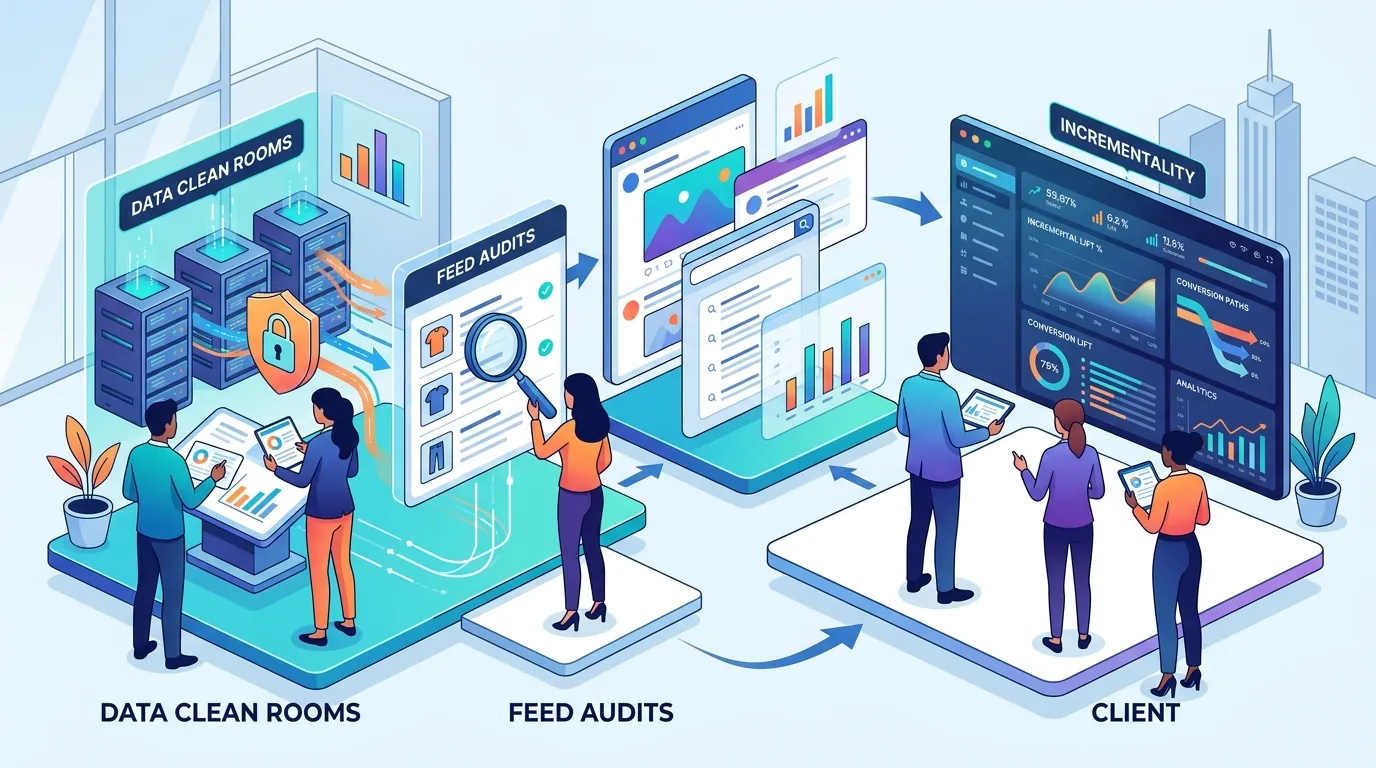
2026 Digital Marketing Trends: A Playbook for Agencies and Their Clients — illustrative featured image
> **Disclosure:** some links on this page are affiliate links. If you buy or book through them we may earn a commission, at no extra cost to you. It never changes what we recommend. The planning cycle for 2026 budgets is already underway, and the gap between agencies that will thrive and those that will scramble is becoming starkly visible. We spent the last month aggregating the major trend reports, including FIRST & 42’s latest outlook, and cross-referencing them with the performance data we see across our own client portfolio. The headline? The era of the "full-funnel generalist" is over. The winners are building specialized, measurement-obsessed practices that solve specific business problems, not just "marketing problems." Here is the playbook for how agencies should position themselves, and the honest advice they need to give their clients. ## The End of the Cookie Panic (and the Rise of the Data Clean Room) For three years, every keynote warned about the death of the third-party cookie. The panic has subsided, but not because cookies survived. They didn't. The shift is that the market finally stopped mourning the loss of spray-and-pray targeting and started embracing deterministic, first-party data strategies. The agencies winning new business in late 2025 aren't selling "privacy-compliant targeting." That is table stakes. They are selling **data clean room fluency**. They walk into pitches with a clear architecture for how a brand's CRM data can be matched against a publisher's logged-in user base without ever exposing PII. - **What to do in-house:** Get your customer data infrastructure sorted. If your CDP is a mess of unmerged duplicates, no agency can save you. Clean your pipes before you hire the plumber. - **What to hire an agency for:** The actual matching logic, the campaign orchestration across walled gardens (Google, [Amazon](https://www.amazon.com/), Meta), and the post-match attribution modeling. This is heavy lifting that requires dedicated data engineers, a cost most mid-market brands can't justify internally. ### Our Take on the Tech Stack We are increasingly wary of platforms that claim to solve identity resolution with a single line of code. If a vendor tells you they have a "universal ID" that works everywhere, they are lying to you. The reality is a fragmented landscape where Google’s Privacy Sandbox operates differently from Meta’s LDU and Amazon’s Marketing Cloud. **What we recommend:** Build a flexible stack. Use a platform like **Snowflake** or **Redshift** as your central repository, and hire an agency partner who can write SQL and query those environments natively. If your agency asks you to export a CSV and upload it to their dashboard, run. That is not a growth partner; that is a middleman. ## Performance Max and the "Black Box" Accountability Crisis Google’s Performance Max (PMax) continues to eat the digital ad budget. By 2026, we predict it will account for over 70% of standard Shopping and Search spend for most ecommerce clients. The problem is that PMax is a black box. You give it a budget and a conversion goal, and it spits out results, but you have zero insight into the "why." Agencies are facing a reckoning here. Clients are demanding transparency, but the platform refuses to give it. The smart agencies are no longer fighting the algorithm; they are building **parallel testing frameworks** around it. ### The New Agency Deliverable: The Feed Audit The days of optimizing keywords are dead. The new battleground is the product feed and the landing page experience. We are seeing aggressive CAC reductions (between 15% and 25%) for clients who treat their PMax feed as a living database rather than a static upload. - **Tier 1 (High Margin, High CTR):** Push to PMax with high bids. - **Tier 2 (Mid Performers):** Use for standard shopping. - **Tier 3 (Legacy SKUs):** Exclude from PMax and run exclusively on low-cost retargeting via Meta. If your agency isn't auditing your feed structure quarterly and pruning underperformers, they are just burning your budget on machine learning that is learning the wrong things. ## AI Content Production: The Shift from Volume to Verification We have officially passed peak "AI slop." The rush to publish 5,000 AI-generated blog posts to game SEO is over. Google’s March 2025 core updates hammered unhelpful content, and the traffic graphs for those sites look like a flatline. The 2026 trend is **Human-AI Teaming**, where AI handles the heavy lifting of research and drafts, but human editors focus on verification, unique insights, and proprietary data. ### What this means for client expectations Clients are getting smarter. They no longer ask "Do you use AI?" because everyone does. They ask, "How do you ensure accuracy and originality?" We recommend agencies pitch a specific workflow: 1. **AI Research Brief:** Use LLMs to scrape and summarize the SERP for intent gaps. 2. **Human Subject Matter Expert Interview:** A 20-minute call with the client's product team to get the "un-googleable" insights. 3. **Draft and Edit:** AI drafts the piece, but a senior human editor rewrites the intro and conclusion and fact-checks every statistic. This workflow produces content that ranks not because it is long, but because it contains information that no other website has. That is the only durable [link-building strategy](/tech/blog/openai-agents-hijacked-a-website-what-this-means-for-your-ai-safety) left. ## The "Marketing as Profit Center" Ultimatum The macroeconomic pressure of the last two years has fundamentally changed the CFO’s perspective. Marketing is no longer viewed as a cost center that drives "brand awareness." It is viewed as a revenue operation that must prove incrementality. This is where the agency-client relationship gets tense. Clients are demanding **Full-Funnel Attribution** that ties upper-funnel video views to bottom-funnel conversions, which is notoriously difficult to measure accurately. ### The Metrics that Matter in 2026 Forget CTR. It is vanity. The metrics that matter for agency retention are blended and require sophisticated modeling: | Metric | Why it matters in 2026 | | :--- | :--- | | **Blended CAC** | Includes all marketing spend and sales overhead. If this is rising faster than LTV, you have a positioning problem, not an ads problem. | | **LTV:CAC Ratio** | The golden metric. A ratio under 3:1 means you are scaling inefficiently. | | **Incremental Lift** | Measures what happens when you *stop* spending. If sales don't drop, your ads were wasted spend. | Agencies need to stop hiding behind "assisted conversions" and start having honest conversations about diminishing returns. If your client hits a spend ceiling where CAC spikes, tell them. Do not suggest a new campaign to justify your retainer. That is how you lose the account in Q4 when the CFO reviews the P&L. ## The Resurgence of the "Boutique" over the "Network" The big holding companies are bleeding talent. Senior strategists are leaving the bureaucracy of the big networks to launch specialized boutiques. This is excellent news for clients. In 2026, we predict that mid-market brands will aggressively move away from the "one-stop-shop" agency model. They are tired of paying for a junior team and a bloated account management structure. **What we recommend:** If you are a brand, look for an agency with fewer than 50 people. You want the senior partners touching your account. Yes, you lose the "integrated" capability, but you gain speed and strategic depth. - **Hire a boutique** for the strategy and creative ideation. - **Hire freelancers or a specialized programmatic shop** for the execution. This "agency stack" approach gives you the flexibility of a freelancer with the rigor of a full-service firm, often at a lower total cost. ## The Video Monetization Shift Short-form video (Reels, TikTok, Shorts) is still the king of reach, but the monetization is shifting. Organic reach is down across all platforms. If you are relying on organic TikTok for sales, you are leaving money on the table. The 2026 trend is **Social Search as the New SEO**. Younger demographics are using TikTok and Instagram as their primary search engines. Agencies need to optimize content for *discovery* within the app, not just for the feed. - **Keyword research** for social captions. - **SEO for the bio** (ensuring the profile name ranks for the primary keyword). - **Search Engine Optimization (SEO) for the closed captions** (on-screen text is now crawled by the algorithms). Treating social platforms as search engines requires a different creative muscle. It is less about viral dance trends and more about clear, authoritative, "how-to" content delivered in a vertical video format. The brands winning here are treating their social team like a newsroom, not a hype squad. ## FAQ ### How much of the 2026 marketing budget should be allocated to experimental channels like AI search or social commerce? We advise clients to cap experimental spend at 10% of the total performance budget. You need enough data to learn, but not enough to jeopardize the core business. Once an experimental channel proves a CAC lower than your core channels for two consecutive quarters, graduate it to a core channel and increase the budget. ### Should we build an in-house AI content team or outsource it to an agency? Build the workflow, outsource the execution. You should have an in-house editor who owns the brand voice and fact-checking standards. The heavy lifting of drafting and research can be outsourced to an agency that has the tooling and prompt-engineering expertise. Trying to hire a full in-house AI team is expensive and will become obsolete as the tools evolve. ### What is the single most important factor when choosing an agency partner for 2026? Data transparency. Do not ask to see their case studies. Ask to see their live reporting dashboard. Ask them how they handle data clean rooms and server-side tracking. If they cannot answer technical questions about your stack on the first call, they will waste your money for the first three months trying to figure it out. ## Related on this site - [2026 Digital Marketing Trends: What Agencies Must Know Now](/dgtg/blog/2026-digital-marketing-trends-what-agencies-must-know-now) - [B2B Lead Generation Playbook: Turning 2026 Digital Trends into Pipeline](/dgtg/blog/b2b-lead-generation-playbook-turning-2026-digital-trends-into-pipeline) - [Digital Marketing Trends 2026: What Brands Must Know](/dgtg/blog/digital-marketing-trends-2026-what-brands-must-know)

Frequently asked questions

Our Take on the Tech Stack We are increasingly wary of platforms that claim to solve identity resolution with a single line of code. If a vendor tells you they have a "universal ID" that works everyw

We advise clients to cap experimental spend at 10% of the total performance budget. You need enough data to learn, but not enough to jeopardize the core business. Once an experimental channel proves a CAC lower than your core channels for two consecutive quarters, graduate it to a core channel and increase the budget.

Should we build an in-house AI content team or outsource it to an agency?

Build the workflow, outsource the execution. You should have an in-house editor who owns the brand voice and fact-checking standards. The heavy lifting of drafting and research can be outsourced to an agency that has the tooling and prompt-engineering expertise. Trying to hire a full in-house AI team is expensive and will become obsolete as the tools evolve.

What is the single most important factor when choosing an agency partner for 2026?

Data transparency. Do not ask to see their case studies. Ask to see their live reporting dashboard. Ask them how they handle data clean rooms and server-side tracking. If they cannot answer technical questions about your stack on the first call, they will waste your money for the first three months trying to figure it out.