
DGTG logo DGTG

2026 Digital Marketing Trends: Strategic Agency Guide

Explore 2026 digital marketing trends for agencies and clients. From AI operations to privacy shifts, get a strategic guide to plan your service offerings.
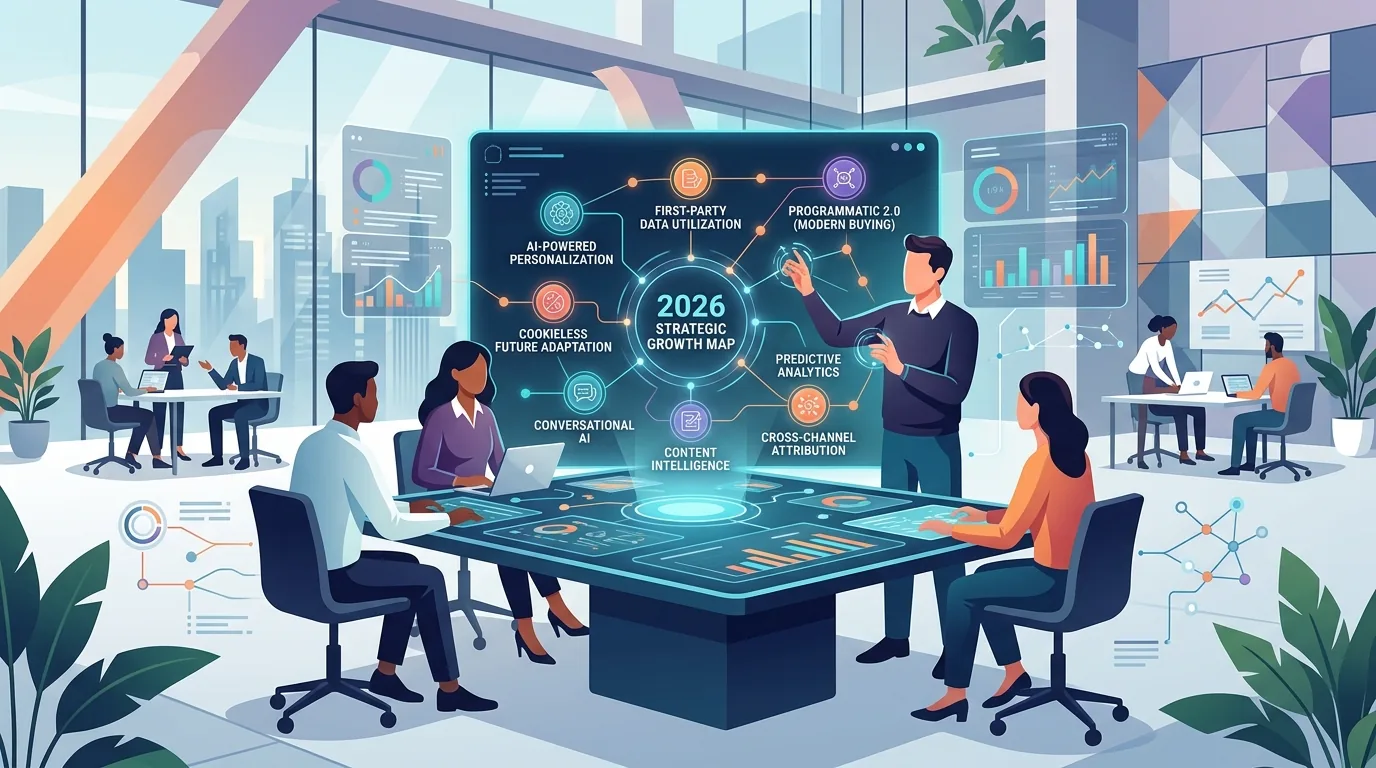
2026 Digital Marketing Trends: A Strategic Guide for Agencies and Their Clients — illustrative featured image
The calendar flipped to 2026, and somewhere in the last quarter of 2025, the conversation shifted. You can hear it in every agency kickoff call. Clients are no longer asking, “How do we get more leads?” They are asking, “How do we prove that the leads we get are worth what we pay for them?” That single question is rewriting the agency playbook. We spent the last few weeks parsing the major industry reports, including the recent FIRST & 42 breakdown of what brands need to know next. The signal is clear: the era of the spray-and-pray media buyer is officially over. The winners in 2026 will be the agencies that stop selling hours and start selling outcomes, specifically outcomes tied to first-party data and full-funnel attribution. For a deeper dive into the forces reshaping the landscape, our [2026 Digital Marketing Trends: A Strategic Guide for Agencies and Their Clients](/dgtg/blog/2026-digital-marketing-trends-a-strategic-guide-for-agencies-and-their-clients) covers the essential shifts every leader should track. Here is the strategic guide for agency leaders and the CMOs who hire them. ## The Death of the "Funnel" and the Rise of the Loop For a decade, we drew the funnel on whiteboards. Top of funnel, middle, bottom. It was a linear lie. The modern customer journey is a chaotic loop. They see a TikTok review, Google your brand, ignore your retargeting ads for three days, read a Reddit thread, then click a newsletter link at 11 PM on a Sunday and buy. The trend for 2026 is treating marketing as a continuous feedback system, not a pipeline. This changes what clients should demand from their agencies. If your agency still presents a report with “Impressions, Clicks, CTR” and calls it a day, run. The metrics that matter now are engagement velocity and micro-conversion rates across channels. ### What this means for your service stack - **In-house:** You need a data analyst who can stitch together SQL tables from your CRM and ad platforms. This is not a junior role. - **Agency:** You need to hire for media strategy that prioritizes creative testing velocity over budget size. The agency that can iterate 50 ad variations in a week will beat the agency that spends $50,000 on a single produced spot. ## AI Is Not a Feature, It Is the Operating System We are past the novelty of [ChatGPT](https://chat.openai.com/) prompts. In 2026, AI is the infrastructure. But the trends show a distinct split: brands that use AI to replace human empathy are failing, and brands that use AI to scale human empathy are winning. This dynamic is explored further in our piece on [2026 Digital Marketing Trends: How AI and Search Shape Agency Strategies](/dgtg/blog/2026-digital-marketing-trends-how-ai-and-search-shape-agency-strategies), which breaks down the practical applications agencies should be adopting. The winning play is using AI for predictive segmentation. Instead of building audiences based on demographics (age, gender, location), the top agencies are building predictive cohorts based on behavioral intent. We saw one case study where a B2B SaaS client reduced CAC by 38% simply by feeding their historical lead data into a model that identified lookalike behavioral patterns, rather than relying on platform algorithms alone. For a practical look at how AI agents are reshaping workflows, [Meta's Muse AI Agent](/tech/blog/meta-s-muse-ai-agent-what-it-means-for-your-productivity) offers a useful parallel for understanding automation's role in creative and operational tasks. ### The agency skill gap Here is the rub. Most agencies are using AI to write copy faster. The leaders are using AI to build custom bidding algorithms and dynamic creative assembly. The former is a cost saver. The latter is a competitive weapon. When vetting an agency, ask them specifically about their model training workflow. If they look confused, they are reselling you a basic plug-in. ## Creative Fragmentation: The "Micro-Content" Imperative The report data is brutal for brands that still think one Super Bowl spot or one viral YouTube video will save them. Attention is not just shrinking; it is shattering. We are seeing the rise of what we call "contextual creative." That means the same core message needs to be reformatted for a 15-second vertical video, a 3-second bumper ad, a static image for a niche forum, and a long-form LinkedIn article. Agencies that structure their creative teams around "campaigns" are dying. Agencies that structure around "content pods" that can spin up variations in hours are thriving. For more tactical advice on structuring these efforts, check out our [2026 Digital Marketing Trends: An Actionable Guide for Agencies and Brands](/dgtg/blog/2026-digital-marketing-trends-an-actionable-guide-for-agencies-and-brands). ### How to structure your team in 2026 | Function | Do In-House | Hire Agency | | --- | --- | --- | | Brand Strategy & Voice | Yes (Core DNA) | No | | High-Volume Creative Production | No (Too slow) | Yes (Pod structure) | | Paid Media Orchestration | Maybe (If >$500k monthly spend) | Yes (Access to beta tools) | | Deep Data Engineering | Yes (Own the warehouse) | No (Security risk) | | SEO & Content Authority | Split (Strategy in-house, production outsourced) | Yes (Scale) | ## The Privacy Pivot is Finally Here We have been talking about the cookie apocalypse for five years. It finally happened. The 2026 trends show that contextual targeting (placing ads based on the content of the page, not the history of the user) is back with a vengeance. But there is a nuance. The report highlights that the real winner is "clean room" technology. This allows brands to match their first-party data with a publisher’s data without ever sharing PII. For agencies, this means you cannot rely on the Meta or Google pixel alone anymore. You need to build what is called a "consent-based data spine" for your clients. This involves: 1. Implementing a robust CDP (Customer Data Platform) that unifies anonymous and known behavior. 2. Moving budget toward retail media networks and publisher direct deals where the data is cleaner. 3. Investing in server-side tracking to bypass ad-blockers that are now standard on most browsers. The agency that does not have a certified CDP implementation partner on staff will lose the enterprise deals this year. ## The "Zero-Click" Search Economy SEO is not dead, but the definition of "top of the page" has changed. With AI Overviews and chat interfaces taking the first 500 pixels of the screen, organic click-through rates are plummeting. The trend for 2026 is "Generative Engine Optimization" (GEO). You need to optimize your content to be cited by AI models, not just clicked by humans. This requires a shift from writing "How to fix a leaky faucet" to writing authoritative, statistic-heavy definitions that a chatbot wants to quote. ### Our take: What we actually recommend We have to be blunt here. A lot of the "trends" being peddled by consultancies are just repackaged buzzwords to sell workshops. Here is what we actually recommend our readers invest in for 2026: - **Hire a Fractional CMO before you hire a big agency.** The agency landscape is full of excellent execution teams and terrible strategists. A good fractional CMO can navigate the noise and hold the agency accountable to the metrics that matter for your specific LTV, not just their campaign ROAS. - **Stop using generic tier-1 agencies for paid social.** The magic is now in the niche. Look for specialized shops like DGTG models (full-service but vertical-specific) or hyper-specialized media buyers who only work with e-commerce or only with B2B. Generalists are obsolete. - **Invest 10% of your budget in "Zero-Data" experiments.** Take a small portion of your media spend and test channels that offer no tracking at all (like certain podcast sponsorships or physical mailers). Use a unique promo code or a custom landing page with a QR code. This forces you to measure incrementality, not just last-click attribution. ## The Shift from CAC to LTV: The Subscription State of Mind Finally, the biggest strategic shift in the 2026 reports is the focus on retention as a growth channel. With ad costs rising and privacy constraints limiting prospecting, it is mathematically cheaper to keep a customer than to find a new one. Agencies need to offer "Lifecycle Marketing" as a core pillar. This is not just email blasts. It is a coordinated strategy of in-app messaging, direct mail for high-value accounts, and community management. We saw a report where a D2C brand reduced their blended CAC by 22% simply by launching a "win-back" flow for lapsed customers that offered a human callback option instead of just a discount code. The human touch is the differentiator in an automated world. The agencies that survive 2026 will be the ones that stop treating their clients’ customers as data points and start treating them as members of a community. The tech stack facilitates the connection, but the strategy must be human-centric. ## FAQ **Q: Should we switch agencies now to prepare for these trends, or wait until our contract ends?** A: Review your current agency’s reporting. If they are still using CTR as their primary success metric, start the search now. The transition period takes 60 to 90 days, and you want your new partner in place before Q3 planning begins. If they are already talking about predictive LTV modeling, give them a chance to evolve. **Q: Is it better to build an in-house AI marketing tool or use off-the-shelf SaaS?** A: Use off-the-shelf SaaS for the execution layer (content generation, ad management). Build in-house only for your data warehouse and the specific models that score your leads. Your proprietary data is your moat. The tooling is not. **Q: What is the single most important metric to track in 2026?** A: Paying Customer Acquisition Cost (Paying CAC) segmented by cohort. Not blended CAC, not ROAS. You need to know exactly how much it costs to acquire a customer who actually pays you, broken down by the month they signed up. That tells you if your marketing trends are improving or degrading in real time.

Frequently asked questions

Q: Should we switch agencies now to prepare for these trends, or wait until our contract ends?

A: Review your current agency’s reporting. If they are still using CTR as their primary success metric, start the search now. The transition period takes 60 to 90 days, and you want your new partner in place before Q3 planning begins. If they are already talking about predictive LTV modeling, give them a chance to evolve.

Q: Is it better to build an in-house AI marketing tool or use off-the-shelf SaaS?

A: Use off-the-shelf SaaS for the execution layer (content generation, ad management). Build in-house only for your data warehouse and the specific models that score your leads. Your proprietary data is your moat. The tooling is not.

Q: What is the single most important metric to track in 2026?

A: Paying Customer Acquisition Cost (Paying CAC) segmented by cohort. Not blended CAC, not ROAS. You need to know exactly how much it costs to acquire a customer who actually pays you, broken down by the month they signed up. That tells you if your marketing trends are improving or degrading in real time.