DGTG logo DGTG

Digital Marketing Trends 2026: A Buyer's Guide for CMOs

Cut through the 2026 digital marketing hype. A pragmatic guide for founders and CMOs on what to hire out, what to build in-house, and which trends move CAC and…
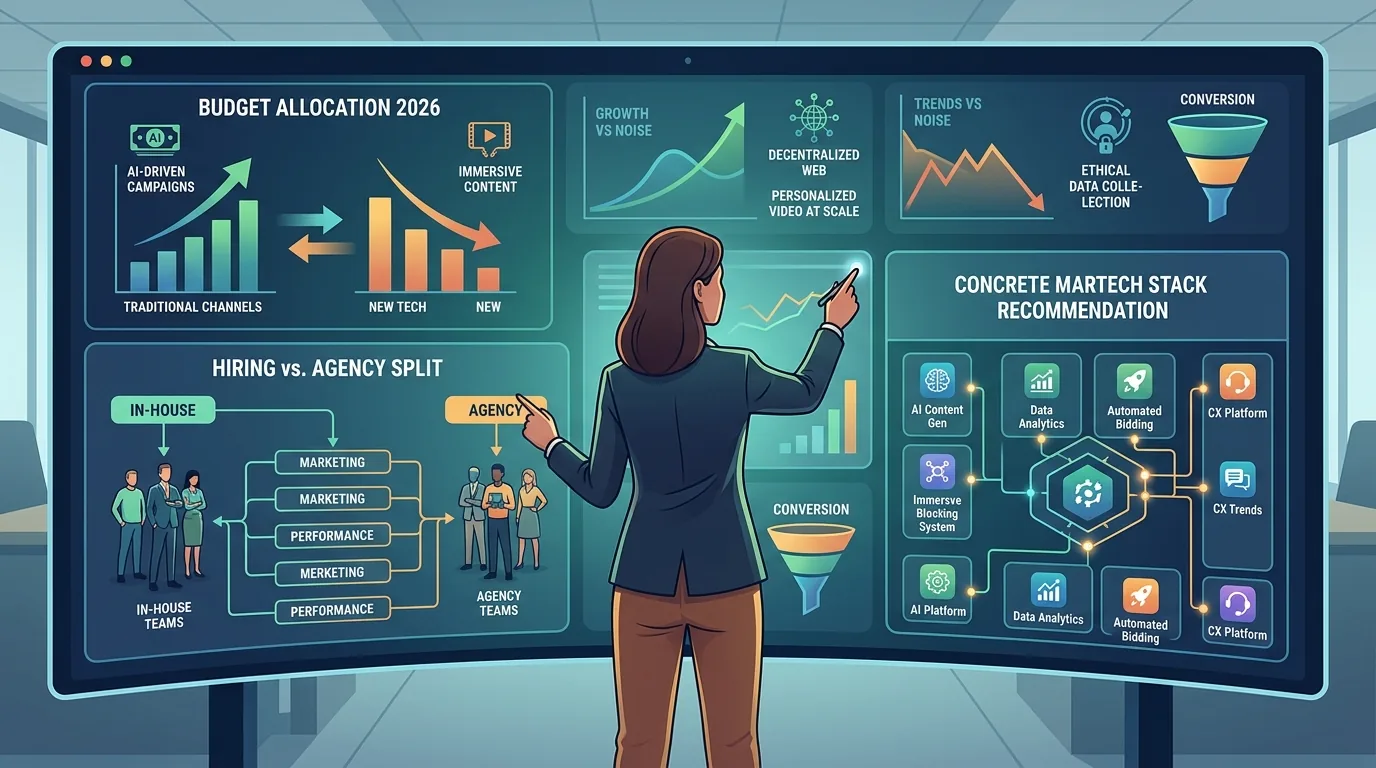
Digital Marketing Trends 2026: A Buyer's Guide for Founders and CMOs — illustrative featured image
A CMO I know killed her retargeting budget in October. Not because it underperformed, but because the numbers had quietly flipped. Her team's first-touch ROAS on cold prospecting had climbed to 3.1 while retargeting sat at 1.4, weighed down by frequency caps that had been maxed for two years. Nobody noticed until a new analyst asked why 40 percent of spend was chasing people who had already said no. That story is the whole 2026 story. The trends that matter next year are not the shiny ones. They are the ones that change how you allocate budget, what you hire for, and which vendors survive procurement. If you are a founder or CMO deciding between an agency retainer and an in-house hire, here is the filter we use with clients. Call it a [buyer's guide to the noise](/dgtg/blog/2026-digital-marketing-trends-a-playbook-for-agencies-and-their-clients). ## The three trends that actually move your P&L in 2026 Plenty of [2026 digital marketing guides](/dgtg/blog/digital-marketing-trends-2026-what-brands-must-know) will sell you on AI avatars and zero-click search panic. Both matter. Neither should top your decision list. These three should. ### 1. Signal loss finally hits mid-market budgets, not just enterprise Privacy changes stopped being an enterprise problem around 2024. By 2026, the mid-market feels it in CAC. If your pixel-based attribution still claims credit for 70 percent of conversions, you are measuring a ghost. The fix is not another dashboard. It is server-side tracking plus a clean room or a warehouse-native setup where your CRM data and ad platform data meet without a browser in between. What this costs: expect 15 to 30 percent of your paid media budget to shift from "optimize the platform" to "feed the platform." That feels like waste until you see blended CAC stabilize. Ask any agency pitching you in 2026 how they handle server-side events and identity resolution. If the answer is "we use the native pixel plus some UTM magic," walk. ### 2. AI search changes discovery, but not the way vendors claim Zero-click behavior is real. Google's AI Overviews and [Perplexity](https://www.perplexity.ai/)-style answer engines now intercept a meaningful slice of informational queries. But here is the part agencies gloss over: for most B2B and considered-purchase categories, the money query still lands on a page you control. What changes is the top of the funnel. Informational content that used to earn a click now earns a citation, or nothing. The practical response is not "write for LLMs." It is to build content that earns citations and conversions from the same asset. Comparison pages, pricing transparency, integration docs, and original data studies pull their weight in both worlds. Listicles do not. ### 3. Creative volume becomes a media buying constraint Ad platforms in 2026 reward fresh creative more than they reward bid strategy. Meta and Google both lean harder on automated placements and broad targeting, which means your creative is the targeting. Teams that ship 20 to 40 new concepts a month outperform teams shipping four, even when the four are better produced. This is the single biggest argument for hiring an agency in 2026. Creative throughput is an operations problem, not a taste problem. ## What to hire an agency for vs. build in-house We get this question every quarter. The honest answer depends on where your bottleneck sits. Here is the split we recommend, based on what actually breaks when teams scale. | Function | Hire out in 2026 | Build in-house | |---|---|---| | Paid media buying | Yes, if you spend over $50k/month | Under $50k, a strong generalist wins | | Creative production | Yes, volume is brutal | Brand system and final polish | | Lifecycle and CRM | Usually yes for setup | Always for ongoing sends | | Analytics and data plumbing | Yes for the first 90 days | Yes, permanently, one owner | | SEO and content | Hybrid | Subject matter expertise stays inside | The pattern: hire out for throughput and specialized setup, keep ownership of customer data and brand voice. Agencies that refuse to hand over raw data or ad account admin access are a red flag in 2026. So are in-house teams that try to build a server-side tracking stack without a dedicated data owner. ## Our take: the 2026 stack we actually recommend We test tools constantly. Most are fine. A few earn a permanent slot. Here is what we would put in front of a founder or CMO building a [2026 digital marketing stack](/dgtg/blog/2026-digital-marketing-trends-an-actionable-guide-for-agencies-and-brands), with the caveat that tool choice matters less than data hygiene. - **Analytics:** GA4 if you must, but pair it with a warehouse-native tool like **PostHog** or **Mixpanel**. Server-side events via **Segment** or **RudderStack**. Do not skip this layer. - **Attribution:** A clean room or warehouse join. **BigQuery** plus your ad platform's data share is the cheapest credible path. Skip anything that promises perfect attribution. - **Creative ops:** **Figma** for system, **Canva** for volume, and a shared brief template your media buyer and designer both sign off on. Boring, works. - **Lifecycle:** **Klaviyo** for ecommerce, **Customer.io** or **Braze** for B2B. The tool matters less than who owns the send calendar. - **AI in workflow:** Use it for first drafts, variant generation, and QA. Do not let it publish unsupervised. Every client we have seen do that has a story they regret. If you take one thing from this 2026 digital marketing guide, take this: the winning stack in 2026 is boring on purpose. The excitement lives in creative and offer, not in tool logos. ## The agency question, settled Founders ask us whether 2026 is a good year to bring in an agency. The answer depends on one metric: your cost to acquire a customer relative to lifetime value. If LTV to CAC is above 3 and stable, you have room to experiment. Hire an agency to compress time to learning, not to outsource thinking. If LTV to CAC is below 2, do not hire anyone yet. Fix the offer and the landing page first. No agency can outrun a broken funnel, and the good ones will tell you that in the pitch. The bad ones will take the retainer and blame the algorithm. For CMOs at larger orgs, the calculus flips. You likely have in-house capability and a throughput problem. Agencies in 2026 should function as capacity, not strategy. If your agency is setting strategy and your team is executing, you have the model backwards. ## FAQ ### Are 2026 digital marketing trends really different from 2025? The mechanics are similar. The pressure is different. Signal loss, creative volume, and AI search all crossed a threshold in 2025 that makes 2026 the year mid-market teams feel them in CAC and ROAS, not just enterprise teams. ### Should I hire an agency or build in-house for 2026? Hire out for throughput and specialized setup (paid media at scale, creative volume, server-side tracking). Keep customer data, brand voice, and lifecycle sends in-house. The split matters more than the headcount. ### Which 2026 marketing trend should I ignore? Most AI-generated content plays. The platforms are flooded, the returns are thin, and the risk to brand trust is real. Spend that budget on creative volume and data plumbing instead.

Frequently asked questions

1. Signal loss finally hits mid-market budgets, not just enterprise Privacy changes stopped being an enterprise problem around 2024. By 2026, the mid-market feels it in CAC. If your pixel-based attri

The mechanics are similar. The pressure is different. Signal loss, creative volume, and AI search all crossed a threshold in 2025 that makes 2026 the year mid-market teams feel them in CAC and ROAS, not just enterprise teams.

Should I hire an agency or build in-house for 2026?

Hire out for throughput and specialized setup (paid media at scale, creative volume, server-side tracking). Keep customer data, brand voice, and lifecycle sends in-house. The split matters more than the headcount.

Which 2026 marketing trend should I ignore?

Most AI-generated content plays. The platforms are flooded, the returns are thin, and the risk to brand trust is real. Spend that budget on creative volume and data plumbing instead.