DGTG logo DGTG

Digital Marketing Trends 2026: AI Search Agency Strategy

Explore 2026 digital marketing trends for agencies. Learn how AI search, agentic optimization, and new content ops reshape strategy and retainer models.
2026 Digital Marketing Trends: How AI and Search Shape Agency Strategies — illustrative featured image
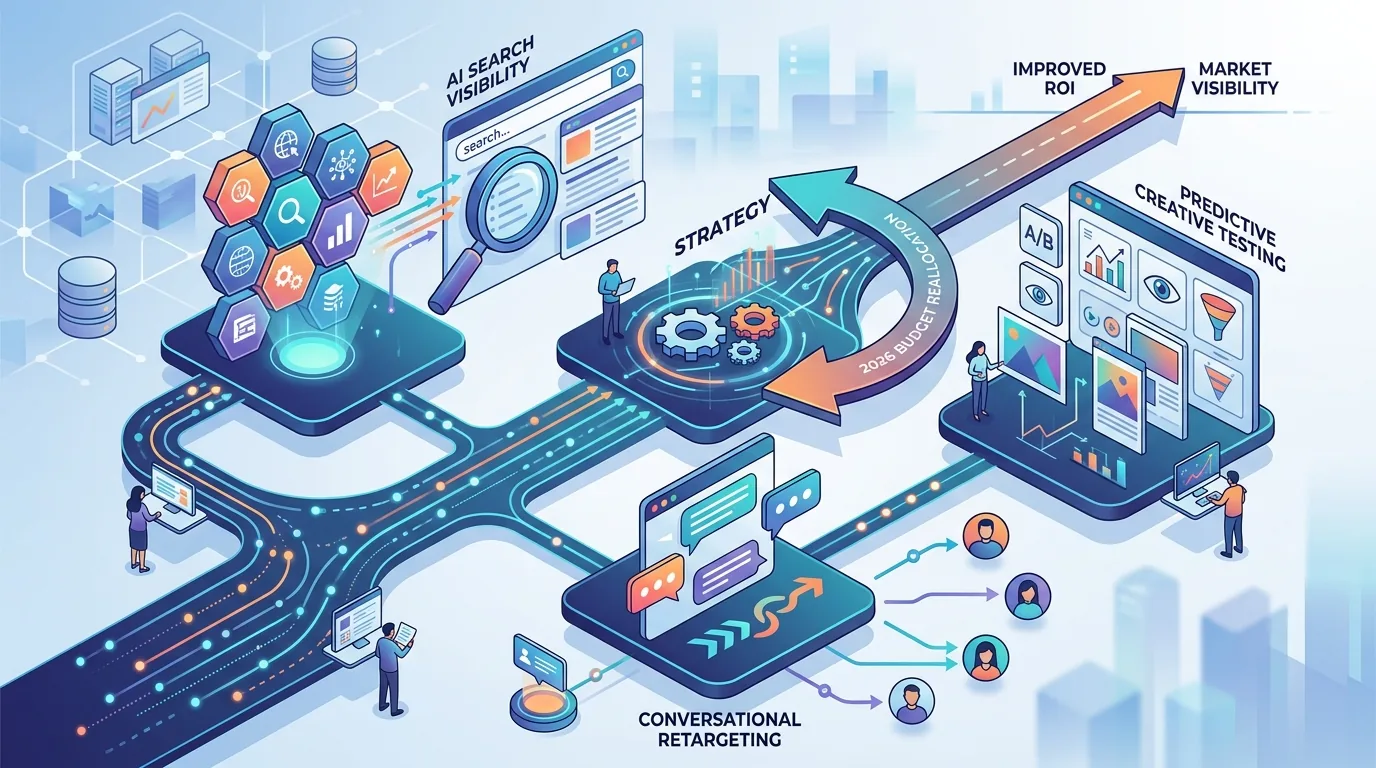
The last time a major brand paid for a search ad that simply said “Buy our product,” the year was probably 2019. That model is now a rounding error in most media plans. We spent the back half of 2025 watching Google’s AI Overviews eat into traditional click-through rates, while [ChatGPT](https://chat.openai.com/) and [Perplexity](https://www.perplexity.ai/) became the default research layer for B2B buyers under 40. If your agency is still pitching last year’s SEO audit and a boosted LinkedIn post, the 2026 budget cycle is going to be uncomfortable. This is not another “AI will change everything” think piece. This is a practical read on where the money is moving, what search actually looks like now, and how to structure your team or agency retainer around the new reality. ## The Death of the Page-One Race (and What Replaces It) For two decades, the SEO playbook was simple: rank for high-volume keywords, optimize meta tags, build links, watch the traffic spike. That playbook is broken. Google’s AI Overviews now appear in over 60% of search queries in some verticals, and they pull answers directly from the top results. The user gets their answer without clicking. CTR for the first organic result has dropped by nearly a third in many commercial categories since 2024. But here is the nuance most agencies miss. The click is not dead. The click is just happening later in the funnel. Users are no longer clicking on the first result to learn about a product category. They are using AI to shortlist, compare, and validate. By the time they click, they are ready to buy or at least ready to talk to sales. ### What this means for your 2026 strategy - **Own the answer, not just the link.** If your content is the source cited by an AI overview, you win the referral traffic when the user decides to dig deeper. - **Optimize for extraction, not engagement.** AI models pull from clear, structured, factual content. Fluffy intros and clickbait headings get ignored. - **Track zero-click conversions.** If your CRM can’t attribute a lead to a search impression without a click, you are flying blind. ## AI Marketing Trends That Are Actually Budgeted Every vendor on the planet is selling “AI-powered” something. Most of it is a wrapper around an old API. But three trends are showing real ROI in client accounts, and they are changing how agencies staff and bill. ### 1. Agentic Search Optimization (ASO) Forget keywords. Large language models don’t match strings, they match entities and intent. ASO is the practice of structuring your site data (schema, product feeds, FAQ blocks) so that AI agents can parse and synthesize your offer reliably. We have seen clients who added comprehensive schema markup and structured comparison tables see a 40% increase in AI-referral traffic within two quarters. ### 2. Predictive Creative Testing Instead of A/B testing two ad variants for two weeks, agencies are now using generative AI to produce 50 variants of a single hook, then letting the ad platform’s machine learning find the winners in 48 hours. The cost per acquisition on these campaigns consistently drops 15-25% compared to human-only creative testing. The catch? Someone still has to write the strategy behind the variants. AI generates the permutations, but a human defines the emotional trigger. ### 3. Conversational Retargeting Email and display retargeting are getting hammered by privacy changes and ad blockers. The new channel is conversational AI on your own site. Chatbots that understand product catalogs and can answer specific questions (pricing tiers, implementation timelines, integration limits) are converting 8-12% of their sessions into qualified leads. That is a number that gets a CMO’s attention. ## Search Is Now a Hybrid Beast We need to stop talking about “search” as if it is one channel. In 2026, there are three distinct search surfaces, and they require different strategies. As [2026 digital marketing trends](/dgtg/blog/2026-digital-marketing-trends-what-agencies-must-know-now) continue to evolve, agencies must adapt their approach across each surface. | Search Surface | User Intent | Agency Play | | --- | --- | --- | | Traditional Search (Google/Bing) | Quick answers, local intent, navigational | Structured data, review management, brand SERP control | | AI Chat (ChatGPT, Perplexity, Gemini) | Research, comparison, validation | Entity building, citation sourcing, technical content depth | | Social Search (TikTok, YouTube, Reddit) | Peer validation, visual demos, honest opinions | Creator partnerships, UGC seeding, forum monitoring | Most agencies are still excellent at the first column and terrible at the other two. The [2026 digital marketing trends](/dgtg/blog/2026-digital-marketing-trends-a-strategic-guide-for-agencies-and-their-clients-2) favor agencies that can build a unified content engine that feeds all three surfaces simultaneously. A single technical whitepaper can become a source for an AI citation, a series of short video clips for social search, and a downloadable asset for traditional lead capture. ## What We Recommend: Rethinking the Agency Retainer Here is our take, and it is going to annoy some traditionalists. The days of the monthly “SEO hours” retainer are numbered. You cannot bill for hours spent chasing rankings that no longer guarantee clicks. Instead, we recommend a performance architecture that aligns with the new buyer journey. **For in-house teams:** Hire a Director of Search Innovation, not just an SEO manager. This person needs to understand prompt engineering, data schema, and content operations. They should report to the CMO, not the IT department. **For agencies:** Pitch a three-pillar model. Pillar one is technical foundation (site speed, schema, indexation). Pillar two is AI visibility (getting cited by models, monitoring AI brand mentions). Pillar three is conversion optimization (turning that AI-referred traffic into pipeline). This structure justifies a higher retainer because it ties directly to revenue, not just rankings. **Specific tools we are betting on:** For ASO, we like the structured data capabilities in RankMath and the AI citation tracking from Semrush. For predictive creative, AdCreative.ai is still the frontrunner for volume, but the new entrant Movio is better for video hooks. For conversational retargeting, Intercom’s Fin is the safest enterprise bet, but you can get 80% of the value with a custom GPT trained on your help docs and a simple chat widget. ## The Content Production Bottleneck Here is the problem no one is solving yet. AI search engines and social search platforms are content-hungry. They want fresh, authoritative, structured information constantly. But producing high-quality technical content is expensive. The brands that win in 2026 are not the ones with the biggest content teams. They are the ones with the best content operations. We have seen a 200-person SaaS company outrank a 5,000-person competitor because they built a feedback loop. They publish a technical comparison guide. They monitor which AI models cite it. They see what follow-up questions users ask the AI. They publish a new piece answering those questions. Rinse and repeat. That loop generates compounding visibility that a one-off viral post cannot match. The operational takeaway is this: your content calendar should be driven by AI query gaps, not by internal brainstorming. If your agency or in-house team is still doing quarterly content planning based on “what we think customers want to know,” you are already behind. ## Budget Shifts We Are Tracking The 2026 planning sessions we are seeing reflect a clear redistribution of spend. Paid social is flat. Traditional display is down. The incremental dollars are going to three places: AI-compatible content production, conversational marketing tools, and creator partnerships for social search. The smartest CMOs we talk to are moving 20-30% of their traditional SEO retainer into what they call “model visibility.” That is the budget for getting cited by AI systems, appearing in ChatGPT’s recommended sources, and showing up in Perplexity’s answer boxes. It is harder to measure than a rank tracker, but it is where the buyer attention is going. As new AI models emerge, understanding their capabilities becomes essential for planning which ones to target for citations, for instance, [comparing the latest AI models](/tech/blog/gpt-6-astra-vs-gemini-3-8-comparing-the-latest-ai-models) helps you decide where to focus your structured content efforts. ## FAQ ### How do I measure ROI on AI search visibility if I can’t see the clicks? Track branded search impressions as a proxy. When users see your brand name in an AI answer, they often search for you directly afterward. A rise in branded searches with no corresponding ad spend is the clearest signal of AI visibility. Also, implement UTM-tagged links inside your authored content that AI systems scrape. Some attribution is possible. ### Should we still invest in traditional SEO in 2026? Yes, but with a narrower focus. Traditional SEO is now about owning your brand SERP, ranking for high-intent commercial terms where users still click, and maintaining the technical health that AI crawlers rely on. The days of chasing 5,000 low-volume informational keywords are over. That budget is better spent on structured data and content depth. ### What is the biggest mistake agencies will make in 2026? Treating AI as a content generator instead of a distribution channel. Using AI to write 200 blog posts will flood the internet with generic noise that no model will cite and no human will read. The winning play is to use AI to research and outline, then invest in expert human review and data validation to make the content authoritative enough to be referenced by other machines.

Frequently asked questions

What this means for your 2026 strategy - **Own the answer, not just the link.** If your content is the source cited by an AI overview, you win the referral traffic when the user decides to dig deeper

Track branded search impressions as a proxy. When users see your brand name in an AI answer, they often search for you directly afterward. A rise in branded searches with no corresponding ad spend is the clearest signal of AI visibility. Also, implement UTM-tagged links inside your authored content that AI systems scrape. Some attribution is possible.

Should we still invest in traditional SEO in 2026?

Yes, but with a narrower focus. Traditional SEO is now about owning your brand SERP, ranking for high-intent commercial terms where users still click, and maintaining the technical health that AI crawlers rely on. The days of chasing 5,000 low-volume informational keywords are over. That budget is better spent on structured data and content depth.

What is the biggest mistake agencies will make in 2026?

Treating AI as a content generator instead of a distribution channel. Using AI to write 200 blog posts will flood the internet with generic noise that no model will cite and no human will read. The winning play is to use AI to research and outline, then invest in expert human review and data validation to make the content authoritative enough to be referenced by other machines.