
DGTG logo DGTG

Will AI Replace Programmers? Data Says No, Here's Why

AI in software development is rising, but job data shows a shift, not a collapse. Learn what skills matter and how to hire for the AI era.
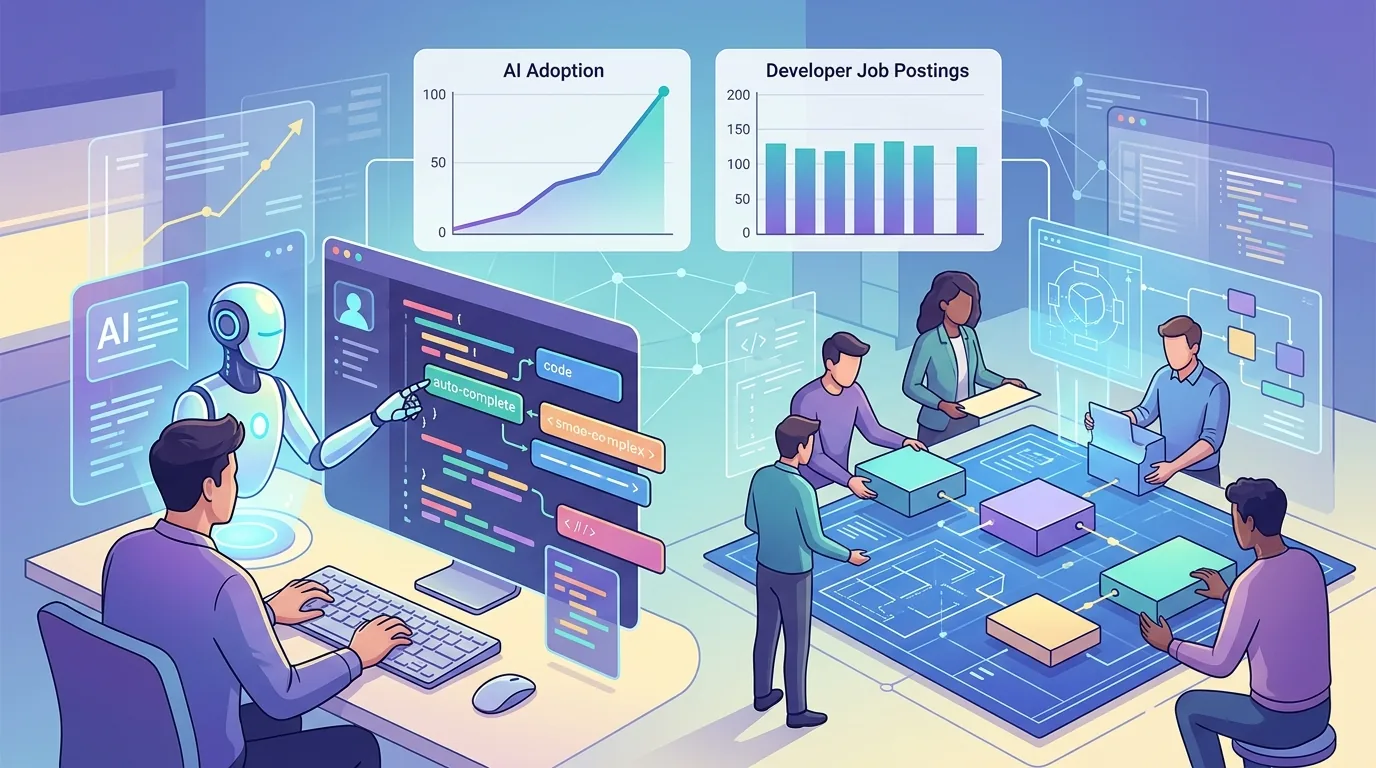
Will AI Replace Coders? The Data Says Something Surprising — illustrative featured image
The Economist recently asked a question that has been quietly haunting engineering leadership meetings: “Will anybody use AI as much as coders?” It’s a fair query, but it sidesteps the real anxiety. The fear isn’t that developers will adopt AI. They already have. The fear is that the adoption curve is so steep that the demand for human programmers will collapse before the next funding round closes. Let’s look at the data, because the data tells a story that is both less dramatic and more interesting than the doomsday headlines. A 2024 survey from Stack Overflow found that 76% of developers are already using or planning to use AI tools in their workflow. GitHub’s own telemetry shows Copilot is responsible for over 46% of code written in projects where it’s enabled. Those are big numbers. But here is the surprise: the same period saw job postings for software developers on major boards like Indeed and LinkedIn remain flat, not negative. In some verticals, like fintech and healthcare SaaS, postings are actually up. The market is not behaving like a collapse. It’s behaving like a shift. ## The Productivity Paradox Hits Engineering Here’s the counterintuitive reality that agency owners and CTOs are grappling with: AI doesn’t reduce the need for engineers, it raises the ceiling on what a single engineer can ship. That sounds like a win for the bottom line, and it is, until you realize that the bottleneck moves. When coding becomes faster, the constraint shifts to architecture, system design, and product logic. You don’t need fewer people writing code. You need more people deciding what the code should do and how it should talk to the rest of the stack. We saw this exact pattern with the rise of cloud computing. When AWS made server provisioning instant, the number of DevOps engineers did not drop. It multiplied, because suddenly every team could afford to run its own infrastructure. The same thing is happening with AI-assisted development. It commoditizes the typing, not the thinking. ### What the Metrics Actually Show If you are a CMO or founder evaluating an agency, you care about delivery speed and cost. Here is a practical breakdown of where AI is genuinely changing the economics of software delivery: | Task Type | Time Reduction with AI | Quality Impact | | --- | --- | --- | | Boilerplate CRUD APIs | 40-60% faster | Neutral to slightly better | | Unit test generation | 30-50% faster | Better coverage, worse edge cases | | Refactoring legacy code | 20-30% faster | High risk, needs human review | | Debugging complex concurrency | 5-10% faster | Human still required | Notice the pattern. The closer the task is to pure pattern recognition, the more AI helps. The closer it gets to reasoning about state, user intent, or business logic, the more the human matters. ## The Skills That Just Got More Expensive The Economist piece hinted at something we see every day in our own hiring and in the agencies we vet. The value of junior developers is dropping. The value of senior developers is spiking. And a new hybrid role is emerging that didn’t exist three years ago. That role is the prompt-to-production engineer. Not a prompt engineer, which is mostly a marketing term. We mean someone who can take a vague product requirement, decompose it into a series of precise AI prompts, validate the generated code against the actual business rules, and then wire it into the CI/CD pipeline. That person is worth more than two senior engineers were in 2021. The data backs this up. A study from MIT’s Computer Science and AI Lab (CSAIL) found that access to AI tools increased the productivity of less experienced developers by 35%, but it had a negligible effect on highly experienced developers. That sounds great, but it creates a talent trap. You can now hire a mid-level developer who produces senior-level volume. The problem is that the mid-level developer still thinks like a mid-level developer. They will ship code faster, but they will also ship architectural debt faster. ### What to Hire an Agency For vs. Do In-House This is the exact question we get from clients every week. Here is our pragmatic split, based on real project outcomes: - **In-house:** Core product logic, proprietary algorithms, anything touching customer data pipelines. You want control and institutional memory here. - **Agency:** Feature sprints, integrations, migrations, and any project with a hard deadline. Agencies that have invested in AI tooling can deliver 30-40% faster than a traditional shop, and you don’t carry the headcount risk. The trap is hiring an agency that just uses AI to inflate margins without passing the speed benefit to you. Ask for their prompt library. Ask how they handle AI-generated code review. If they don’t have a formal review gate, walk away. If you’re uncertain about the broader evaluation process, [this guide on how to choose a digital marketing agency](/dgtg/blog/how-to-choose-a-digital-marketing-agency-tips-for-founders-cmos) offers a useful framework for vetting any tech partner. ## The Real Job Killer Is Not AI, It’s Scope Here is the uncomfortable truth that nobody in the doom loop wants to admit. AI is not eliminating programming jobs. It is eliminating the *excuse* for programming jobs that shouldn’t have existed in the first place. For years, companies built custom internal tools that were really just CRUD apps with a login page. They hired three developers to maintain a dashboard that a single developer could have built with a low-code platform. AI is the final nail in that coffin. If your product is a form that writes to a database and displays a chart, yes, AI will replace the coder. It will also replace the agency that bills for that coder. But if your product involves real-time bidding, fraud detection, or complex supply chain optimization, you are not going to see a reduction in engineering headcount. You are going to see a reduction in the time to market, which means you will build more features, which means you will need more engineers to maintain them. For a deeper look at how [AI in finance](https://www.tech-n-ai-talks.com/tech/blog/ai-in-finance-how-to-protect-your-portfolio-from-the-next-black-swan-2) handles complex systems like fraud detection, the parallel is instructive. The Jevons paradox applies to code. When a resource becomes cheaper, we use more of it, not less. Cheaper steel led to more bridges, not fewer. Cheaper compute led to more servers, not fewer. Cheaper code generation will lead to more software, not less. ## What We Recommend If you are building a growth team or evaluating a tech partner, here is our opinionated take on how to play this market. **1. Invest in a senior reviewer, not a prompt writer.** Hire someone who can read AI-generated code and spot the subtle race condition or the missing error handling. This is the highest ROI hire you can make right now. A good reviewer will save you from the 20% of AI code that is confidently wrong. **2. Use AI for test coverage, not for feature bets.** Let the machines generate the exhaustive unit tests and the integration stubs. Save your human budget for the 10% of features that actually differentiate you. Your competitors are doing the same, so the differentiation window is shrinking. As [AI search reshapes digital marketing](/dgtg/blog/ai-search-is-reshaping-digital-marketing-how-to-optimize-for-generative-engines), the same principle applies: leverage automation for the commodity work and focus human effort on strategic advantage. **3. If you hire an agency, ask for their AI governance policy.** We have seen agencies ship code that violates a client’s open-source license because the AI generated a snippet from a GPL repository. That is a legal liability you do not want. A reputable agency will have a filter and a review process. We do. Make sure yours does too. **4. Build your own internal prompt library.** This is the moat. The models are the same for everyone. The difference is the institutional knowledge you encode into your prompts. Start documenting your architectural decisions and your coding standards now. In two years, that library will be worth more than your codebase. If you’re curious about [free & open source AI tools](https://www.tech-n-ai-talks.com/tech/blog/free-open-source-ai-5-tools-that-replace-paid-subscriptions) to start this library, many are worth exploring. ## FAQ **Will AI replace programmers entirely?** No. It will replace programmers who only write code. It will not replace programmers who understand the business problem, the data flow, and the failure modes. The demand for engineers who can translate business requirements into robust systems is actually increasing, because the cost of building the wrong thing has dropped, which means more companies are willing to take the risk. **How should a non-technical founder evaluate an AI-assisted development team?** Ask them to show you a code review log. Specifically, look for how many AI-generated pull requests were rejected or sent back for major changes. A rejection rate between 10% and 20% is healthy. If it is zero, they are not reviewing. If it is over 50%, they are not prompting well. **What is the biggest risk of using AI in software development?** Silent complexity. AI-generated code is excellent at solving the problem you stated and terrible at solving the problem you meant. The risk is not syntax errors. It is the slow accumulation of code that works in isolation but fails under load, or handles the happy path but corrupts data on the edge case. That is why human review is not a luxury. It is the core feature. ## Related on this site - [Social Media Trends 2026: A Strategic Guide for B2B and SaaS Marketers](/dgtg/blog/social-media-trends-2026-a-strategic-guide-for-b2b-and-saas-marketers) - [AI Marketing Tools: 2026 Buyer's Guide for Agencies and Brands](/dgtg/blog/ai-marketing-tools-2026-buyer-s-guide-for-agencies-and-brands) - [Google Algorithm Updates 2026: How to Protect Your Rankings Without Panic](/dgtg/blog/google-algorithm-updates-2026-how-to-protect-your-rankings-without-panic)

Frequently asked questions

Will AI replace programmers entirely?

No. It will replace programmers who only write code. It will not replace programmers who understand the business problem, the data flow, and the failure modes. The demand for engineers who can translate business requirements into robust systems is actually increasing, because the cost of building the wrong thing has dropped, which means more companies are willing to take the risk.

How should a non-technical founder evaluate an AI-assisted development team?

Ask them to show you a code review log. Specifically, look for how many AI-generated pull requests were rejected or sent back for major changes. A rejection rate between 10% and 20% is healthy. If it is zero, they are not reviewing. If it is over 50%, they are not prompting well.

What is the biggest risk of using AI in software development?

Silent complexity. AI-generated code is excellent at solving the problem you stated and terrible at solving the problem you meant. The risk is not syntax errors. It is the slow accumulation of code that works in isolation but fails under load, or handles the happy path but corrupts data on the edge case. That is why human review is not a luxury. It is the core feature.