
DGTG logo DGTG

Social Media Trends 2026: 3 Rules for Marketers

Discover the top social media trends for 2026. Learn how to build engagement strategies that lower CAC and boost organic reach in the new platform landscape.
The New Social Media Rules: 3 Trends Marketers Need in 2026 — illustrative featured image
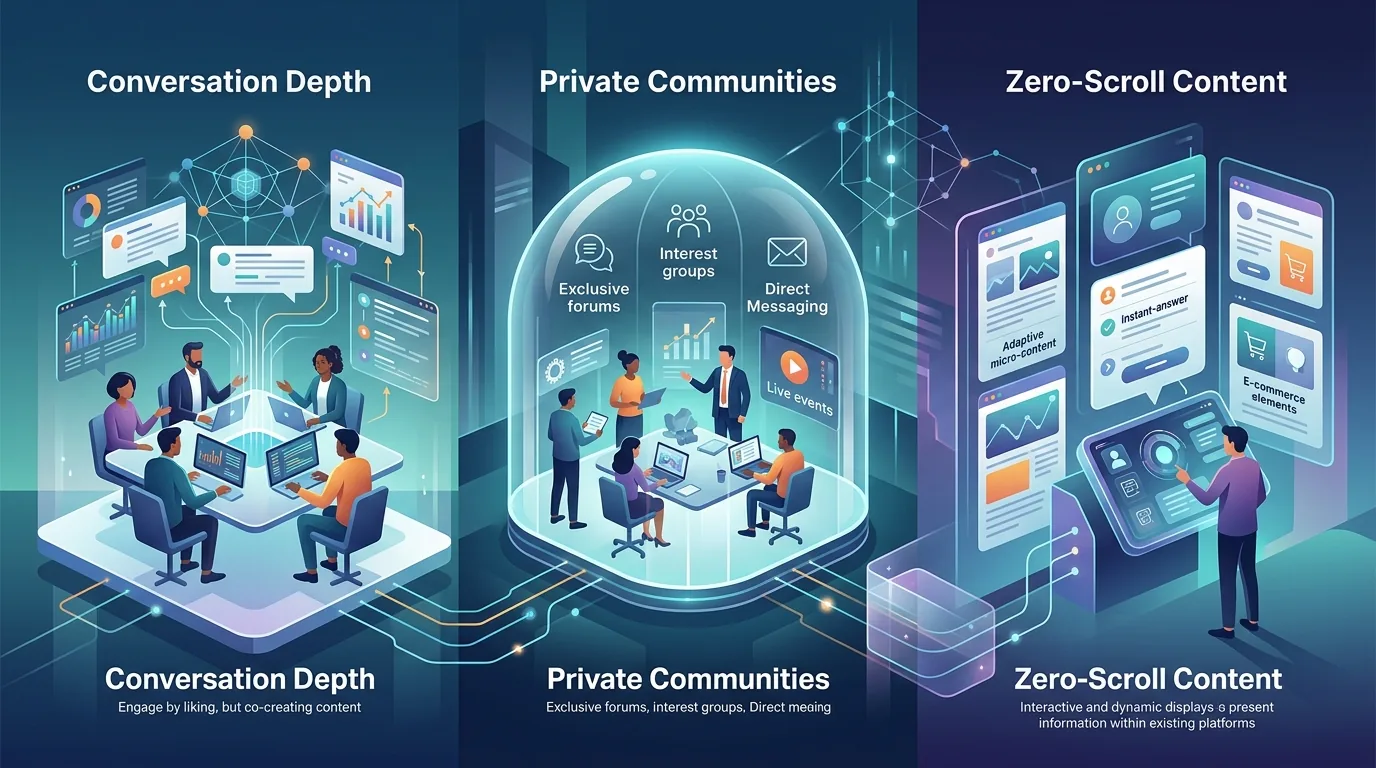
The last time we checked, the average organic reach on a Facebook business page was somewhere between the population of a small village and a rounding error. That was years ago. Now, in 2026, the game has shifted again, and not in the direction most CMOs hoped. The platforms are no longer just fighting for your ad budget; they are fighting for your organic strategy, and they have built walls around the data that used to make it all work. We have spent the last quarter auditing campaigns for a few mid-sized B2B firms and a DTC hardware brand. The patterns are stark. The old playbook of "post three times a day, reply to comments, boost the winners" is dead. What is working now feels less like broadcasting and more like a private utility service. Here are the three trends that are actually moving CAC and LTV in 2026, and how to build your [social media marketing strategy](/dgtg/blog/social-media-trends-2026-a-strategic-guide-for-b2b-marketers) around them. ## Trend 1: The "Closed-Loop" Comment Section For years, we told clients to drive traffic to a landing page. The metric was CTR, and the goal was to get the click. In 2026, the click is becoming secondary. The metric that matters now is the **conversation depth within the native post**. Platforms are aggressively penalizing outbound links in favor of native content that keeps users inside the app. But more importantly, the algorithms are now reading the *sentiment* of the comment section, not just the volume. A post with 50 comments that are all generic praise ("Great post!") gets less distribution than a post with 15 comments that feature a genuine back-and-forth between the brand and a skeptical user. This is a fundamental shift from engagement bait to engagement substance. The new rule is: if you cannot answer a specific technical question about your product in the comments, you are losing reach. **What this means for your workflow:** - Stop scheduling posts and walking away. You need a human on the clock for the first 90 minutes after posting. - Move the FAQ from your website into the comment thread. When a user asks "Does this integrate with Salesforce?" do not reply with a link. Reply with the answer, then ask a follow-up question. - Track "reply depth" (how many times a thread continues) as a KPI, not just total comments. The brands winning here are treating their comment sections like a live support ticket system. It is tedious, but the algorithmic payoff is real. One client, a logistics software provider, saw a 34% increase in organic reach simply by switching from link-heavy posts to "Ask us anything" threads that pinned the answers to the top. ## Trend 2: The Rise of the "Micro-Community" and the Death of the Hashtag Hashtags are not dead, but they are neutered. In 2026, hashtags are for discovery by strangers, which is the lowest-intent traffic you can get. The real engagement strategies are now happening inside private groups, Slack channels, and Discord servers that are *hosted* by the brand but *owned* by the users. The shift here is from the "funnel" to the "campfire." You are no longer trying to get a user to follow you; you are trying to get them to join a specific niche cohort. For B2B, this is the single most effective way to lower your CAC. Why? Because a user in a private community is a user who has already self-identified as a high-intent buyer. We saw a compliance startup build a private LinkedIn group for "HR Directors in Manufacturing." It has 800 members. They do not post product updates there. They post regulatory changes and ask for opinions. When they launched a new feature, they mentioned it once, in a comment, as a solution to a problem a member raised. That single comment generated 40 qualified demo requests. That is a better conversion rate than any paid ad they ran that quarter. ### How to execute this without a dedicated community manager - Start small. A WhatsApp group or a Slack channel with 50 customers is better than a dead forum with 5,000 followers. - Set a strict topic. If the group drifts into general sales chatter, it dies. - Give the group a tangible benefit: early access to product updates, a direct line to the CEO, or a quarterly data report that is exclusive to members. - Do not invite your sales team to pitch. Invite your product team to listen. Hiring an agency for this is often a mistake. Community building is an inside job. You need your internal subject matter experts to be present. An agency can set up the infrastructure and the content calendar, but the *presence* has to be authentic and internal. ## Trend 3: The "Zero-Scroll" Content Standard We have all seen the stats: attention spans are shrinking. But the data from our recent campaigns suggests something different. It is not that attention spans are shrinking; it is that **tolerance for low-effort content is at zero**. The swipe-away rate is now the primary ranking signal on most video platforms. If a user swipes away in the first three seconds, the algorithm assumes the content is bad, regardless of watch time. This has created a new standard: the "Zero-Scroll" post. This is content that is so specific, so visually dense, or so contrarian that the user physically stops their thumb. This is not about flashy production value. In fact, we are seeing raw, screen-recorded Loom videos outperform polished studio productions for B2B. The "Zero-Scroll" effect comes from **specificity of the hook**. - **Bad hook:** "Here are 5 tips for better email marketing." - **Good hook:** "We tested 14 subject lines for a plumbing supply client. The one that won used a typo. Here is why." The second hook works because it is a story with a specific data point. It promises a narrative, not a listicle. ### The 3-Second Rule | Element | Old Standard | 2026 Standard | | :--- | :--- | :--- | | **The Hook** | "In this video, we will show you..." | "We lost $10k on this ad. Here is the fix." | | **The Visual** | Branded intro, logo animation | A messy whiteboard, a specific dashboard, a face | | **The Payoff** | End of the video | The first 5 seconds (or they are gone) | This standard applies to static posts too. The old "quote graphic" with a generic business mantra is digital wallpaper. Nobody sees it. The new standard is the "data drop" post: a simple screenshot of a chart with a one-line caption that explains the anomaly. ## What We Recommend We have to be honest here: we are seeing a lot of agencies fail at this. They are still selling "content calendars" and "engagement packages" that are just automated replies. That is not social media marketing in 2026; that is a bot farm with a retainer. Here is our take on where to spend your budget and your time: 1. **Hire an agency for the "Zero-Scroll" audit.** You need an outside eye to look at your current feed and tell you which posts are causing scroll fatigue. We recommend looking for a partner like **Viral Nation** or a specialized growth consultancy that focuses on native video editing. They are expensive, but they will save you from wasting ad spend on content that users ignore. 2. **Keep the community management in-house.** As mentioned, this is a trust play. Do not outsource your voice to a junior account manager who doesn't know your product's edge cases. 3. **Invest in a "social listening" tool that measures sentiment, not just mentions.** Tools like **Brandwatch** or even the native analytics dashboards are getting better at this. If you are still using a tool that only counts "likes," you are flying blind. Our core recommendation is simple: stop treating social media as a distribution channel and start treating it as a product feature. The comment section is part of your UX. The community group is part of your retention strategy. The video is part of your sales pitch. If you integrate those three, you will see your organic CAC drop faster than your paid ROAS. These shifts align with the broader [new social media rules](/dgtg/blog/the-new-social-media-rules-3-trends-marketers-need-for-2026) we've been tracking, and they're also reshaping how we approach [measuring marketing success](/dgtg/blog/beyond-pageviews-how-to-measure-marketing-success-in-a-post-core-update-world). ## FAQ ### How often should we post in 2026? Frequency is less important than responsiveness. Posting three times a week with deep comment engagement beats posting three times a day with zero replies. The algorithm rewards the "dwell time" in your comment section, so focus on quality threads over volume. ### Is it worth investing in TikTok for B2B? Only if you are willing to show process, not polish. The "Zero-Scroll" standard is brutal on TikTok, but the platform still has the lowest organic reach barrier. If you can film a founder explaining a pricing mistake for 60 seconds, it is worth it. If you are going to hire a production crew to make a corporate video, skip it. ### Do we need to be on every platform? No. Pick one platform where your ICP actually complains about their problems. For most B2B, that is still LinkedIn. For DTC, it is usually Instagram or YouTube. Go deep on one, build the community, and ignore the rest. Trying to be everywhere in 2026 is the fastest way to be invisible everywhere. ## Sources - [The Hook (Wikipedia)](https://en.wikipedia.org/wiki/The_Hook)

Frequently asked questions

How to execute this without a dedicated community manager - Start small. A WhatsApp group or a Slack channel with 50 customers is better than a dead forum with 5,000 followers. - Set a strict topic.

Frequency is less important than responsiveness. Posting three times a week with deep comment engagement beats posting three times a day with zero replies. The algorithm rewards the "dwell time" in your comment section, so focus on quality threads over volume.

Is it worth investing in TikTok for B2B?

Only if you are willing to show process, not polish. The "Zero-Scroll" standard is brutal on TikTok, but the platform still has the lowest organic reach barrier. If you can film a founder explaining a pricing mistake for 60 seconds, it is worth it. If you are going to hire a production crew to make a corporate video, skip it.

Do we need to be on every platform?

No. Pick one platform where your ICP actually complains about their problems. For most B2B, that is still LinkedIn. For DTC, it is usually Instagram or YouTube. Go deep on one, build the community, and ignore the rest. Trying to be everywhere in 2026 is the fastest way to be invisible everywhere.