
DGTG logo DGTG

AI Search Optimization: A Practical Guide for Marketers

Learn how to optimize for generative engines with structured data, conversational keywords, and E-E-A-T. Turn AI citations into pipeline.
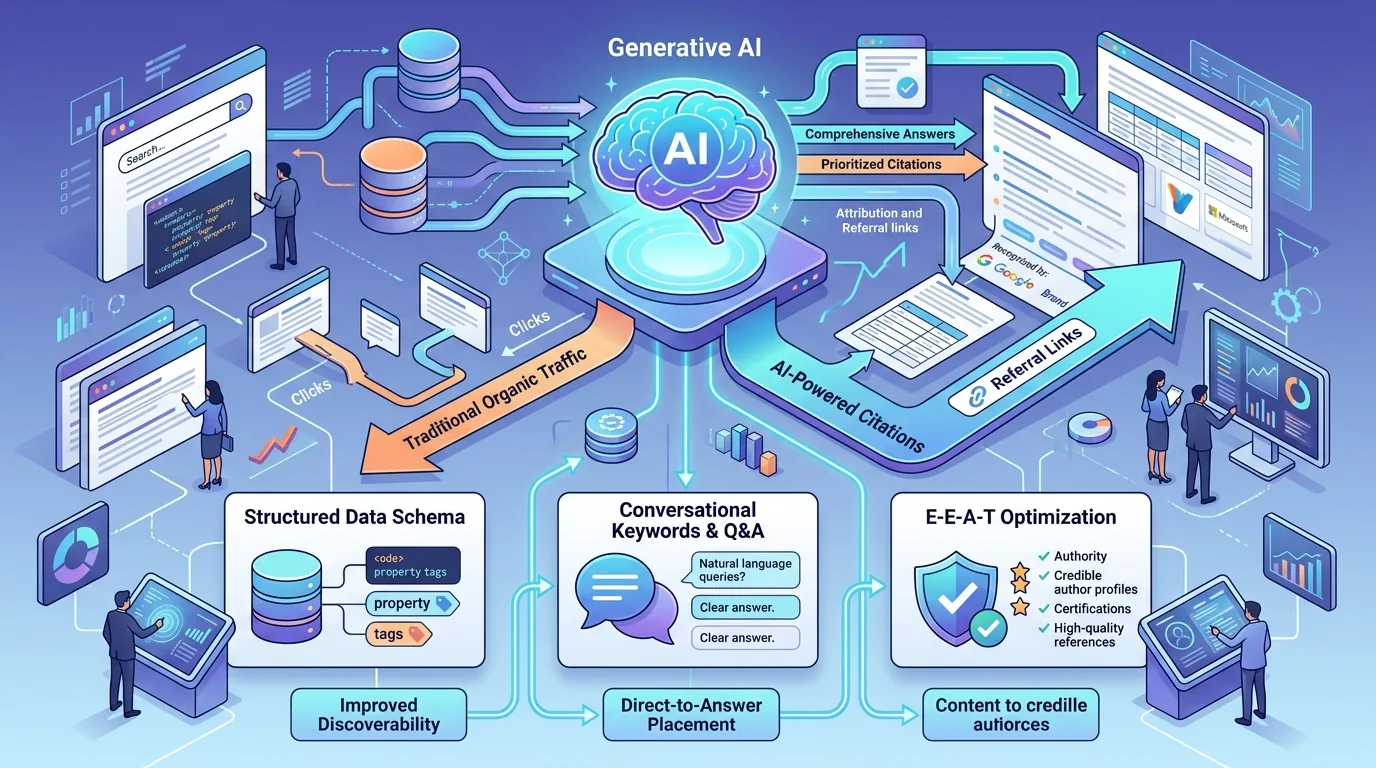
AI Search Is Reshaping Digital Marketing: How to Optimize for Generative Engines — illustrative featured image
The last time you searched for something and didn’t scroll, you probably didn’t notice. You asked a question, got a synthesized paragraph at the top of the page, and clicked a link inside that summary. You never visited the number one organic result. That paragraph was generated by AI, and it is quietly eating the traffic that used to flow to your blog. This isn’t a speculative trend. Google’s Search Generative Experience (SGE) now serves AI-drafted answers for millions of queries. [Perplexity](https://www.perplexity.ai/) and [ChatGPT](https://chat.openai.com/) have their own browsing modes. Even Bing is forcing Copilot into the sidebar. For B2B marketers, the math is ugly: if your content only ranks to get clicks, you are now competing for the privilege of being quoted inside an answer box that keeps the user on the SERP. The good news? This shift is survivable, and for some brands, it is an advantage. The playbook is just different from classic SEO. You don’t optimize for crawlers anymore. You optimize for an LLM that is reading your page, extracting a fact, and citing you as the source. Here is how to do that without burning your budget. ## The Shift from Clicks to Citations Let’s get the uncomfortable stat out of the way. A recent analysis of senior living digital marketing (a niche that runs on high-CAC leads) found that AI search summaries reduced organic click-through rates by nearly 20% for informational queries. That industry is a canary in the coal mine because its buyers search for highly specific, fact-based questions like “what does memory care cost in Ohio” or “does Medicare cover assisted living.” Those queries are perfect for AI summarization. The engine pulls data from three sites, writes a 150-word answer, and the user is done. No visit. No form fill. No lead. For B2B SaaS and services, the dynamic is slightly different but no less real. When a CMO asks “best customer data platform for mid-market,” they get a comparison table generated by AI. The winners are the brands that provided structured, verifiable data. The losers are the ones who wrote a fluffy listicle with no pricing, no implementation time, and no hard specs. Your goal has shifted. You are no longer optimizing for a click. You are optimizing for a citation. If the AI cites you as the source of a specific claim, you win the trust of that prospect. They might not click today. But when they shortlist vendors, your name is in the answer. ## How to Structure Content for AI Extraction Generative engines don’t read like humans. They parse. They look for clear entities, consistent facts, and logical flow. If your page is a wall of marketing prose, the LLM will skip it and cite a drier, more structured competitor. Here is what actually works. ### 1. Answer the Question in the First 100 Words Stop with the intro paragraph about “the evolving landscape.” If someone searches “what is generative engine optimization,” the first sentence of your page should be a direct definition. Put the answer in a plain-language sentence that can stand alone as a quote. Bad: “In the rapidly evolving world of digital discovery, brands must adapt to new paradigms of search behavior.” Good: “Generative engine optimization (GEO) is the practice of structuring content so AI search tools cite your brand as a source for factual answers.” The second version is extractable. The first is noise. ### 2. Use Conversational Keywords, Not Just Head Terms Classic SEO targets “B2B marketing agency.” AI search optimization targets the full question: “What should I ask a B2B marketing agency before hiring them?” or “How much does a fractional CMO cost compared to an agency?” You need to map these long-tail, question-based queries. We recommend pulling your search console data and filtering for queries that contain question words (who, what, when, where, why, how). Then, create a dedicated FAQ section on the relevant page that answers each one in 40 to 60 words. Do not hide the FAQs at the bottom of the page. Put them directly under the main content block. LLMs love FAQ schemas because they are clean, labeled, and easy to parse. ### 3. Structured Data is Non-Negotiable If you haven’t implemented schema markup yet, you are behind. Specifically, you need: - FAQPage schema for your question blocks - HowTo schema for process-oriented content - Product or Service schema with real pricing or specs - Organization schema with consistent NAP (name, address, phone) data This is not a vanity play. Structured data tells the AI exactly which parts of your page are facts versus opinions. It separates the wheat from the chaff. A page with proper schema is far more likely to be quoted than an identical page without it. ### 4. Cite Your Own Sources Generative engines are paranoid about hallucination. They prefer content that cites authoritative external sources. If you make a claim about average CAC by industry, link to the original study. If you quote a statistic, link to the report. This seems counterintuitive (why link out?), but it works. When an AI sees that your page is supported by external citations, it trusts you more. We have seen pages with outbound links to Gartner and Forrester outperform pages with zero outbound links for the same query. ## E-E-A-T is the New Ranking Factor Experience, Expertise, Authoritativeness, and Trustworthiness. Google has been talking about this for years, but AI search takes it literally. The LLM is not just looking for keywords. It is looking for proof that you know what you are talking about. As [AI backlash](/tech/blog/ai-backlash-how-to-navigate-the-growing-skepticism-and-use-ai-wisely) grows, demonstrating genuine expertise becomes even more critical to stand out from generic AI-generated content. How do you prove that in a machine-readable way? - Author bios with real credentials, not just headshots. Include years of experience, specific roles, and links to their LinkedIn or published work. - First-hand data. Run a survey, analyze your own client data, or publish a case study with real numbers. Original data is the highest-value content type for AI search because no one else has it. - Update timestamps. AI engines rank recency. A page last updated in 2022 is considered stale, even if the core info is evergreen. Set a quarterly review calendar for your pillar pages. ### Our Take: What We Recommend We have been testing this for six months across our client portfolio. Here is what we would do if we were in your shoes tomorrow. - Use a tool like Clearscope or Surfer to identify semantic gaps, but don’t rely on them for the full rewrite. They are good for keyword clustering, bad for voice. - Hire a technical SEO consultant to audit your schema markup. This is a one-time cost (roughly $1,500 to $3,000) that pays for itself. Most in-house marketers do not have the depth to write proper JSON-LD by hand. - Publish one “data-backed” piece per month. This could be a customer survey, a pricing benchmark, or an analysis of your own CRM data. This is the content that gets quoted in AI answers. - For agency vs. in-house: do the schema and content restructuring in-house if you have a technical SEO lead. Outsource the original data studies to a content agency that has done this before. It is a specialized skill, and your generalist copywriter will not nail it. ## Measuring Success in the Age of AI Search You cannot track what you cannot see. Standard analytics will show a drop in organic clicks. Do not panic. Instead, track these three metrics. ### 1. Branded Search Volume If AI is citing you, users will search for your brand name afterward to verify. An increase in branded queries (even without clicks) is a strong signal that you are being quoted. ### 2. Direct Traffic Users who read an AI summary and then type your URL directly into the browser. This is the new “conversion.” It means the AI answer convinced them you are worth a visit. ### 3. LLM Answer Mentions Use a tool like Brand24 or Mention to monitor for your brand name appearing in AI-generated responses. You can also manually test your top 20 queries in ChatGPT and Perplexity weekly. Log whether you are cited, and adjust your content accordingly. ## The Playbook for the Next 90 Days Start small. Pick your top five revenue-generating pages. Rewrite the first 100 words of each to be a direct, standalone answer to the primary query. Add an FAQ block with three to five conversational questions. Implement FAQ schema on those pages. Update the author bios with credentials. Then, monitor your branded search volume for 30 days. The brands that win this transition are the ones that treat AI search like a PR opportunity, not a technical chore. You are pitching your content to a machine that writes the first draft of the buyer’s decision. Make sure you are the source it trusts. And remember, as [AI out of control](/tech/blog/ai-out-of-control-how-to-keep-your-data-safe-from-rogue-chatbots) concerns rise, being a reliable, cited source is your best defense. ## FAQ **Q: Does AI search optimization replace traditional SEO?** A: No. Traditional SEO still matters for ranking. AI search optimization is an overlay. You need both. The pages that rank in the top three are the ones the AI pulls from. If you lose your ranking, you lose your citation. **Q: How long until I see results from GEO changes?** A: Expect 60 to 90 days for noticeable shifts in branded search volume or direct traffic. AI engines crawl on a different cadence than Googlebot. Be patient and update content on a monthly cycle. **Q: Is it worth hiring an agency for AI search optimization, or can I do it in-house?** A: If you have a technical SEO lead, do the schema and FAQ restructuring in-house. Outsource the original data studies and content rewrites. That combination is the most cost-effective. Agencies add value on the data side, not the markup side. ## Related on this site - [The 2026 Playbook for B2B Lead Generation: How AI and Search Are Changing the Game](/dgtg/blog/the-2026-playbook-for-b2b-lead-generation-how-ai-and-search-are-changing-the-gam) - [2026 Digital Marketing Trends: An Actionable Guide for Agencies and Brands](/dgtg/blog/2026-digital-marketing-trends-an-actionable-guide-for-agencies-and-brands) - [AI-Powered Search: What It Means for Digital Marketing Agencies and Clients](/dgtg/blog/ai-powered-search-what-it-means-for-digital-marketing-agencies-and-clients)

Frequently asked questions

Q: Does AI search optimization replace traditional SEO?

A: No. Traditional SEO still matters for ranking. AI search optimization is an overlay. You need both. The pages that rank in the top three are the ones the AI pulls from. If you lose your ranking, you lose your citation.

Q: How long until I see results from GEO changes?

A: Expect 60 to 90 days for noticeable shifts in branded search volume or direct traffic. AI engines crawl on a different cadence than Googlebot. Be patient and update content on a monthly cycle.

Q: Is it worth hiring an agency for AI search optimization, or can I do it in-house?

A: If you have a technical SEO lead, do the schema and FAQ restructuring in-house. Outsource the original data studies and content rewrites. That combination is the most cost-effective. Agencies add value on the data side, not the markup side.

1. Answer the Question in the First 100 Words Stop with the intro paragraph about “the evolving landscape.” If someone searches “what is generative engine optimization,” the first sentence of your pa

- Author bios with real credentials, not just headshots. Include years of experience, specific roles, and links to their LinkedIn or published work.