DGTG logo DGTG

2026 Digital Marketing Trends Guide for Agencies and Brands

Practical 2026 marketing trends for founders and CMOs. Learn how to cut ad waste, adapt to AI search, and build first-party data assets. Actionable playbook in…
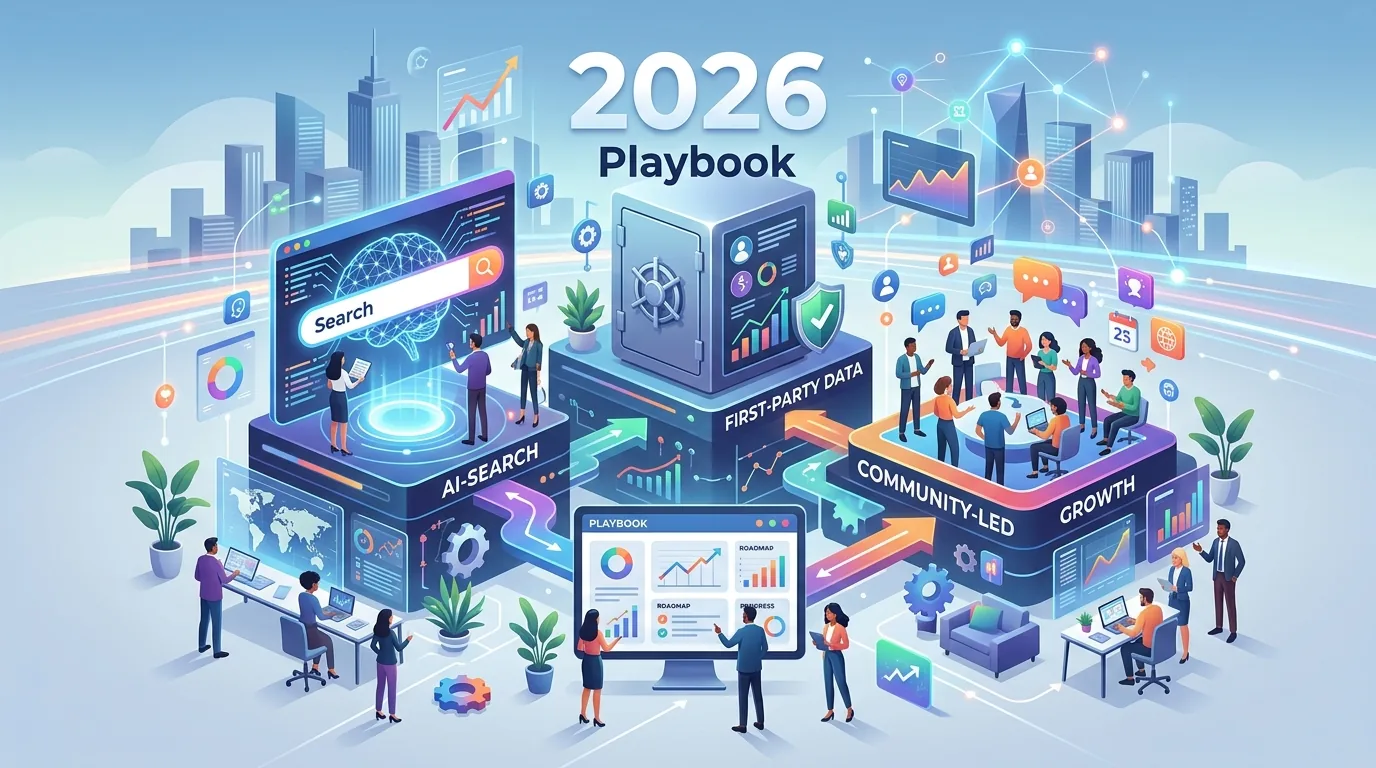
2026 Digital Marketing Trends: An Actionable Guide for Agencies and Brands — illustrative featured image
Every November, the trend reports start piling up. HubSpot publishes its state of marketing. Gartner drops its predictions. First & 42, Deloitte, and a dozen other consultancies all claim to have cracked the code for the coming year. By January, most of these PDFs are buried in a bookmark folder, never to be opened again. The problem is not a lack of information. It is a lack of prioritization. Founders and CMOs do not need another list of 47 shiny tactics. They need to know where to spend the next 12 months of budget and energy without burning out their teams. So we read the [2026 reports](/dgtg/blog/digital-marketing-trends-2026-what-brands-must-know) so you do not have to. Here is the pragmatic distillation, stripped of hype, focused on what actually moves CAC, ROAS, and LTV. ## The End of the "Always-On" Social Feed If you have not noticed the shift in your own scrolling habits, the data is clear. Organic reach on Instagram and Facebook has been in decline for years, but the 2026 projections suggest a fundamental change in platform economics. Meta and TikTok are pushing harder toward paid distribution for business accounts, while simultaneously rewarding "broadcast" content from creators and public figures. What does this mean for a B2B brand? The days of posting three times a day to "stay top of mind" are over. That strategy now just feeds the algorithm with low-quality noise that your audience never sees. Instead, the winning play is selective volume. Post less, but make every piece count. Invest in one or two hero formats per quarter (long-form video for YouTube, data-heavy carousels for LinkedIn) and put paid behind them from day one. **The 2026 social math:** - Organic post: 2% to 3% reach of followers (down from 5% to 6% in 2023) - Paid boosted hero content: 15% to 25% reach of target audience - Cost per engaged view on LinkedIn: up 12% year over year If you are not budgeting for distribution, you are not budgeting for content. ## Search Is No Longer a Rectangle The biggest structural shift in 2026 is the fragmentation of search intent. Google still owns the traditional query, but AI Overviews have pushed classic blue links down the page. Meanwhile, [ChatGPT](https://chat.openai.com/), [Perplexity](https://www.perplexity.ai/), and Gemini are eating the "how to" and "best of" queries entirely. For a marketing manager, this creates a fork in the road. You cannot optimize for a single SERP anymore. You have to [optimize for generative engines](/dgtg/blog/ai-search-is-reshaping-digital-marketing-how-to-optimize-for-generative-engines). ### What changes in practice - **Keyword research is now question research.** Stop chasing head terms with high volume. Chase the long-tail questions your buyers actually ask in private. Those are the queries feeding AI models. - **Entity clarity beats keyword stuffing.** AI engines pull from sources that clearly establish what a company does, who it serves, and what its unique methodology is. Your homepage needs to state this in plain language, not marketing jargon. - **The "zero click" is now the "zero visit."** Users get their answer inside the AI chat window. They never click through. This means your content needs to be useful enough to be cited, but your conversion path needs to exist outside of organic traffic. The brands winning in 2026 treat their website as a knowledge base, not a brochure. They publish structured data, clear author bios, and update content on a rolling basis rather than doing a quarterly "refresh." ## First-Party Data Becomes the Only Data We have been talking about the cookie apocalypse for five years. It finally arrived. With third-party tracking effectively neutered across major browsers, the quality of your retargeting pools has collapsed. Here is the uncomfortable truth: if you have been renting your audience from Meta and Google, you are starting from zero. The 2026 playbook demands a shift from "traffic acquisition" to "identity capture." This is not about gated content spam. It is about creating genuine value exchanges. ### The data capture stack that works 1. **Interactive tools** (ROI calculators, pricing configurators) generate 3x more email captures than static PDFs. 2. **Community spaces** (Slack groups, Discord servers) provide zero-cost engagement data and direct feedback loops. 3. **Transactional emails** are the new retargeting. A post-purchase sequence with relevant cross-sells outperforms a dead display campaign by a factor of five. For agencies reading this: your client reporting needs to change. Stop reporting impressions and CTR. Start reporting on the depth of the first-party data graph you have built for them. That is the asset that compounds. ## AI Is Now a Junior Team Member, Not a Toy Last year, the conversation was about "experimenting with generative AI." In 2026, that mindset is a competitive disadvantage. The brands that are scaling efficiently have integrated AI into their workflow as a permanent, supervised employee. This does not mean replacing your senior strategist with a prompt. It means re-architecting the workflow. **What we are seeing in high-performing teams:** - **Research phase:** AI compiles competitor analysis and market shifts in minutes. Human validates the strategic angle. - **Creation phase:** AI drafts the first version of ad copy, landing pages, and email sequences. Human edits for voice and inserts proprietary insights. - **Optimization phase:** AI runs A/B tests continuously, adjusting bids and creative variations without waiting for a weekly meeting. The cost savings are real. We have seen clients reduce content production costs by 40% while increasing output. The catch is that the human oversight becomes more critical, not less. AI generates average work by default. Your edge comes from the editorial judgment applied on top. ### What to hire an agency for vs. do in-house - **In-house:** Rapid response content, community management, and data collection. - **Agency:** Strategic AI workflow design, complex attribution modeling, and creative direction that stands out from the algorithmic sludge. ## Community-Led Growth Goes Mainstream The term "community-led growth" has been floating around SaaS circles since 2020. In 2026, it becomes a core pillar for B2B brands, not just a nice-to-have. Why now? Because paid acquisition costs have hit a ceiling for many categories. When your CAC for a demo request exceeds $800, you start looking for cheaper, more sustainable channels. A well-run community provides a compounding asset where members recruit other members. The key distinction for 2026: community is not a Facebook group where you post blog links. It is a product feature. - **For a martech company:** A public roadmap where users vote on features. - **For an agency:** A private mastermind group for clients that includes office hours with your strategists. - **For an ecommerce brand:** A loyalty tier that offers early access to drops and direct chat with the founder. The metric to watch is not member count. It is the percentage of new business that comes from community referrals. We have seen B2B companies push that number from 5% to 25% within two quarters by treating the community as a first-class channel with its own budget and KPIs. ## Our Take: The 2026 Priority Stack If we had to pick the three investments that matter most for the coming year, here is where we would put money: 1. **Rebuild your content engine around answer-engine optimization.** Hire a technical SEO who understands schema markup and entity-based SEO. This is the highest leverage, lowest cost move available. Tools like Semrush and Ahrefs have added AI visibility tracking, but the real work is in restructuring your site architecture. 2. **Kill 70% of your low-performing campaigns.** The data is clear that most ad spend is wasted on retargeting and broad prospecting. Take that budget and put it into two places: a high-intent search campaign for your top three buyer keywords, and a direct outreach program where your sales team sends personalized video messages to your top 200 ICP accounts. 3. **Invest in a "human layer" for your AI output.** Whether you use Jasper, Copy.ai, or ChatGPT Enterprise, the differentiator is the person editing the output. Hire a senior editor or content strategist whose sole job is to inject proprietary data points and industry nuance into AI drafts. This is the 2026 version of a competitive moat. ## FAQ ### Do small brands need to worry about AI search optimization? Yes, but not at the expense of basic SEO. Start by ensuring your Google Business Profile is complete and your website clearly states your service area and offerings. Then publish one definitive guide per month that answers a specific buyer question. Consistency beats volume. ### How much budget should we allocate to community building? If you are B2B with a contract value above $10,000, allocate 5% to 10% of your marketing budget. If you are selling lower ticket items, keep it lean and focus on a referral incentive program instead. ### Is paid social dead for B2B in 2026? Not dead, but it has changed. Broad awareness campaigns are wasteful. Paid social works for retargeting warm audiences and for promoting your hero content to lookalike audiences. Budget for it, but expect a higher CPM and plan for a longer testing window to find winning creative. ## Related on this site - [2026 Digital Marketing Trends: What Agencies Must Know to Win Clients](/dgtg/blog/2026-digital-marketing-trends-what-agencies-must-know-to-win-clients) - [B2B Lead Generation Playbook: Turning 2026 Digital Trends into Pipeline](/dgtg/blog/b2b-lead-generation-playbook-turning-2026-digital-trends-into-pipeline) - [The 2026 Playbook for B2B Lead Generation: How AI and Search Are Changing the Game](/dgtg/blog/the-2026-playbook-for-b2b-lead-generation-how-ai-and-search-are-changing-the-gam)

Frequently asked questions

What changes in practice - **Keyword research is now question research.** Stop chasing head terms with high volume. Chase the long-tail questions your buyers actually ask in private. Those are the qu

Yes, but not at the expense of basic SEO. Start by ensuring your Google Business Profile is complete and your website clearly states your service area and offerings. Then publish one definitive guide per month that answers a specific buyer question. Consistency beats volume.

How much budget should we allocate to community building?

If you are B2B with a contract value above $10,000, allocate 5% to 10% of your marketing budget. If you are selling lower ticket items, keep it lean and focus on a referral incentive program instead.

Is paid social dead for B2B in 2026?

Not dead, but it has changed. Broad awareness campaigns are wasteful. Paid social works for retargeting warm audiences and for promoting your hero content to lookalike audiences. Budget for it, but expect a higher CPM and plan for a longer testing window to find winning creative.