DGTG logo DGTG

Marketing Trends 2026: A Buyer's Guide for Founders

Nine marketing trends for 2026, sorted by what to hire an agency for and what to keep in-house. A practical guide for founders and CMOs planning budget.
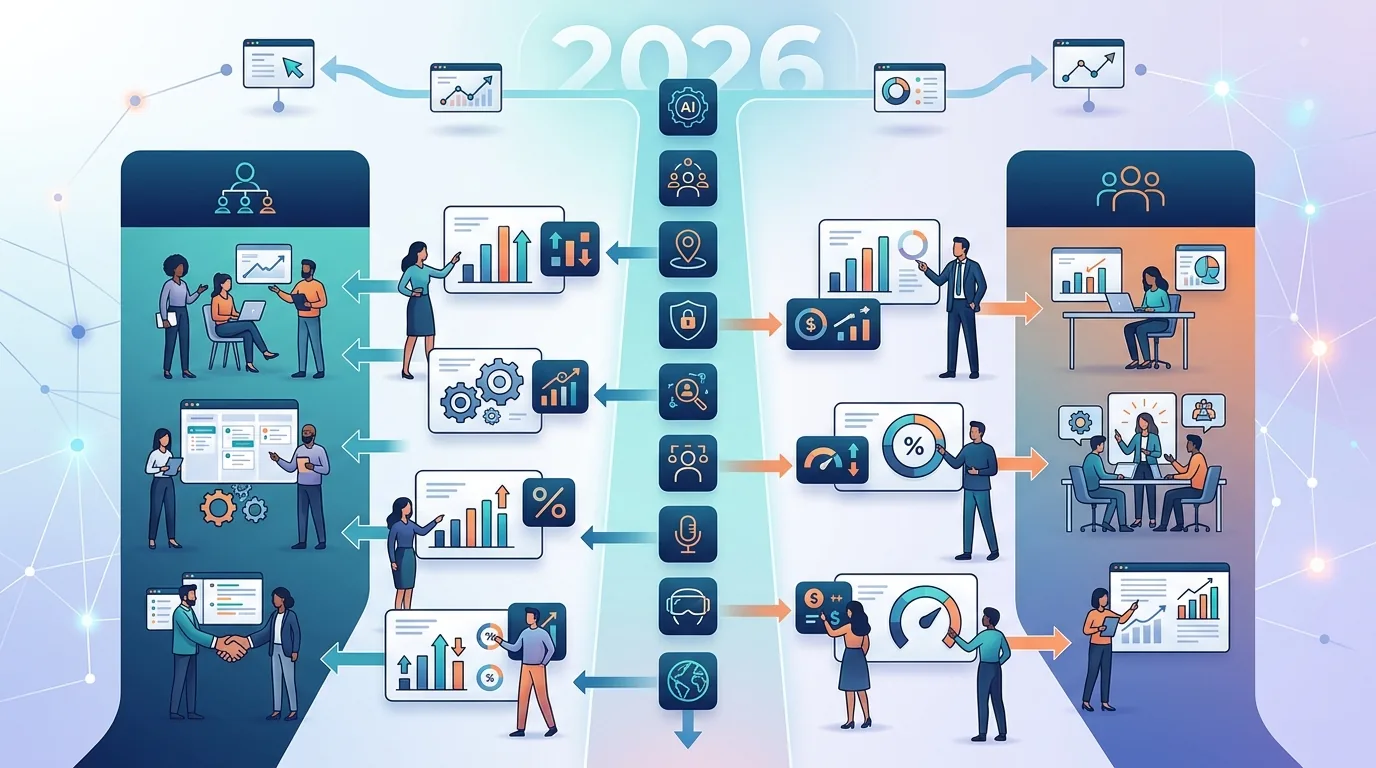
9 Marketing Trends for 2026: A Buyer's Guide for Founders and CMOs — illustrative featured image
> **Disclosure:** some links on this page are affiliate links. If you buy or book through them we may earn a commission, at no extra cost to you. It never changes what we recommend. A CMO I know spent $180,000 on a "2025 AI marketing stack" last January. Chatbots, predictive scoring, an intent-data subscription. Twelve months later, her team had killed two of the three tools and renewed exactly one. The scoring model worked. The chatbot answered questions nobody asked. The intent data sat in a dashboard that three people opened. Her verdict stuck with me: "Nobody sold me a bad trend. They sold me a trend that didn't fit my funnel." That's the problem with every "marketing trends 2026" list you'll read this quarter, including this one. A trend is not a strategy. It's a condition you have to operate inside. The useful question isn't "is this real?" It's "is this worth budget, and should I hire for it or build it?" So here's the guide we wish someone had handed that CMO. Nine trends, sorted by what they actually demand from your team, with a straight answer on agency versus in-house for each. ## The three buckets that matter Before the list, a sorting rule. Every trend below falls into one of three categories: - **Table stakes.** Ignore it and you lose ground quietly. Cheap to adopt, hard to justify as a "project." - **Compounding bets.** Expensive now, cheaper per unit of output later. These reward patience and punish quarterly thinking. - **Noise with a budget line.** Real technology, wrong stage for most companies under $50M in revenue. Most agencies sell everything as bucket two. Most in-house teams underfund bucket one because it's boring. Both mistakes cost money. ## 1. AI moves from pilot to plumbing The 2026 shift isn't new AI tools. It's AI disappearing into the workflow. Content briefs drafted from call transcripts. Ad variants generated against a fixed brand spec. Lead routing that reads the form fill and writes the first reply. The tell that you're ready: you have clean data and a repeatable process for the AI to sit inside. The tell that you're not: your CRM has three spellings of the same company name. **Agency or in-house?** In-house for the workflow design, because it touches your ops. Agency for the content and creative volume, where the tooling changes every quarter and you don't want to maintain it. ## 2. Search splits into two front doors Google still matters. So does the answer box inside [ChatGPT](https://chat.openai.com/), [Perplexity](https://www.perplexity.ai/), and whatever ships next. Buyers now arrive pre-educated, having already asked an assistant "what's the difference between X and Y" before they ever hit your site. This changes your content brief. You're no longer writing only for a ranking position. You're writing to be the source an assistant cites. That means clear claims, named entities, and structured answers near the top of the page. | Metric | Old benchmark | 2026 benchmark | |---|---|---| | Organic CTR on position 1 | 25 to 30% | 12 to 20%, depending on query intent | | Assisted conversions from AI referrals | Not tracked | Track separately in GA4 | | Time to first meaningful content | 400 words | Under 150 words | **Agency or in-house?** Agency, at least for the first two quarters. The tactics are moving fast enough that maintaining internal expertise is a poor use of a marketing manager's calendar. ## 3. First-party data stops being optional Third-party cookies are mostly gone in practice, and the workarounds are getting expensive. The companies winning on CAC right now are the ones with a real email list, a clean consent record, and a lead magnet that people actually want. If your cost per acquisition has drifted up 20% year over year and your creative hasn't changed, this is usually why. ## 4. Brand spend returns, quietly Performance marketing has a ceiling. When every competitor bids on the same keywords with the same offer, ROAS compresses and nobody wins. The escape hatch is brand: distinctive assets, consistent voice, a point of view. The catch is measurement. Brand doesn't show up in last-click. It shows up in branded search volume, direct traffic, and the conversion rate of people who saw you three times before they clicked. **Our take:** Budget 15 to 20% of paid spend toward brand and measure it with branded search lift, not ROAS. If your agency can't report on that, they're a media buyer, not a growth partner. ## 5. Short-form video becomes a B2B channel For years, video was consumer territory. That's over. Founders recording three-minute teardowns of their own category are generating qualified pipeline, because the format rewards specificity and punishes polish. You don't need a studio. You need a phone, a script, and the discipline to publish weekly for six months before judging results. ## 6. Creator partnerships get professionalized This is not influencer marketing. It's paying a domain expert, a niche newsletter writer, or a practitioner with an audience to make something with you. The economics work because trust transfers. The risk is that it doesn't scale the way paid does. **Agency or in-house?** Agency for sourcing and contracting. In-house for the brief, because only you know what claim you're willing to defend. ## 7. Marketing ops becomes a hiring category Attribution, consent management, data hygiene, tool consolidation. Unglamorous, and increasingly the difference between a marketing team that can prove its impact and one that gets cut in the next budget cycle. If you're hiring one person this year, this is the role. ## 8. Retail media keeps eating the display budget [Amazon](https://www.amazon.com/), Walmart Connect, and the retail networks now offer targeting that display advertising lost years ago. If you sell anything through a retailer, this is where your next dollar of paid goes. ## 9. Consolidation pressure on the agency side Holding companies are merging. Boutiques are specializing. For buyers, this means fewer generalists and more shops that do one thing well. The upside: better work. The downside: you now manage four relationships instead of one. ## What we recommend If you have one budget cycle and one shot, here's where we'd put it. - **Fund first-party data and marketing ops first.** Everything else gets cheaper once this is clean. - **Hire an agency for search and AI-visibility work.** The tactics shift too fast to own internally. - **Keep brand and creator briefs in-house.** You can't outsource your point of view. - **Skip retail media unless you sell through retail.** Obvious, and still worth saying. The trends that matter in 2026 are the ones that compound. Everything else is a line item you'll cancel in November. ## FAQ ### Which marketing trend 2026 should a small team adopt first? First-party data. It's unglamorous, it's cheap relative to everything else on this list, and every other trend performs better once your list and CRM are clean. ### Should I hire an agency or build in-house for AI marketing? Split it. Keep workflow and ops design in-house because it touches your systems. Hire out for content and creative volume, where tooling changes faster than you want to retrain staff. ### How do I measure brand spend if it doesn't show in ROAS? Track branded search volume, direct traffic, and the conversion rate of users with multiple prior touchpoints. Set a baseline before you spend, then compare quarter over quarter. ## Related on this site - [2026 Marketing Trends: A Buyer's Guide for Founders and CMOs](/dgtg/blog/2026-marketing-trends-a-buyer-s-guide-for-founders-and-cmos) - [9 Marketing Trends for 2026: What Founders Must Know](/dgtg/blog/9-marketing-trends-for-2026-what-founders-must-know) - [The Future of Marketing: 5 Gartner Predictions Every Agency Should Heed](/dgtg/blog/the-future-of-marketing-5-gartner-predictions-every-agency-should-heed)

Frequently asked questions

Which marketing trend 2026 should a small team adopt first?

First-party data. It's unglamorous, it's cheap relative to everything else on this list, and every other trend performs better once your list and CRM are clean.

Should I hire an agency or build in-house for AI marketing?

Split it. Keep workflow and ops design in-house because it touches your systems. Hire out for content and creative volume, where tooling changes faster than you want to retrain staff.

How do I measure brand spend if it doesn't show in ROAS?

Track branded search volume, direct traffic, and the conversion rate of users with multiple prior touchpoints. Set a baseline before you spend, then compare quarter over quarter.