DGTG logo DGTG

Social Media Rules 2026: 3 Trends to Define Your Strategy

Discover the new social media rules for 2026: follower funnel collapse, private communities, and performance creative. Adapt your strategy to stay ahead. Read…
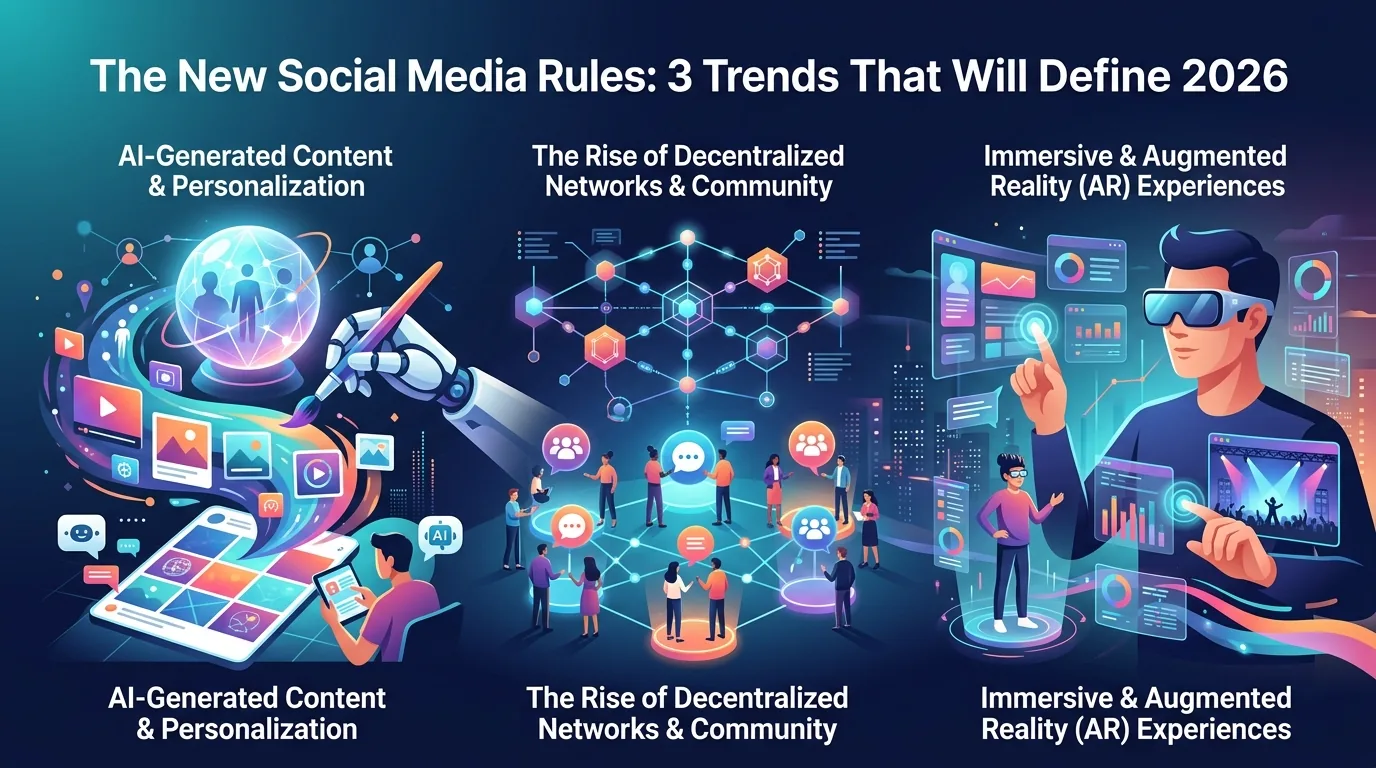
The New Social Media Rules: 3 Trends That Will Define 2026 — illustrative featured image
Every quarter, we sit through the same agency deck. The one that opens with a screenshot of a viral TikTok and declares, “This is where your customers are!” It is almost always followed by a recommendation to blow 40% of the social budget on an influencer with a million followers and an engagement rate of 0.8%. That advice is stale. The ground has shifted. As with [Google Algorithm Updates 2026](/dgtg/blog/google-algorithm-updates-2026-what-changed-and-how-to-protect-your-rankings), the changes that matter aren't surface-level tweaks but fundamental structural ones. If you are a founder or a CMO looking at your 2026 roadmap, you need to look past the interface changes and the algorithm updates. The real shifts are structural. They are about how platforms monetize, how content is produced, and how you prove return on investment to a finance team that has stopped accepting “brand awareness” as a deliverable. Here are the three trends that will actually define social media strategy in 2026, based on what we are seeing in performance data and platform roadmaps. ## 1. The Death of the Follower Funnel For a decade, the social playbook was simple: grow followers, push content, watch the traffic trickle to your site. That funnel has collapsed. The platforms have realized that the follower graph is a poor predictor of revenue. They make more money when they serve content to *non-followers* based on interest signals, because that increases session time and ad inventory. Consequently, organic reach for your existing audience is dropping faster than a bad stock. The data backs this up. We are seeing clients where organic traffic from social is down 30% year-over-year, yet total social-driven revenue is up. How? Because the content that wins is not the content your followers see. It is the content that the algorithm decides is relevant to a cold audience searching for a solution. ### The shift to Search and AI Surfaces The biggest change is that social platforms are now search engines. TikTok is a search engine for restaurants and travel. Instagram is a search engine for aesthetics and tutorials. LinkedIn is a search engine for B2B pain points. This changes the creative brief. You are no longer writing a post for a person who opted in. You are writing a landing page for a query. - **Keyword research is now social research.** You need to know what your buyer types into the search bar on YouTube and TikTok, not just Google. - **Content must answer a question immediately.** The first three seconds of a video need to state the problem and the promise. No cold opens, no "Hey guys." - **Volume beats polish.** In a search-driven feed, you need to hit every long-tail keyword variant. A single polished hero video will lose to thirty scrappy, specific videos that answer thirty specific questions. ### Our take Stop obsessing over follower count. It is a vanity metric that influences no one except your board. Instead, track **Search Impressions** within the platform analytics (where available) and **Direct/Organic Social Conversion Rate** in your analytics suite. If you are an agency reading this, this is your chance to reposition. Stop selling "community management." Start selling "social SEO." This aligns with the broader shifts outlined in our [2026 Digital Marketing Trends: A Strategic Guide for Agencies and Their Clients](/dgtg/blog/2026-digital-marketing-trends-a-strategic-guide-for-agencies-and-their-clients-2). The agency that can audit a client’s content library against search demand and produce a content calendar that targets transactional keywords will win the budget. This is a technical skill, not a creative one. If your in-house team is full of pure creatives who hate spreadsheets, this is a task to outsource. ## 2. The Rise of the "Private Circle" and Micro-Commerce The era of the public broadcast is over. The most engaged audiences are now in private spaces: Discord servers, Slack communities, WhatsApp channels, and Telegram groups. This is not about consumer hype. It is about customer acquisition costs (CAC). Public feeds are expensive to rent. Private channels are owned. When you post in a private community, you are not paying the algorithm tax, and you are talking to people who have already raised their hands. We are seeing a specific pattern with our B2B SaaS clients. They use public social (LinkedIn and X) to generate awareness, but they drive all high-intent conversations into a private Slack group or a WhatsApp broadcast list. In those private channels, they run beta tests, gather feedback, and offer exclusive pricing. ### The Commerce Angle This trend pairs with the rise of native commerce in messaging apps. The friction of "see a post, click a link, wait for a page to load, enter a credit card" is too high. In 2026, the winning play is conversational commerce. - **WhatsApp Business Catalogs** are becoming the primary storefront for small and medium businesses in emerging markets. - **Live Shopping** is migrating from public feeds to private, invite-only streams for VIP customers. - **Community tiers** are becoming a revenue line. Charging for access to a premium Discord or Slack channel is becoming a viable subscription model, separate from your core product. ### What we recommend If you are a B2B company, your social media strategy for 2026 should have two distinct pillars: **Broadcast** (for reach) and **Community** (for retention and upsell). Do not try to build a community on a public platform. The platform owns the data. Build it on a tool you control. Start small. Invite your top 50 customers to a private channel. Give them direct access to your product team. Offer them exclusive roadmaps. The metric here is not impressions. It is **Net Revenue Retention (NRR)** . If your community members have a higher LTV than your average customer, the strategy is working. If they do not, you are just running a fan club. ## 3. The Performance Creative Reckoning Here is the uncomfortable truth: the days of the "viral brand post" are numbered. Finance teams have realized that a post with a million views and zero attributable sales is just a very expensive pat on the back. This is the same reckoning happening across the web, as [pageviews lose their value as a meaningful metric](/dgtg/blog/why-pageviews-are-dying-rethinking-metrics-after-google-s-core-update). The shift is toward what the performance marketing world calls **Creative Testing**. In 2026, social media managers will be judged on the same metrics as paid media buyers: Return on Ad Spend (ROAS) and Cost per Acquisition (CPA). The line between organic and paid is blurring to the point of invisibility. We are seeing algorithms prioritize content that keeps users on the platform, but we are also seeing ad platforms prioritize content that converts. The winning format is the "Ugly Ad." It looks native, it is shot on an iPhone, and it speaks directly to a pain point that the founder just solved for a client. ### The Content Stack To survive this, you need a content engine, not a content calendar. Here is what the structure looks like: | Component | Description | Volume Target (per week) | | :--- | :--- | :--- | | **Hero Assets** | High-production brand films for launch moments | 1 | | **Hygiene Assets** | Scrappy, founder-led videos answering specific FAQs | 10-15 | | **Remix Assets** | User-generated content and testimonials, re-cut for ads | 5 | | **Utility Assets** | Carousels and PDFs that solve a specific workflow problem | 3 | The biggest mistake we see is companies spending all their budget on the Hero Asset and ignoring the Hygiene Assets. The Hero Asset builds the brand. The Hygiene Assets build the pipeline. In a downturn, you need pipeline. ### Our take on the Agency vs. In-House split This is where you need to make a hard decision. If you are a company under $10M ARR, do not hire a full-time social media manager to run this engine. You cannot afford the talent required to do this well. Instead, hire an agency to build the **testing framework** and the **content pillars**, and then have your founder record the videos. The founder-led content will outperform any slick agency production anyway because it has authority and specific knowledge. If you are a company over $50M ARR, you need an in-house team of editors and a performance marketer who can manage the ad spend. Use an agency for the strategic roadmap and for producing the high-end Hero Assets that require location shoots and talent. The era of the "Social Media Manager" who just schedules posts is over. You need a **Growth Editor**. Someone who understands hook points, retention graphs, and pixel data. If you are hiring for this role, test their editing skills, not their hashtag knowledge. ## The New Rules of Engagement To sum up the strategic shift: - **Rule 1:** Treat the feed like a search index, not a megaphone. - **Rule 2:** Move your best customers off the public feed and into a private channel. - **Rule 3:** Judge every post by its contribution to pipeline, not its like count. The social media marketing trends for 2026 are not about new features. They are about maturity. The platforms have become too expensive and too noisy for vanity plays. The winners will be the teams that treat social media strategy with the same rigor as their SEO strategy or their paid media strategy. That means specific keywords, specific offers, and a direct line to the sales team. If you cannot trace a social media interaction to a pipeline dollar within two touches, you are doing it wrong. ## FAQ **Do we still need to be on every platform?** No. You need to be on the platform where your buyer searches for solutions. For B2B, that is usually LinkedIn and YouTube. For D2C, it is TikTok and Instagram. Pick two, dominate them, and ignore the rest. Spreading yourself thin is a strategy for failure. **How often should we post in 2026?** Consistency matters more than frequency. But if you are doing social SEO correctly, you should be posting daily. The algorithm rewards recency for search results. If you cannot sustain daily posting, invest in a content repurposing tool to turn one podcast or webinar into five short-form videos. **What is the most important metric to track?** Revenue per post. If you cannot calculate that, track the click-through rate to your product or pricing page. If your content is not driving clicks to a page where a transaction can happen, it is entertainment, not marketing.

Frequently asked questions

Do we still need to be on every platform?

No. You need to be on the platform where your buyer searches for solutions. For B2B, that is usually LinkedIn and YouTube. For D2C, it is TikTok and Instagram. Pick two, dominate them, and ignore the rest. Spreading yourself thin is a strategy for failure.

How often should we post in 2026?

Consistency matters more than frequency. But if you are doing social SEO correctly, you should be posting daily. The algorithm rewards recency for search results. If you cannot sustain daily posting, invest in a content repurposing tool to turn one podcast or webinar into five short-form videos.

What is the most important metric to track?

Revenue per post. If you cannot calculate that, track the click-through rate to your product or pricing page. If your content is not driving clicks to a page where a transaction can happen, it is entertainment, not marketing.