DGTG logo DGTG

Social Media Trends 2026: 3 Rules for Marketers

Discover the 2026 social media rules that matter. Cut frequency, build private communities, and embrace authenticity. Actionable agency tips inside.
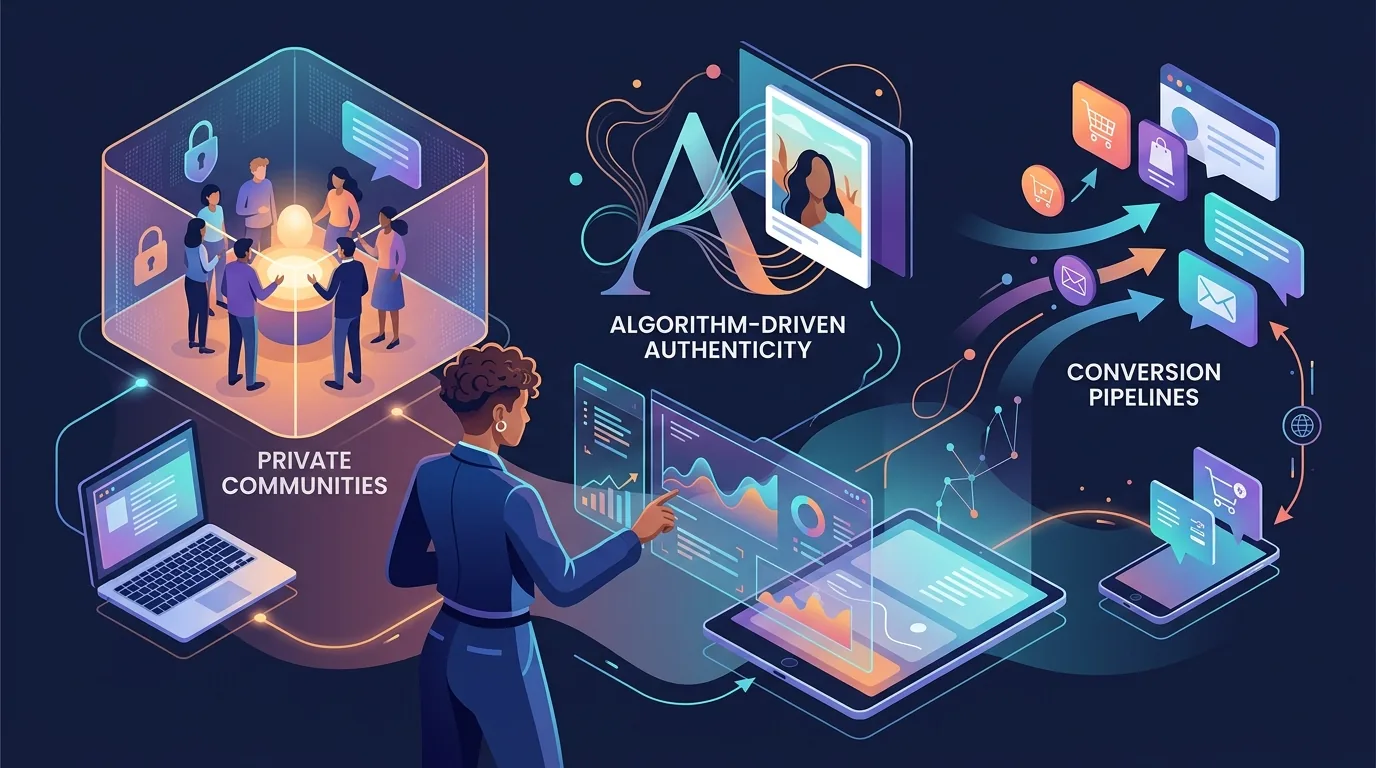
The New Social Media Rules: 3 Trends Marketers Need in 2026 — illustrative featured image
The last time we saw a major platform shift like this, we were all scrambling to make square crops work and wondering if hashtags were finally dead. That was years ago. The 2026 playbook is different, and most marketing teams are still running the 2023 one. Here is a concrete scene to frame it. A founder we work with at a B2B SaaS company, roughly $12M ARR, was spending $40k a month on sponsored LinkedIn posts and organic social management. Their CAC had crept up 18% quarter over quarter. Their organic reach on X had dropped by half in six months. Their CMO, a sharp operator, kept asking the same question in every status meeting: "Is this channel actually working, or are we just posting because we have a content calendar?" That is the wrong question. The right question is: "What rules changed while we were not paying attention?" Here are the three [social media trends for 2026](/dgtg/blog/social-media-trends-2026-what-brands-and-agencies-need-to-know) that will separate the agencies that deliver from the ones that just report impressions. ## Trend 1: The Death of the "Always-On" Feed For a decade, the advice was consistent. Post daily. Keep the content engine running. Feed the algorithm. That strategy is now actively hurting performance for most brands. The data is clear. Engagement rates on standard feed posts have dropped across every major platform. LinkedIn, which was the last holdout for professional content, has seen organic reach per follower decline steadily. The reason is not that people stopped scrolling. It is that platforms have fundamentally reorganized how content surfaces. The new algorithm logic is event-driven, not schedule-driven. Platforms now prioritize moments. A product launch, a funding announcement, a major customer win, a controversial industry take. These create spikes. The platforms detect the spike and push it to broader audiences. Routine "here is our weekly tip" content gets buried because it signals nothing new. What this means for marketers is uncomfortable. Your content calendar is now a liability if it is filled with filler. The brands winning in early 2026 are treating social like a newsroom, not a content mill. ### What changed - **Frequency is down, intensity is up.** Posting three times a week with high signal beats posting daily with low signal. - **Search is eating the feed.** Platforms are now search engines first. People search for "best CRM for agencies" on LinkedIn and TikTok. Your content needs to answer queries, not just broadcast opinions. - **Dwell time is the new CTR.** The metric that matters is how long someone stays on your post before scrolling. That means longer, more substantive posts win. A 300-word LinkedIn post with a contrarian take outperforms a slick carousel. The tactical shift for agencies is to audit every client's calendar. Cut 60% of the scheduled posts. Replace them with reactive, newsjacked content that ties into industry events or client-specific milestones. The remaining 40% should be search-optimized, answering specific questions your ICP is typing into the platform's search bar. ## Trend 2: The Rise of the Private and the Semi-Private Open feeds are becoming town squares where nobody wants to speak loudly. The real engagement is happening in private spaces. WhatsApp channels, Discord servers, Slack communities, and even the comment sections of niche newsletters. This is not a new phenomenon, but the scale is new. In 2026, a significant portion of high-intent B2B conversations happen in closed groups where your ads cannot reach and your organic posts will never appear. The CMO who is evaluating your software is asking for peer recommendations in a private Slack group with 400 other CMOs. They are not reading your tweet. This creates a paradox. Your public social presence is now a credibility signal, not a conversion channel. It exists to get you invited into the private rooms. The actual selling happens where the public cannot see. ### How to play it - **Public content should be bait, not the meal.** The goal of a public post is to get a DM, a comment that opens a conversation, or a share into a private group. Measure private conversations started, not likes. - **Community management is a revenue function.** The person who runs your client's Discord or Slack channel needs to be as sharp as the sales team. They are fielding buying signals disguised as questions. - **Agency tip:** Offer to run a private roundtable for a client's top 50 prospects. Use social to drive sign-ups, then move the conversation to a closed forum. This is where deals get influenced. We have seen this work directly. One client, a fintech infrastructure company, stopped trying to generate leads from LinkedIn ads. Instead, they used LinkedIn posts to invite CFOs to a private monthly call. The call had 30 attendees. From that group, they closed three enterprise deals worth over $200k in ACV each. The public posts were the door. The private room was the sales floor. ## Trend 3: Authenticity Becomes a Measurable Asset For years, "authenticity" was a buzzword that meant posting behind-the-scenes photos and using a casual tone. That era is over. In 2026, authenticity is a quantifiable factor in ad delivery and organic reach. The platforms have gotten better at detecting engagement bait, stock footage, and overly polished content. They are actively suppressing it. The algorithm now rewards content that looks like it was made by a human with a point of view, not a brand with a creative team. This is especially important as [AI "slop"](/tech/blog/ai-slop-and-how-to-avoid-it-a-guide-to-quality-content-creation) becomes more prevalent across the web. This pushes against every instinct of a traditional marketing department. We are trained to polish, approve, and refine until the edge is gone. That edge is exactly what the algorithm wants. ### The metrics that matter now | Old Metric | New Metric | | --- | --- | | Follower count | Share of voice in private groups | | Impressions | Dwell time per post | | Likes | Comments that start threads | | Reach | Invites to closed communities | | CTR on ads | Cost per qualified conversation | The shift means agencies need to change how they staff client work. The most valuable person on the account is no longer the content strategist. It is the subject matter expert who can write a sharp, opinionated post in 15 minutes without a legal review. ### Our take We are pragmatic about this. We are not suggesting you fire your brand team and let your CEO rant on X at 2am. But we are recommending a structural change. - **Hire or assign a "voice engineer."** This is someone who understands the client's product deeply and can translate technical wins into narrative posts. They should have direct access to product managers and customer success calls. - **Run A/B tests on authenticity.** Post one version of a message that is polished and one that is raw. Measure dwell time and comment quality, not just reach. The raw version wins more often than you expect. - **Stop approving everything.** Give the voice engineer a clear set of boundaries (no financials, no unannounced partnerships, no political takes) and let them post without a five-person approval chain. Speed is a feature now. For agencies pitching new business, this is your wedge. Show a prospect a sample post that is sharp, specific, and slightly risky. Contrast it with their current feed of corporate fluff. The contrast is the pitch. ## What we recommend If you are evaluating your social strategy for the rest of 2026, here is our blunt advice. 1. **Cut your posting frequency by half.** Use the saved time to write longer, more opinionated pieces that answer search queries. 2. **Invest in private community infrastructure.** Whether that is a Discord server, a WhatsApp broadcast list, or a simple email group. Your public social is the front porch. The living room is where the deals happen. 3. **Get comfortable with imperfection.** The content that performs best in 2026 looks like it was written by a smart human, not a committee. If it reads like it went through legal, it will perform like it went through legal. Platforms to watch: [LinkedIn is still the home for B2B](/dgtg/blog/the-new-social-media-rules-3-trends-marketers-need-for-2026), but it is now a search engine with social features. X is a news wire, useful for real-time reactions but not for building community. TikTok and Instagram remain relevant for employer branding and reaching younger buyers, but the B2B ROI case is still weak for most categories. The agencies that win in 2026 are the ones that stop selling "social media management" and start selling "audience intelligence and private community access." That is a different service, with different pricing, and it is worth significantly more. ## FAQ ### How often should we post on social media in 2026? Quality over quantity is the rule. Three to five substantive posts per week per platform will outperform daily posting of filler content. Focus on posts that answer a specific question, take a clear stance, or tie into a company milestone. ### Is organic social dead for B2B lead generation? Organic social is not dead, but it is no longer a direct lead generation channel. It is a credibility and discovery layer. The actual conversion happens in private groups, DMs, or after a prospect searches for your brand because they saw a sharp post. Budget accordingly. ### Should we hire an agency for social or build in-house? Hire an agency if you need help with strategy, voice development, and private community setup. Build in-house once you have a proven playbook and need a dedicated voice engineer who lives inside your product team. The hybrid model, agency for strategy and in-house for execution, is the most common winning structure we see.

Frequently asked questions

What changed - **Frequency is down, intensity is up.** Posting three times a week with high signal beats posting daily with low signal. - **Search is eating the feed.** Platforms are now search engin

Quality over quantity is the rule. Three to five substantive posts per week per platform will outperform daily posting of filler content. Focus on posts that answer a specific question, take a clear stance, or tie into a company milestone.

Is organic social dead for B2B lead generation?

Organic social is not dead, but it is no longer a direct lead generation channel. It is a credibility and discovery layer. The actual conversion happens in private groups, DMs, or after a prospect searches for your brand because they saw a sharp post. Budget accordingly.

Should we hire an agency for social or build in-house?

Hire an agency if you need help with strategy, voice development, and private community setup. Build in-house once you have a proven playbook and need a dedicated voice engineer who lives inside your product team. The hybrid model, agency for strategy and in-house for execution, is the most common winning structure we see.