
DGTG logo DGTG

Martech Stack 2026: AI Marketing Tools That Scale

Build a martech stack 2026 that scales: define CAC and payback first, layer your tools, and use AI for execution not strategy. See the red flags to avoid.
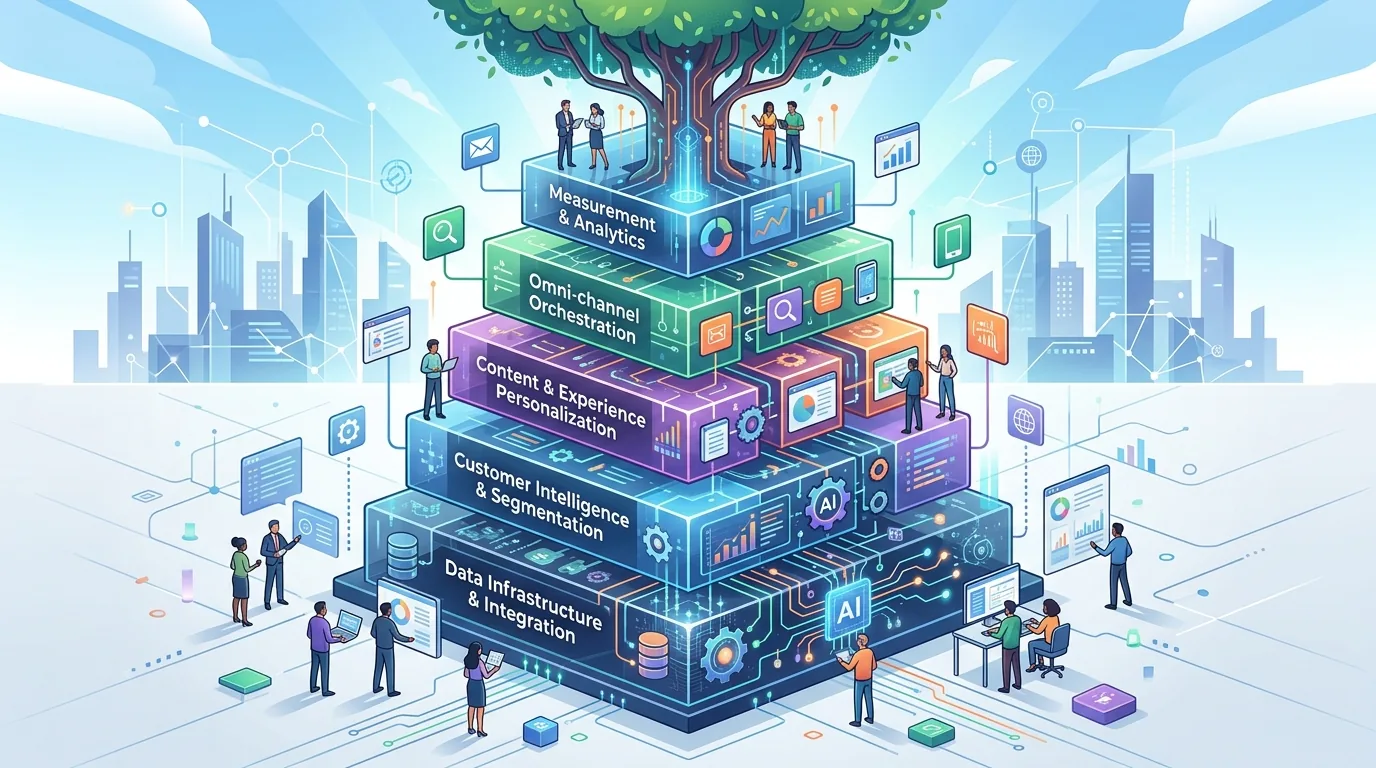
Martech and AI Tools: How to Build a Stack That Scales in 2026 — illustrative featured image
A CMO I know spent $140,000 last year on marketing technology. Fourteen tools, eleven vendors, one very tired ops manager. When I asked what the stack had done for her CAC, she pulled up a dashboard and went quiet. It had gone up 18 percent. Not because the tools were bad. Because nobody had defined what "working" meant before the contracts were signed. That story is not unusual. Gartner's 2026 trend work keeps circling the same idea: the constraint on AI marketing tools has shifted from capability to governance. The software can do almost anything now. The question is whether your team can prove it is doing the right thing. That gap is where most martech stacks in 2026 quietly fall apart. ## The stack is not the strategy Most founders and CMOs treat the martech stack 2026 question as a shopping problem. It is not. It is a decision-rights problem. Before you evaluate a single vendor, write down three numbers: your current CAC, your target CAC, and the payback window you can live with. If a tool cannot plausibly move one of those, it is a hobby, not infrastructure. We have watched teams buy attribution platforms to fix a positioning problem. We have watched them buy a CDP to fix a data hygiene problem that a two-week cleanup would have solved. The tool gets blamed. The diagnosis was wrong. The uncomfortable truth is that the average B2B stack now runs seven to twelve tools, and most teams use roughly 40 percent of the features they pay for. Consolidation is not a cost-cutting exercise. It is a clarity exercise. Every additional tool adds a data contract, an integration surface, and a person who has to own it. ### A quick triage before any purchase Ask these in order. If you cannot answer the first one, stop. 1. What decision does this tool change, and who makes that decision? 2. What is the current cost of that decision being wrong (in hours or dollars)? 3. Which system of record does this tool read from, and which does it write to? 4. Who owns it on day 90, not day one? If the answers are vague, the tool will be too. ## Where AI actually earns its budget Let us separate the noise from the useful. [AI marketing tools](/dgtg/blog/ai-marketing-tools-2026-buyer-s-guide-for-agencies-and-brands) fall into roughly four buckets, and they do not deserve equal trust. | Bucket | Typical use | Realistic payoff | Watch out for | |---|---|---|---| | Content generation | Drafts, variants, localization | 20-40% time saved on first drafts | Brand drift, SEO cannibalization | | Predictive scoring | Lead prioritization, churn flags | 5-15% lift in conversion on good data | Garbage-in scoring, false confidence | | Creative testing | Ad variants, subject lines | Faster iteration, modest CTR gains | Overfitting to small samples | | Ops automation | Routing, enrichment, reporting | Real hours back, compounding | Silent failures, broken handoffs | The pattern is consistent. AI is excellent at compression (doing a known task faster) and mediocre at discovery (telling you what to do). Teams that buy AI to think for them get disappointed. Teams that buy it to execute a defined playbook get leverage. Predictive scoring deserves a specific warning. It only works when your historical data is clean and your win definitions are stable. If sales and marketing disagree on what a qualified lead is, an AI model will simply encode that disagreement at scale, faster and with more confidence. ## Build the stack in layers, not in a shopping cart A stack that scales in 2026 looks less like a toolbox and more like a pipeline. Four layers, in this order. ### 1. The system of record Pick one. CRM, warehouse, or both. Everything else reads from it. If two tools both claim to be the source of truth for the same field, you have already lost. Most teams we work with land on a CRM plus a lightweight warehouse, with the warehouse winning any dispute. ### 2. The identity layer This is where most stacks leak money. If you cannot reliably connect a session, a form fill, and a closed deal to the same person, your attribution is fiction and your AI models are guessing. Invest here before you invest in dashboards. ### 3. The activation layer Email, ads, lifecycle, sales enablement. This is where AI tools shine because the tasks are repetitive and measurable. Keep this layer thin. Two or three tools, tightly integrated, beat seven loosely stitched ones. ### 4. The measurement layer Attribution, incrementality testing, reporting. Build this last, and build it honestly. If your measurement layer is designed to make last quarter look good, it will quietly poison every decision that follows. ### The agency question This is where the do-it-in-house versus hire-an-agency decision usually goes wrong. We see a clean split. - **Do in-house:** system of record, identity layer, data governance, anything touching customer PII. - **Hire out:** creative testing at volume, paid media execution, technical SEO, and short-term analytics sprints where you need a specialist for 90 days, not a full-time hire. The mistake is outsourcing the layer that defines your strategy. An agency can run your activation layer brilliantly. It cannot decide what your company is for. ## Red flags when an agency recommends tech We have reviewed a lot of agency tech proposals. The bad ones share tells. - **The stack arrives before the diagnosis.** If the first deliverable is a tool recommendation and not a measurement of your current funnel, walk. - **Reseller incentives are undisclosed.** Ask directly: do you earn a margin on this license? A good partner answers without flinching. - **No exit plan.** Every tool should have a documented way to leave, including data export and a named owner. If the proposal does not mention it, the lock-in is the business model. - **Vanity metrics in the pitch.** Impressions, reach, and "AI-powered" as a feature. Ask for CAC, ROAS, and LTV impact instead. - **One-size-fits-all stacks.** If the same five-tool stack gets recommended to a seed-stage SaaS company and a $200M manufacturer, it is a template, not a strategy. - **No pilot window.** Any serious recommendation includes a 30 to 60 day test with defined success criteria. No pilot, no deal. ## Our take We are opinionated about this because we have cleaned up the mess. Here is what we would actually run in 2026. For the system of record, HubSpot or Salesforce, depending on deal complexity. For the warehouse, BigQuery or Snowflake, with a lightweight reverse ETL tool like Hightouch or Census to push data back into activation. For identity and analytics, Segment plus a warehouse-native tool such as dbt for modeling. For AI-assisted content and testing, Jasper or Writer for drafts, and a dedicated experimentation tool rather than a general-purpose AI platform. For scoring, start with your CRM's native model before buying a standalone AI product. You will learn more in two weeks than a vendor demo will teach you in two months. None of this is exotic. That is the point. The stack that scales in 2026 is boring, integrated, and owned. The exciting part is what it lets you decide. ## FAQ **How many tools should a martech stack in 2026 actually have?** For most B2B teams under $50M in revenue, five to eight is the sweet spot. Fewer if you are under $10M. The number matters less than whether every tool has a named owner and a documented data contract. **Do we need a CDP, or is a warehouse enough?** If your customer data lives in three or more systems and you need real-time activation, a CDP earns its cost. If you are mostly batch, a warehouse plus reverse ETL is cheaper and easier to govern. **How do we know if an AI marketing tool is actually working?** Define the metric before the pilot, not after. Run a 30 to 60 day test against a control, measure CAC or ROAS impact, and be willing to kill it. A tool that cannot survive a controlled test is not a tool. It is a subscription. ## Related on this site - [10 Martech and AI Tools That Will Transform Your 2026 Marketing Strategy](/dgtg/blog/10-martech-and-ai-tools-that-will-transform-your-2026-marketing-strategy) - [AI Marketing Tools in 2026: Build vs. Buy vs. Partner](/dgtg/blog/ai-marketing-tools-in-2026-build-vs-buy-vs-partner) - [AI in Marketing: How to Leverage AI Tools for Client Success](/dgtg/blog/ai-in-marketing-how-to-leverage-ai-tools-for-client-success) ## Sources - [The stack (philosophy) (Wikipedia)](https://en.wikipedia.org/wiki/The_stack_(philosophy))

Frequently asked questions

How many tools should a martech stack in 2026 actually have?

For most B2B teams under $50M in revenue, five to eight is the sweet spot. Fewer if you are under $10M. The number matters less than whether every tool has a named owner and a documented data contract.

Do we need a CDP, or is a warehouse enough?

If your customer data lives in three or more systems and you need real-time activation, a CDP earns its cost. If you are mostly batch, a warehouse plus reverse ETL is cheaper and easier to govern.

How do we know if an AI marketing tool is actually working?

Define the metric before the pilot, not after. Run a 30 to 60 day test against a control, measure CAC or ROAS impact, and be willing to kill it. A tool that cannot survive a controlled test is not a tool. It is a subscription.

A quick triage before any purchase Ask these in order. If you cannot answer the first one, stop. 1. What decision does this tool change, and who makes that decision?

2. What is the current cost of that decision being wrong (in hours or dollars)?