
DGTG logo DGTG

Google 2026 Core Update Recovery: SEO Playbook

Learn how to recover from the Google 2026 core update. A practical SEO playbook to diagnose ranking drops, rebuild topic clusters, and regain organic traffic.
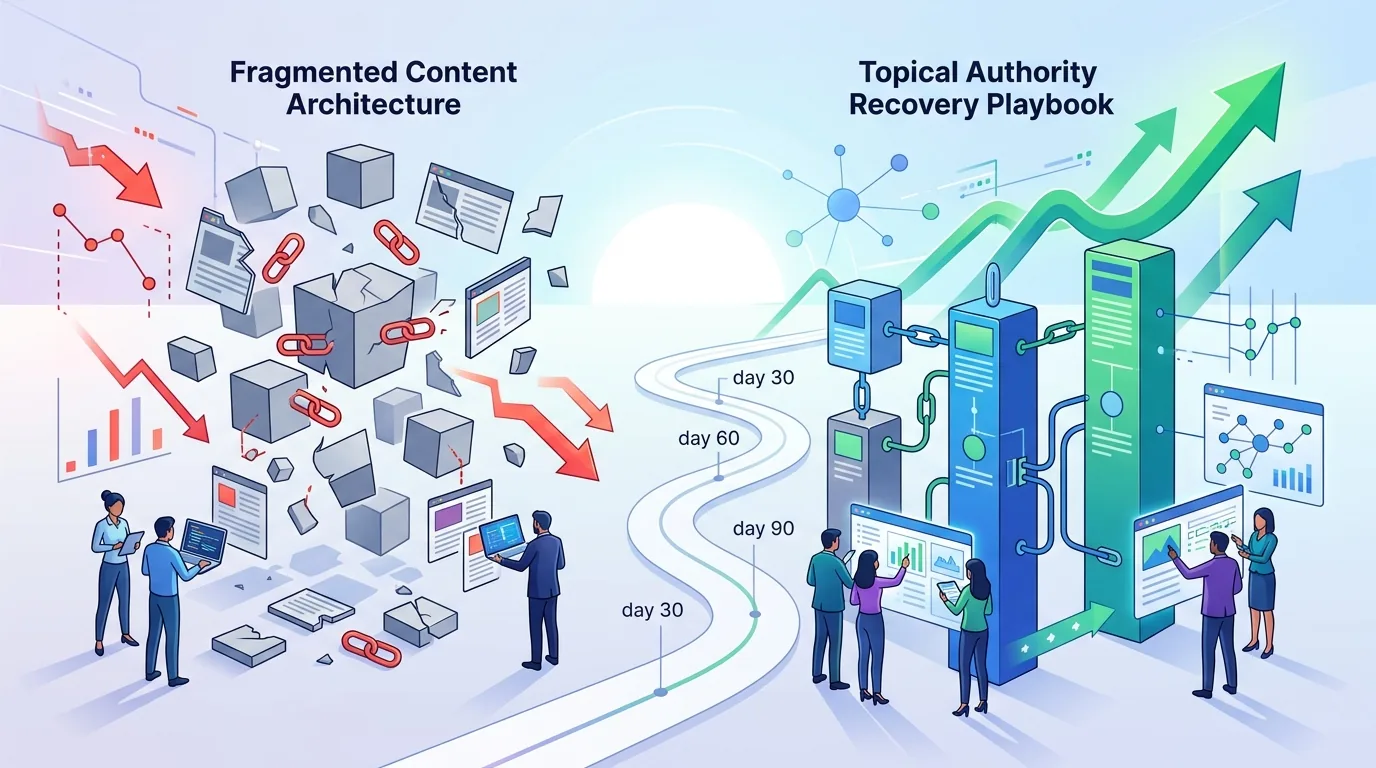
How Google's 2026 Core Updates Impact Your SEO: A Recovery Playbook — illustrative featured image
The last time you saw organic traffic graph like a ski jump, it was probably March 2024. The March 2025 core update did a number on thin affiliate content. But the August 2026 release is different. It is targeting something more structural. We have been auditing accounts hit by the August 2026 core update for the last three weeks. The pattern is not about AI slop or link spam. It is about site architecture and internal linking logic. Google is now rewarding hubs of topical authority, not just individual articles that answer a query. If your rankings dropped on September 3rd and you are scrambling for a fix, here is the [recovery playbook we are using with clients](/dgtg/blog/recovering-from-google-core-updates-a-playbook-for-agencies). ## First, Diagnose the Drop Before You Touch Anything Do not change a single title tag yet. Panic edits are how you turn a 20% traffic dip into a 50% loss. The August 2026 update has a clear signature. It is not a penalty. It is a reshuffling of relevance scores. Open Search Console and filter by page type. Look for a specific pattern. Are your blog posts down across the board, or only the ones targeting commercial keywords? If your transactional pages (pricing, product pages, case studies) are stable but your top-of-funnel content is bleeding, that is a classic sign of an authority re-rating. ### Run This Quick Diagnostic Checklist 1. Compare week-over-week clicks for your top 50 pages. Are the drops isolated to pages published in the last 12 months? 2. Check your internal link graph. Are your money pages orphaned or only linked from the footer? 3. Look at your bounce rate for organic traffic specifically. If it jumped from 40% to 70%, Google is seeing a mismatch between your title and the content. 4. Review your entity coverage. Do you have a dedicated page for the core topic you want to rank for, or are you relying on blog posts scattered across categories? We saw one client in the B2B SaaS space lose 40% of their traffic overnight. Their content was excellent. But they had 400 blog posts and zero pillar pages. Google could not figure out what their site was actually about. The update made that ambiguity fatal. ## The 2026 Algorithm Shift: Intent Clusters Over Keywords The old model was keyword mapping. You have a keyword, you write a page, you rank. The 2026 model is intent clustering. Google now looks at your site as a collection of entities and asks: does this domain comprehensively answer the questions a buyer has at each stage? This is why the [SEO algorithm update 2026](/dgtg/blog/google-algorithm-updates-2026-how-to-protect-your-rankings-without-panic) is hitting service pages harder than informational content. Google is trying to guess if your business is the right answer for a query like "enterprise CRM implementation services." If you have one service page and a blog post about CRM migration, that is not enough. Google wants to see a cluster: a service page, a pricing page, two case studies, a comparison guide, and a technical FAQ section, all interlinked with descriptive anchor text. ### What the New SERP Landscape Looks Like | Content Type | Pre-2026 Ranking Signal | 2026 Ranking Signal | | :--- | :--- | :--- | | Blog Post | Keyword density, backlinks | Entity depth, internal link proximity to money page | | Service Page | On-page copy, page speed | Supporting cluster size, schema markup for services | | Case Study | N/A (rarely ranked) | Now appears in main results for commercial queries | | Homepage | Domain authority | Topical relevance to the query's intent cluster | If you are still writing one-off blog posts that link to your homepage with the text "click here," you are fighting the algorithm with both hands tied behind your back. [Surviving Google's core updates](/dgtg/blog/surviving-google-s-core-updates-what-marketers-must-do-now) requires adapting to this structural shift. ## The Google Core Update Recovery Plan Once you have confirmed the drop is algorithmic and not a manual action, you need a 90-day sprint. Here is the sequence we are running across our portfolio. ### Phase 1: Consolidate and Prune (Days 1 to 14) Audit your content library for pages that get less than 50 clicks per quarter. Do not delete them yet. Redirect the thin or outdated ones into a relevant pillar page. You want to consolidate link equity and reduce crawl waste. We had a manufacturing client with 300 product spec sheets. 250 of them were for discontinued items. We redirected all of them into a "Legacy Parts Cross-Reference" hub. That single move recovered 15% of their lost traffic because Google stopped seeing their site as a graveyard of dead URLs. ### Phase 2: Build the Topic Cluster Architecture (Days 15 to 45) This is the heavy lifting. Pick your top five revenue-driving services. For each one, map out the questions a procurement manager or CMO would ask before buying. You need at least 10 subtopics per cluster. - Service page (the money page) - 3 case studies (specific to that service) - 2 comparison posts (you vs. alternatives) - 1 pricing guide - 1 technical deep dive - 2 "how to choose" guides Interlink these aggressively with exact match anchors. The service page should be the central node. Every blog post links up to it. The service page links down to the supporting content for further reading. ### Phase 3: Refresh and Rebuild Authority (Days 45 to 90) Google algorithm update impact is often compounded by stale content. Update your old posts with new data, new screenshots, and new internal links to the new cluster pages. Change the publish date only if you actually changed the substance. Do not fake freshness. Then, focus on digital PR. The August update is rewarding brands that get mentioned in industry roundups and news sites, not just generic blog comments. Pitch your new case studies to trade publications. One strong mention in a niche newsletter does more for a topical cluster than 10 spammy guest posts. ## What We Recommend We have tested several recovery tools and workflows over the past month. Here is our honest take on what works and what is a waste of budget. **For auditing:** Use Screaming Frog for the crawl analysis. Do not pay for an expensive "AI audit" tool. The free version of Screaming Frog shows you orphan pages and broken internal links, which is 80% of the diagnosis. **For content refresh:** If you have the budget, hire a specialized SEO content agency rather than a generalist. We have seen good results from agencies that use a "topic modeling" approach. They analyze the top 10 results for your target query and build a content brief that matches the subtopics Google expects. Do this in-house only if you have a dedicated writer who understands search intent, not just "writing quality." **For technical fixes:** This is where you hire an agency. If you are a founder and your site is on a custom CMS, do not try to fix internal linking logic yourself. The cost of a broken migration or a botched redirect chain is far higher than the agency retainer. Specifically, look for an agency that offers technical SEO audits as a standalone service, not just as part of a monthly retainer. **For link building:** Do this in-house. You know your customers and your industry better than any agency. Use a tool like Ahrefs to find unlinked mentions of your brand, and reach out to the webmasters directly. A personalized email from the founder converts better than a generic outreach campaign from an agency. ## The Long Game: What to Do After Recovery Once your rankings stabilize, resist the urge to go back to your old publishing cadence. The 2026 algorithm rewards consistency in structure, not volume. You are better off publishing one deeply researched article per week that links into a cluster than five thin posts that stand alone. Monitor your Search Console for "queries with impressions but low CTR." Those are your opportunities. If you are ranking on page two for a high-value keyword, that means your cluster is almost there. You just need one more strong internal link or a better meta description to push it over the edge. ## FAQ **How long does it take to recover from a Google core update?** Most recoveries take between 60 and 90 days if you actively work on restructuring your content. If you just wait for the next update, you might wait six months or more. The key is to make the structural changes and then wait for the next core update to confirm the re-rating. **Is it better to delete low-quality pages or keep them and update them?** Delete or redirect pages that have no business value. If a page has zero clicks, zero backlinks, and does not support a revenue cluster, it is just diluting your crawl budget. Redirect the URL to a relevant pillar page to consolidate any residual equity. **Should I pause my PPC ads while my organic traffic is down?** No. If your organic rankings dropped for commercial keywords, your paid search campaigns are now your only visibility. Increase your PPC budget on your highest-margin keywords to maintain revenue flow while the SEO recovery takes hold. Think of it as a bridge loan for your traffic.

Frequently asked questions

How long does it take to recover from a Google core update?

Most recoveries take between 60 and 90 days if you actively work on restructuring your content. If you just wait for the next update, you might wait six months or more. The key is to make the structural changes and then wait for the next core update to confirm the re-rating.

Is it better to delete low-quality pages or keep them and update them?

Delete or redirect pages that have no business value. If a page has zero clicks, zero backlinks, and does not support a revenue cluster, it is just diluting your crawl budget. Redirect the URL to a relevant pillar page to consolidate any residual equity.

Should I pause my PPC ads while my organic traffic is down?

No. If your organic rankings dropped for commercial keywords, your paid search campaigns are now your only visibility. Increase your PPC budget on your highest-margin keywords to maintain revenue flow while the SEO recovery takes hold. Think of it as a bridge loan for your traffic.

Run This Quick Diagnostic Checklist 1. Compare week-over-week clicks for your top 50 pages. Are the drops isolated to pages published in the last 12 months?

2. Check your internal link graph. Are your money pages orphaned or only linked from the footer?