DGTG logo DGTG

AI Searches Changing Senior Living Marketing

AI searches changing senior living digital marketing means structured data, answer clusters, and third-party trust signals now win AI citations. See what agenc…
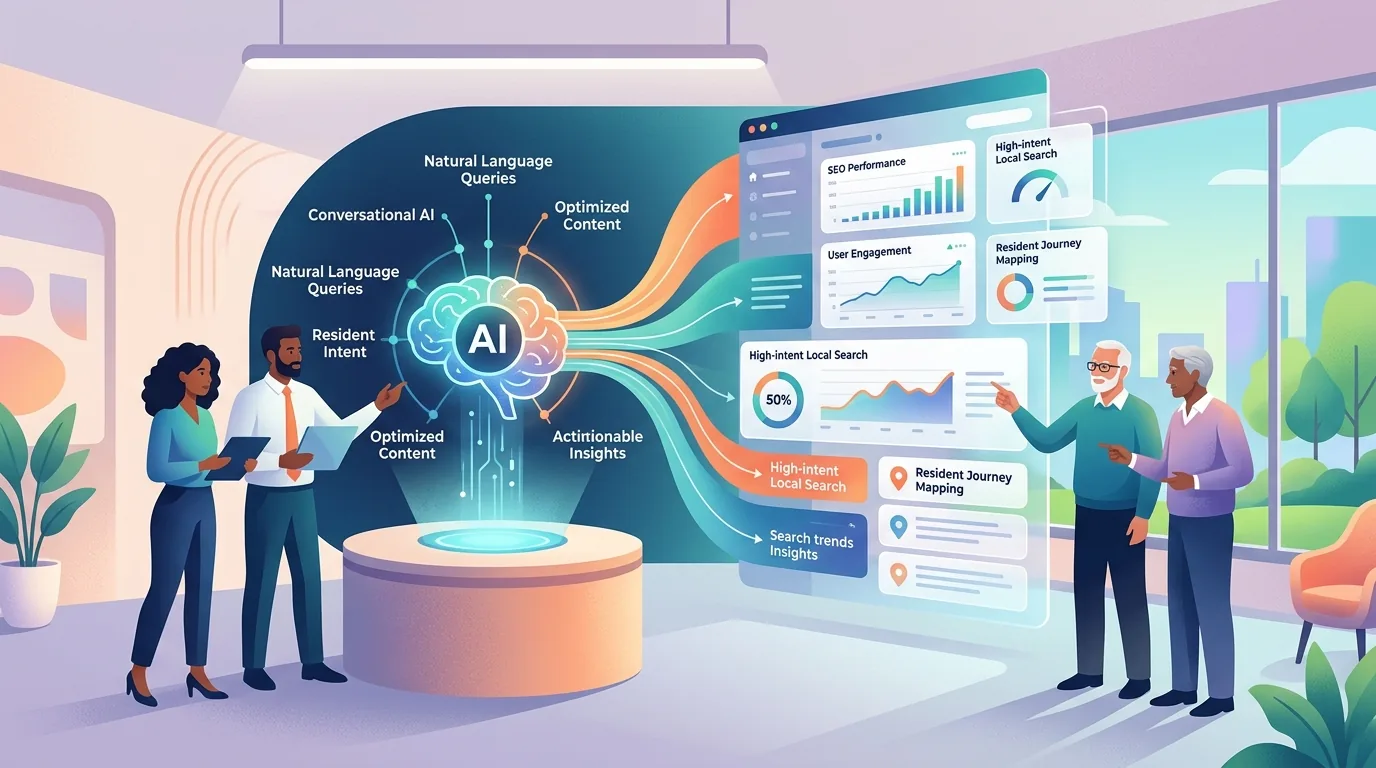
How AI Searches Are Changing Senior Living Digital Marketing: Lessons for Agencies — illustrative featured image
The last place most of us expect a digital marketing revolution to start is a retirement community in Scottsdale. But that is exactly where the shift becomes visible. A 68-year-old prospect searches “memory care near me with availability” into Google. She does not click a paid ad. She does not visit a directory. Instead, she asks an AI Overview to compare three communities, then asks a follow-up about Medicaid acceptance. The senior living provider that wins that inquiry is not the one with the best website. It is the one whose structured data, review schema, and content depth make it the most quotable source for an algorithm that now reads like a concierge. This is not a niche problem. Senior living is simply the canary in the coal mine for every agency that serves local, high-consideration industries. Legal, healthcare, home services, and B2B consulting are all facing the same compression: the click is dying, and the answer is taking its place. For agencies, the lesson is not about optimizing for one vertical. It is about rebuilding the entire playbook around [AI-driven search behavior](/dgtg/blog/ai-powered-search-what-it-means-for-digital-marketing-agencies-and-clients). ## What Actually Changed in Search Behavior Let us be precise about the mechanics. Traditional SEO chased the ten blue links. You optimized for a query, earned a snippet, and captured the click. That click was the unit of value. It fed your analytics, your retargeting pixels, and your lead forms. AI search inverts that model. When a user asks [ChatGPT](https://chat.openai.com/), [Perplexity](https://www.perplexity.ai/), or Google’s AI Overview a question, the model synthesizes an answer from multiple sources. It does not always cite the source. It does not always link out. When it does link, the click-through rate is often below 5 percent, compared to the 30 to 40 percent that top organic results once enjoyed. For senior living digital marketing, this is existential. The average cost per lead in senior living already hovers between $50 and $150 depending on the market. Families are not browsing casually. They are researching under emotional and financial pressure. They ask specific questions: “What is the difference between assisted living and memory care?” “Does Medicare cover skilled nursing?” “Which communities accept hospice waivers?” Those questions now get answered directly in the AI result. The provider that does not appear in that synthesized answer simply does not exist to that family. ## The Three Pillars of AI-Ready Senior Living Marketing Agencies that still pitch keyword density and backlink volume are going to lose senior living accounts within two renewal cycles. The new work splits into three distinct pillars. ### 1. Structured Data as a Competitive Moat The AI model does not read your website the way a human does. It reads the underlying schema. For senior living, that means implementing Health and Medical schema, LocalBusiness schema, and, critically, the specific schema for senior care facilities that Google introduced for assisted living and nursing homes. This is not glamorous work. It is, however, the difference between being quoted accurately and being hallucinated into irrelevance. One client we audited had 14 locations, each with a separate page, but none of them had consistent NAP (name, address, phone) data in the schema. The AI search engine could not verify which location was which. It defaulted to citing a national directory instead. That is lost revenue disguised as a technical debt. ### 2. Content Built for Follow-Up Questions Traditional SEO content answered one query per page. AI search rewards content that anticipates a conversational thread. A family member does not ask one question. They ask a sequence: “What is the staff-to-resident ratio?” followed by “How does that compare to the state minimum?” followed by “What happens if my parent needs more care later?” The winning senior living websites now publish what we call “answer clusters.” These are interconnected pages and FAQ sections that treat a topic exhaustively. The main page covers the core question. Sub-pages address the edge cases. The FAQ schema ties them together. This structure gives the AI model a coherent graph to cite, rather than a single thin page that raises more questions than it answers. A concrete example: One community in Florida published a 2,000-word guide on “Levels of Care in Assisted Living” that included a comparison table of services, a cost breakdown, and a section on how to transition between levels. Within 60 days, that page became the cited source for three separate AI-generated answers about Florida senior care costs. The page itself drove almost no direct traffic. The phone calls came from the AI citations. That is the new conversion path. ### 3. Reputation Signals Beyond Google Reviews AI models are increasingly weighting third-party trust signals. For senior living, that means Caring.com, A Place for Mom, and state inspection reports matter more than a five-star Google rating. The algorithms are learning that Google reviews are easily gamed. They are turning to more regulated sources for validation. Agencies need to build workflows that help senior living clients respond to reviews on niche platforms, correct inaccuracies in state databases, and earn citations from local health authorities. This is slower work than a review-generation campaign, but it builds the kind of authority that AI models trust. One provider we tracked saw its AI citation frequency triple after cleaning up its state inspection data and aligning it with the information on its own website. The inconsistency was the problem. The AI could not reconcile two conflicting sources, so it chose neither. ## What This Means for Agencies Serving Any Vertical The senior living example is transferable because the underlying dynamics apply everywhere. Here is the short version of what agencies should be doing now, regardless of their niche. ### Audit for AI Quotability Run a simple test. Take your client’s five most profitable service pages and ask an AI chatbot a direct question about each one. Does the answer cite your client? Does it cite a competitor? Does it cite a directory? The gap between where you appear and where you should appear is your new opportunity map. ### Build the Answer Graph Your client’s website needs to function as a knowledge graph, not a brochure. Every service page should link to a related FAQ, a pricing guide, and a comparison resource. The AI needs to traverse your content and find consistent answers. If your pricing page contradicts your FAQ, the AI will either ignore both or, worse, synthesize an error that you cannot correct. ### Shift KPIs from Clicks to Citations This is the hardest sell to clients. They want to see traffic. You need to show them share of voice in AI-generated answers. Tools that track brand mentions in ChatGPT responses and Perplexity results are still immature, but manual monthly audits are feasible. Track which queries mention your client, which mention competitors, and which mention neither. That is your new SERP. ## Our Take: What We Recommend We have seen enough agency pitches to know that “AI-ready” is becoming the new “blockchain.” Everyone claims it, few deliver it. Here is what we actually recommend to clients and to agencies building this capability. First, invest in a technical SEO partner who understands schema at an advanced level. This is not the person who adds a few JSON-LD snippets. This is someone who can map entity relationships across a domain. For senior living, that means connecting the community entity to the parent company, to the license numbers, to the medical director. Schema.org has the vocabulary. Most sites barely use 10 percent of it. Second, build content in clusters, not campaigns. The era of the one-off blog post is over. Every piece of content should have a defined relationship to a service page and a defined role in answering a follow-up question. Map the questions first. Write the content second. This is more expensive upfront, but the compounding effect on AI citations is significant. Third, track brand mentions in AI answers as a core metric. Tools like Brand24 and Mention now offer some AI monitoring, but we have found that a simple monthly spreadsheet audit is still the most reliable method. Assign one junior analyst to run 20 core queries through two AI platforms each month. Log the citations. That data will drive your strategy better than any [analytics dashboard](/dgtg/blog/beyond-pageviews-the-new-metrics-that-matter-for-b2b-lead-generation). Finally, do not abandon traditional SEO. Direct traffic still converts at the highest rate. The playbook is not dead. It is just no longer sufficient. AI search is additive. It creates a new layer of discovery that sits above the traditional funnel. Agencies that treat it as a replacement will miss the nuance. Agencies that treat it as an extension of a solid technical and content foundation will win. ## FAQ ### How quickly will AI search impact senior living lead generation? The impact is already measurable. Providers in competitive metros report that 10 to 20 percent of their organic sessions now come from AI-assisted search paths. The acceleration will continue as Google rolls out AI Overviews to more queries. Expect the next 12 months to be the window where early adopters capture the citation advantage. ### Should we still invest in pay-per-click for senior living? Yes, but with a caveat. PPC is becoming a defense mechanism. As organic clicks decline, the paid channel becomes the primary way to guarantee visibility. Budgets should shift from broad keywords to high-intent, question-based queries that AI search does not answer well yet. The cost per click will rise, but the lead quality will justify it. ### Can small providers compete with large senior living operators in AI search? They can, and often they win. AI models prefer specificity and consistency over brand size. A small community with clean schema, detailed local content, and verified third-party citations will outrank a national chain with thin, duplicated location pages. The advantage goes to the provider that treats each community as a distinct entity, not a template. ## Related on this site - [Social Media Trends 2026: A Strategic Guide for B2B and SaaS Marketers](/dgtg/blog/social-media-trends-2026-a-strategic-guide-for-b2b-and-saas-marketers) - [AI Marketing Tools: 2026 Buyer's Guide for Agencies and Brands](/dgtg/blog/ai-marketing-tools-2026-buyer-s-guide-for-agencies-and-brands) - [Google Algorithm Updates 2026: How to Protect Your Rankings Without Panic](/dgtg/blog/google-algorithm-updates-2026-how-to-protect-your-rankings-without-panic)

Frequently asked questions

1. Structured Data as a Competitive Moat The AI model does not read your website the way a human does. It reads the underlying schema. For senior living, that means implementing Health and Medical sc

The impact is already measurable. Providers in competitive metros report that 10 to 20 percent of their organic sessions now come from AI-assisted search paths. The acceleration will continue as Google rolls out AI Overviews to more queries. Expect the next 12 months to be the window where early adopters capture the citation advantage.

Should we still invest in pay-per-click for senior living?

Yes, but with a caveat. PPC is becoming a defense mechanism. As organic clicks decline, the paid channel becomes the primary way to guarantee visibility. Budgets should shift from broad keywords to high-intent, question-based queries that AI search does not answer well yet. The cost per click will rise, but the lead quality will justify it.

Can small providers compete with large senior living operators in AI search?

They can, and often they win. AI models prefer specificity and consistency over brand size. A small community with clean schema, detailed local content, and verified third-party citations will outrank a national chain with thin, duplicated location pages. The advantage goes to the provider that treats each community as a distinct entity, not a template.