DGTG logo DGTG

AI Search SEO: What Marketing Leaders Must Do in 2026

AI search is rewriting SEO. Learn how to adapt keyword strategy, content, and agency selection with a practical checklist for marketing leaders in 2026.
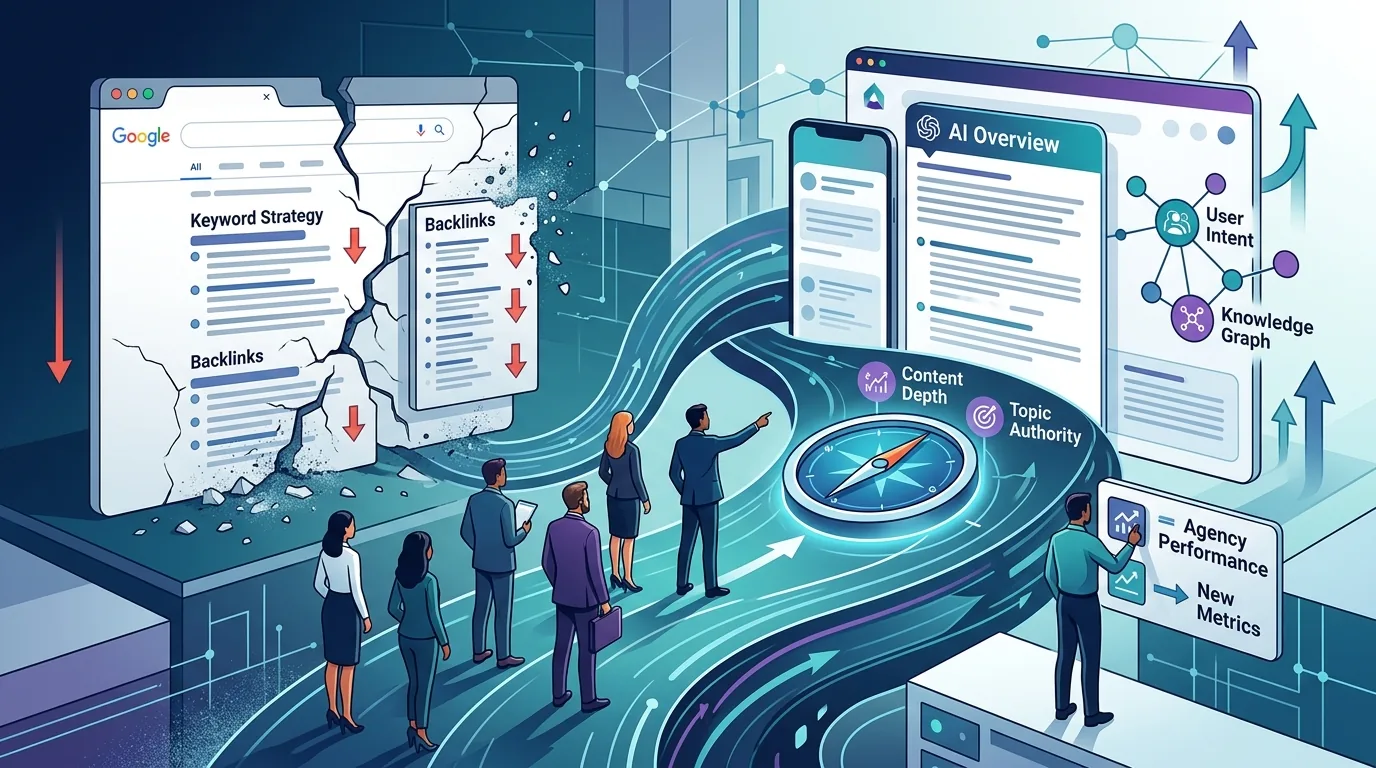
How AI Search Is Reshaping SEO: What Marketing Leaders Must Do Now — illustrative featured image
Google's AI Overviews now appear on roughly half of all search queries in the US, according to tracking from BrightEdge. For a decade, the contract between brands and search engines was simple: publish useful content, earn a ranking, collect the click. That contract is being rewritten in real time, and most marketing teams are still optimizing for a search engine that no longer exists in the form they learned. We have watched this play out with clients across SaaS, ecommerce, and B2B services. The pattern is consistent. Organic sessions hold steady or even climb, but assisted conversions from organic drop. Leads arrive pre-educated and skeptical, having already read an AI-generated summary of your category before they ever hit your site. The funnel did not break. The entry point moved. ## What actually changed in AI search Three shifts matter for planning purposes. First, AI search answers questions instead of listing links. A user asking "best CRM for a 20-person sales team" gets a synthesized recommendation, not ten blue links. Your ranking on page one matters less if the AI never cites you. Second, citation replaces ranking as the new currency. When [ChatGPT](https://chat.openai.com/), [Perplexity](https://www.perplexity.ai/), or Google's AI Overviews reference your brand, that mention carries more weight than position three on a traditional SERP. Citation is earned through entity clarity, structured data, and third-party corroboration, not keyword density. Third, query volume is fragmenting. Long-tail informational queries, the ones that used to feed top-of-funnel content programs, are being absorbed by AI chat interfaces. What remains on traditional search skews transactional and navigational. That changes what content is worth producing. ## The keyword strategy nobody budgeted for Most SEO roadmaps still start with a keyword gap analysis against three competitors. That exercise is now half-blind. It captures what people type into Google, not what they ask an AI assistant in a chat window, and those are diverging fast. The practical adjustment is to think in entities and intent clusters rather than keyword lists. If your product is a project management tool for construction firms, the entity is "construction project management software," and the supporting entities are things like subcontractor scheduling, change order tracking, and OSHA compliance. AI systems connect these. You should too. A working framework we use with clients: | Old approach | AI search approach | |---|---| | Target 200 keywords | Own 8 to 12 entity clusters | | Optimize individual pages | Build topic authority across a cluster | | Measure rank position | Measure citation frequency and share of AI answers | | Publish volume | Publish depth and original data | The volume play is dead for most mid-market budgets. You cannot outproduce a content farm, and AI systems increasingly discount thin content anyway. Depth, proprietary data, and named expertise are the moats that remain. ## What this means for content Content still wins. The form changes. AI systems reward content that demonstrates first-hand experience. A case study with real numbers (we cut onboarding time from 14 days to 3, CAC dropped 22 percent) gets cited. A generic listicle rephrasing what ten other sites already said does not. Google's helpful content signals and the way large language models are trained both point the same direction: original, specific, verifiable. Three content types are pulling their weight right now: 1. **Original research and benchmarks.** Survey your customers, publish the data, let others cite you. This is the single highest-leverage content investment for AI search SEO. 2. **Comparison and alternative pages with real testing.** Not "Top 10 X tools" but "We ran X and Y for 90 days, here is what broke." 3. **Expert-led explainers with named authors.** Byline a real practitioner with a LinkedIn profile and a track record. AI systems weight author entities more than they used to. One caution: do not chase AI search traffic at the expense of conversion paths. A citation in an AI answer is brand awareness, not a lead. You still need a reason for the reader to click through and a landing page that converts. ## The agency question This is where founders and CMOs are getting burned. Plenty of agencies rebranded their SEO retainers as "AI SEO" without changing the deliverable. Ask three questions before you sign anything: - **How do you measure AI citations?** If the answer involves rank tracking tools alone, walk. You want to see mention tracking across ChatGPT, Perplexity, Gemini, and AI Overviews. - **What is your content production model?** If it is AI-generated at scale, the strategy is self-defeating. AI systems are getting better at detecting and discounting [AI-generated filler](/tech/blog/ai-slop-and-how-to-avoid-it-a-guide-to-quality-content-creation). - **Who writes?** Named humans with subject-matter expertise, or anonymous freelancers? This matters more than it did two years ago. ### What we recommend For most mid-market teams, the split should be roughly 60/40 in favor of in-house for strategy and subject-matter content, with agencies handling technical SEO, structured data, and citation monitoring. The expertise lives inside your company. The plumbing does not. If you are hiring, three agencies we have seen do credible work in this space: **Siege Media** for editorial-led content programs, **Animalz** for B2B SaaS content strategy, and **Foundation** for technical SEO and content operations at scale. None of them are cheap, and none of them will fix a broken product or a weak offer. No agency will. For the technical layer, invest in schema markup (Organization, Person, Product, FAQ), a clean entity graph on your site, and presence on the sources AI systems train on and cite. That means Wikipedia where you qualify, industry publications, Reddit threads where your category is discussed, and review sites like G2 and Capterra. Boring, unglamorous, effective. ## A practical checklist for the next two quarters - Audit your top 50 landing pages for entity clarity. Can a machine tell what you do and who you are in the first 100 words? - Add author schema and real bios to every content page. - Kill your lowest-performing 20 percent of content. Redirect or consolidate. - Commission one piece of original research. Budget $5,000 to $15,000. Publish it as a gated report and an ungated summary. - Set up citation monitoring. Tools like Profound, Peec AI, and Ahrefs Brand Radar cover most of the surface. - Rewrite your agency RFP to include AI citation metrics and content provenance requirements. None of this is exotic. It is the same discipline good SEO always required, applied to a search layer that answers instead of lists. The teams that treat AI search as an evolution of fundamentals rather than a new religion will compound the advantage. The ones chasing shortcuts will pay for it in twelve months when the next model update resets the board again. ## FAQ ### Will traditional SEO still matter in 2026? Yes, but the mix shifts. Transactional and navigational queries still run through Google and Bing. Informational queries increasingly route through AI interfaces. Budget accordingly rather than abandoning either channel. ### How do I measure AI search visibility? Track brand mentions across ChatGPT, Perplexity, Gemini, and Google AI Overviews using tools like Profound or Peec AI. Pair that with branded search volume in Google Search Console, which tends to rise when AI citations work. ### Should we stop publishing blog posts? No. Publish fewer, better ones. One piece of original research with real data outperforms twenty generic how-to posts for both traditional rankings and AI citations. ## Related on this site - [How to Choose a Marketing Agency in the Age of AI: 7 Must-Ask Questions](/dgtg/blog/how-to-choose-a-marketing-agency-in-the-age-of-ai-7-must-ask-questions) - [The New Social Media Rules: 3 Trends Marketers Need in 2026](/dgtg/blog/the-new-social-media-rules-3-trends-marketers-need-in-2026-3) - [Building an Algorithm-Proof SEO Strategy: 11 Tactics for Long-Term Growth](/dgtg/blog/building-an-algorithm-proof-seo-strategy-11-tactics-for-long-term-growth)

Frequently asked questions

What we recommend For most mid-market teams, the split should be roughly 60/40 in favor of in-house for strategy and subject-matter content, with agencies handling technical SEO, structured data, and

- Add author schema and real bios to every content page.

Will traditional SEO still matter in 2026?

Yes, but the mix shifts. Transactional and navigational queries still run through Google and Bing. Informational queries increasingly route through AI interfaces. Budget accordingly rather than abandoning either channel.

How do I measure AI search visibility?

Track brand mentions across ChatGPT, Perplexity, Gemini, and Google AI Overviews using tools like Profound or Peec AI. Pair that with branded search volume in Google Search Console, which tends to rise when AI citations work.

Should we stop publishing blog posts?

No. Publish fewer, better ones. One piece of original research with real data outperforms twenty generic how-to posts for both traditional rankings and AI citations.