
DGTG logo DGTG

Gartner 2026 Marketing Trends: Adopt or Avoid Guide

·

Analyze Gartner's 2026 marketing trends to prioritize martech investment. Learn which predictions to adopt for lower CAC and which to avoid for your growth tea…
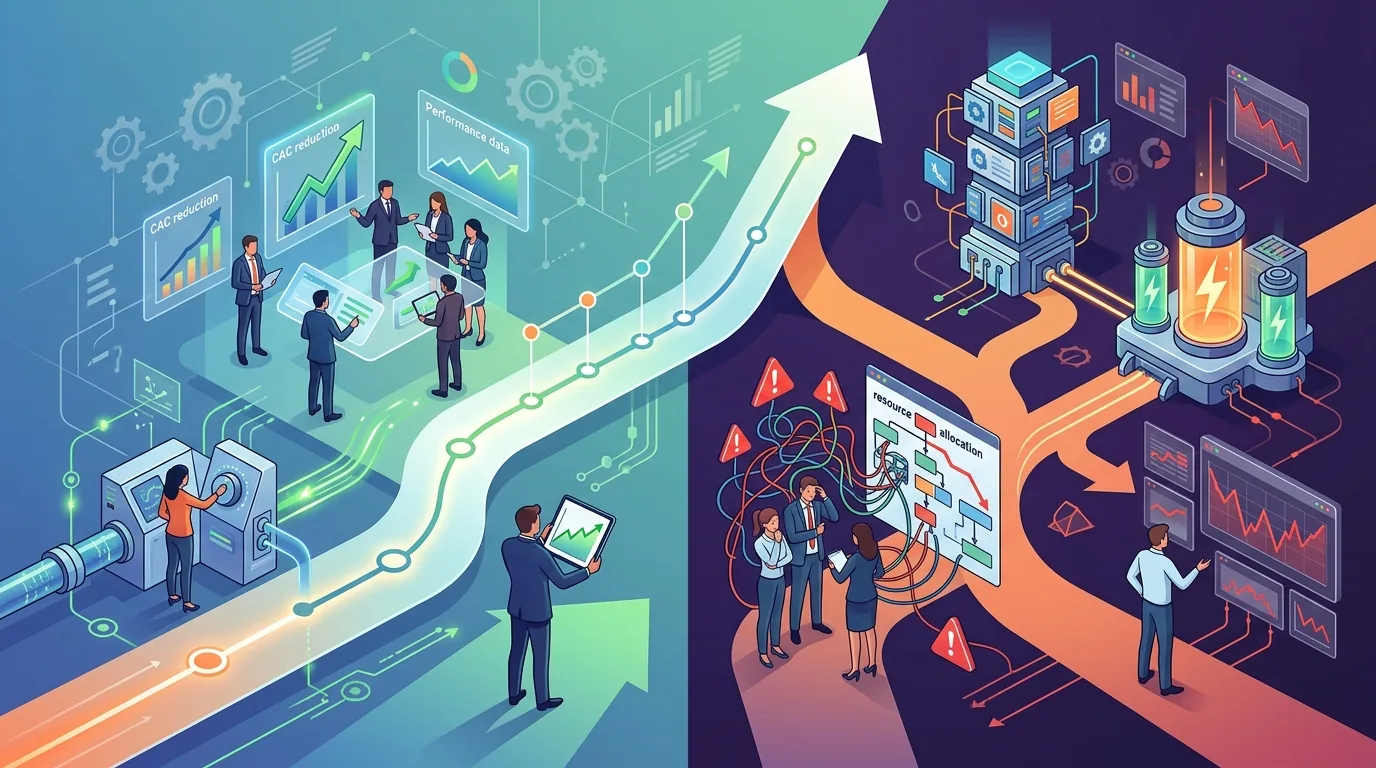
Gartner's 2026 Marketing Trends: What to Adopt and What to Avoid — illustrative featured image
> **Disclosure:** some links on this page are affiliate links. If you buy or book through them we may earn a commission, at no extra cost to you. It never changes what we recommend. Every March, the martech world collectively holds its breath for Gartner’s annual predictions. Last year, they told us to kill the marketing funnel and embrace the "messy middle." The year before, it was all about "composable architecture." If you chased every single one of those directives, your tech stack is probably bloated, your CAC has doubled, and your CFO is looking at you sideways. Gartner’s 2026 report, "The Future of Marketing: 5 Trends and Predictions," is out, and it is a doozy. It predicts a massive consolidation in the vendor landscape, a shift away from third-party data reliance, and the death of the traditional "brand campaign" as we know it. But here is the rub: Gartner writes for the Fortune 500 CMO. Their advice often assumes an unlimited budget and a dedicated data science team. If you are running a lean in-house growth team or evaluating a new agency partner, you need to filter this through a pragmatic lens. You cannot adopt everything, and you certainly should not ignore all of it. Let’s break down what is actually worth your martech investment dollars and what is a distraction dressed up as innovation. ## The 5 Predictions, Distilled Before we get into the weeds, here is the executive summary of what Gartner is forecasting for 2026. I have stripped out the analyst jargon and left the raw meat. 1. **The "Marketing Cloud" Consolidation:** The big platforms (Salesforce, Adobe, Oracle) will absorb more point solutions, forcing marketers to standardize on one suite. 2. **The Rise of "Contextual Intelligence":** With cookies officially dead, brands will pivot to real-time, in-the-moment signals (weather, location, intent) rather than historical user profiles. 3. **Generative AI Moves to the Back Office:** AI will stop being a content-creation toy and become a workflow optimizer, handling budget allocation and media buying in real time. 4. **The "Post-Demand" Era:** Gartner argues that traditional demand generation (gating content, email nurture streams) is yielding negative ROI because buyers are saturated. They push for "co-creation" with buyers instead. 5. **The Death of the "Brand" Metric:** They want to replace awareness and sentiment tracking with "behavioral loyalty" metrics that measure actual customer actions. At first glance, this looks like a roadmap to the future of marketing. But when you dig into the implications, you realize that Trends 1 and 4 are dangerous for the mid-market, while Trends 2 and 3 are absolute gold if implemented correctly. ## What to Avoid: The Pitfalls of "Suite-ification" and "Post-Demand" Nonsense Let’s start with the bad advice, because that is where most companies burn cash. ### Do Not Put All Your Eggs in the "Marketing Cloud" Basket Gartner predicts that by 2026, 70% of marketing leaders will consolidate their martech stack into a single "super-suite" to cut costs. That sounds great on paper. In reality, it is a trap. We have seen this movie before. You sign a massive contract with a major provider to unify your CRM, email, and analytics. You spend six months on implementation. You hire two consultants to make the integrations work. Then, you realize that the "best-of-breed" email tool you were using had a 98% deliverability rate, and the new suite has an 89% deliverability rate because their IP warming process is subpar. **The result:** Your ROAS on email drops by 15% immediately, and your CAC goes up. For a mid-sized B2B company, the math rarely works. The cost of the suite is higher than the sum of your current point solutions. The switching costs are astronomical. Unless you are a trillion-dollar enterprise drowning in technical debt, do not rip out your current stack just because a Gartner Magic Quadrant says you should. **Our advice:** Stick to a "hub and spoke" model. Keep your core CRM as the hub, but feel free to use specialized tools for SEO, paid social, and lifecycle marketing. The integration pain is worth the performance gain. ### Ignore the "Demand Generation is Dead" Rhetoric Prediction four is the most controversial. Gartner claims that buyers are so overwhelmed that they will no longer respond to email nurturing or gated whitepapers. They suggest a shift to "co-creation," where you build products and content *with* your customers in public. That is a beautiful theory for a company with a massive community and a cult following (think Figma or [Notion](https://www.notion.so/)). But for the average B2B SaaS company selling to enterprise clients, the gated whitepaper still works. Look at the data from actual campaigns we run. A targeted [ABM campaign](/dgtg/blog/beyond-pageviews-the-new-metrics-that-matter-for-b2b-lead-generation) that gates a specific ROI calculator for a niche vertical still generates a 20% conversion rate. The issue is not that demand generation is dead; it is that *bad* demand generation is dead. Spraying a generic ebook to a list of 50,000 people is dead. Sending a personalized video and a tailored ROI model to a list of 50 target accounts is not. Do not let Gartner convince you to stop building your pipeline. Instead, refine your targeting. The "cold" market is not ignoring you because they are saturated; they are ignoring you because you are boring. ## What to Adopt: The High-Value Signals Now, for the good stuff. There are two trends here that can genuinely lower your CAC and improve your LTV if you act on them now. ### Embrace "Contextual Intelligence" (But Do It In-House) Prediction two is the most actionable. Gartner notes that with the death of third-party cookies, brands are shifting to "contextual intelligence." This means targeting based on the *environment* of the user rather than the *history* of the user. Think about it practically. You are a B2B logistics software company. Instead of trying to track a CFO across the web (which is now impossible), you place your ads on specific supply-chain trade publications and weather alert sites. If there is a port strike in Rotterdam, your ad for "alternative routing software" appears next to that article. This is not futuristic. This is just good media buying that we used to do in the 90s, but now it is automated. **Our take:** This is where you should spend your martech investment. Tools that offer keyword-level contextual targeting (like Seedtag or GumGum) are seeing CTRs double compared to standard display retargeting. The key is to map your content to these signals. If you are a cybersecurity firm, you need ads that target articles about "data breach in healthcare" specifically, not just "technology." ### Let AI Handle the Budget, Not the Copy Prediction three is about Generative AI moving to the back office. This is the one we are most excited about, but for a specific reason. We do not want AI writing our ad copy (it usually sounds like a robot having a seizure). We want AI managing the *allocation* of that copy. Gartner predicts that AI will handle dynamic budget allocation across channels in real-time. This is the "holy grail" of performance marketing. Imagine this: You have a budget of $100k. You are running Google, LinkedIn, and Meta. Currently, you check the dashboards on Monday morning and manually shift budgets. By 2026, the software will do this every hour. If a specific LinkedIn campaign is hitting a 3.0 ROAS at 11 AM, the AI will automatically shift $5k from the underperforming Google campaign to the LinkedIn campaign by 11:15 AM. **What we recommend:** Look for platforms that offer "portfolio bidding" or "budget pacing" features. Google Ads already has this, but most advertisers are too scared to let it run. Test it with 20% of your budget. The results are usually a 10-15% improvement in ROAS simply because the machine is faster at spotting trends than you are. ## Our Take: The Playbook for 2026 Here is the honest truth. Gartner is looking at the macro-trends for the enterprise. You are looking at your quarterly numbers. Here is how we are advising our clients to bridge that gap. ### What We Recommend (The Pragmatic Picks) - **For your data stack:** Do not buy the whole Adobe suite. Instead, invest in a solid Customer Data Platform (CDP) like **Segment** or **mParticle**. This allows you to collect first-party data without forcing you into a monolithic cloud provider. It gives you the "contextual intelligence" capability without the lock-in. - **For your media buying:** Use **StackAdapt** or **The Trade Desk** for programmatic. They have the best contextual targeting capabilities right now, allowing you to test the "environmental" targeting without a massive commitment. - **For your workflow:** Implement **Hex** or **Airflow** for data orchestration. The biggest bottleneck for AI-driven budget allocation is messy data. If you can clean your data pipeline, you can use the native AI tools inside Google or Meta to handle the "back office" optimization. ### The "Hire vs. Build" Decision - **Do In-House:** Data clean-up and contextual strategy. You know your customer best, and you need to define what "context" matters to them. An agency cannot guess that a surge in "warehouse automation" searches is relevant to your product. - **Hire an Agency For:** The integration of the AI bidding tools and the creative production required for contextual ads. You need 50 different ad variants to match 50 different contexts. Your in-house designer cannot do that. An agency with programmatic creative tools can. ## FAQ **Q: Is Gartner's prediction about the death of the brand campaign accurate for small businesses?** A: No. Brand campaigns are only "dead" for saturated markets where awareness is already high. For a challenger brand, you still need to build trust. The prediction refers to measuring brand via vanity metrics, not the act of branding itself. Keep running brand ads, but tie them to direct traffic and branded search lift, not just "impressions." **Q: How much of our martech budget should we allocate to AI-driven tools in 2026?** A: Start small. Allocate 10% to 15% of your paid media budget to AI-managed portfolio bidding. Do not buy a separate "AI marketing suite." The native tools within Google and Meta are good enough for now. Spend the money on data infrastructure, not on the AI layer itself. **Q: We are a small team. How do we handle the shift from third-party data to contextual intelligence without hiring a data scientist?** A: Use a managed service or an agency that specializes in programmatic. They have the data science built into their platform. You provide the creative and the "context" strategy (i.e., which publications or topics matter to you). Let them handle the algorithm. It is cheaper than hiring a full-time data engineer. ## Related on this site - [Digital Marketing Software Market 2026-2033: What Founders Should Know](/dgtg/blog/digital-marketing-software-market-2026-2033-what-founders-should-know) - [9 Marketing Trends for 2026: What Founders Must Know](/dgtg/blog/9-marketing-trends-for-2026-what-founders-must-know) - [The Future of Marketing: 5 Gartner Predictions Every Agency Must Prepare For](/dgtg/blog/the-future-of-marketing-5-gartner-predictions-every-agency-must-prepare-for) ## Sources - [The Future of Marketing: 5 Trends and Predictions for 2026 - Gartner](https://news.google.com/rss/articles/CBMiZkFVX3lxTE9EUnZsVEVjWDNKYmtjY1liZzNrTjV3TWkwbTJOTFdud25jVDMwZlVBaS1wZktyZ2traWw2T2hLZEhJb2E1TENINUE5dVdyTDVaaEJvZlQ0dEhIazRDY1ZQLXhVLS1Ddw?oc=5) (Gartner) - [Gartner Marketing Survey Finds Awareness and Conversion Account for 62.6% of Total Media Spend - Gartner](https://news.google.com/rss/articles/CBMi6wFBVV95cUxPd3h4aUUxQ3Y0Nks4am4tamhTNmFGVXVEUE1fdnhqWE1OR25wcjVabzJSbDdfY1BYRGdVZUFTOVlCLUpSamozSmRSNURYd3BkX0NWWl9XT3pwejMwR21WcXhfMnRPZnltRXBoZGlaZ0lMbGRabWdlS2FtOEpyeWFnVUR6RzFNX1BQTGZQcFRjU21KbnZTMHR5a3NzTzUxeWNFSjFIZXBaRUFPRWljMG0yRHdWZmxsQ1lpNkk0N1JXYVEzNlVsZGlIUGF6bHB1S2NmbjN2SkptYTE2N1dXM3F6amhvRkJzVmlMRUFV?oc=5) (Gartner) - [Gartner Marketing Survey Finds 84% of Companies Are Stuck in a “Brand Doom Loop” - Gartner](https://news.google.com/rss/articles/CBMi1gFBVV95cUxQNDFOWGVhNGZkU2pOWm5XdkZWY25VQ00wZGZ6X2tIMnpNN2d3bXI5VWpKNjFSbmpyaEZUaG5FWElvNk02RnpvUlNGLUp0eFlNT3ZaSUVibE1ta0h2Nll4Q3I4bzZ1UUhSMzh1TzdYUndaM0NNbVNSdU5YRGJzbi1VNEVsbGIyUEpPZGIwakg3VGs2QkpMNlpNMXhJTE9jV1BXYTVkeXd3Z2JJYzY5Y2x6TjZMRko1M1d4LVNHd2VmN0s0TXFLUWtHOWwxRk05bmFiSWVmdTBR?oc=5) (Gartner) - [Gartner Survey Reveals Marketing Leaders Expect AI Automation of Marketing Work to Double by 2028 - Gartner](https://news.google.com/rss/articles/CBMigwJBVV95cUxPYWxiekt2UmxmX2NmYWtHemJzbi1ldk9kTi1reXEtSlRtVnlROU9VcF9KTmEydEtYMi1lTzI4SHNmREtPQ0VOTkEyZXNXSmJES0h6bzJhR2lKdlpwYWxXd3NlOEdhTXNiRTRBS0F5TE43MmZFUGtqSXBMdEZibS1uNGdYWFFEX2ZPbG12X1F0NFlFZUdKYWJRUmpwWkJHa3paUm9QcHRlVXBfcUFETEJmTEQ5NWt0S3o2Mm5aSGZMeENhS1B0TDdNRUVpeVFLY18xbUdVZUNrbnR6Ml9ab0dHOVpnLVp6eENJdnVheFhwVU9IdnZnY0pEMnoyN3V6SU9KRVcw?oc=5) (Gartner)

Frequently asked questions

Q: Is Gartner's prediction about the death of the brand campaign accurate for small businesses?

A: No. Brand campaigns are only "dead" for saturated markets where awareness is already high. For a challenger brand, you still need to build trust. The prediction refers to measuring brand via vanity metrics, not the act of branding itself. Keep running brand ads, but tie them to direct traffic and branded search lift, not just "impressions."

Q: How much of our martech budget should we allocate to AI-driven tools in 2026?

A: Start small. Allocate 10% to 15% of your paid media budget to AI-managed portfolio bidding. Do not buy a separate "AI marketing suite." The native tools within Google and Meta are good enough for now. Spend the money on data infrastructure, not on the AI layer itself.

Q: We are a small team. How do we handle the shift from third-party data to contextual intelligence without hiring a data scientist?

A: Use a managed service or an agency that specializes in programmatic. They have the data science built into their platform. You provide the creative and the "context" strategy (i.e., which publications or topics matter to you). Let them handle the algorithm. It is cheaper than hiring a full-time data engineer.