
DGTG logo DGTG

AI Marketing Tools 2026: Build vs Buy vs Partner

Decide whether to build, buy, or partner for AI marketing tools in 2026. Real cost benchmarks, integration traps, and our opinionated picks for B2B teams.
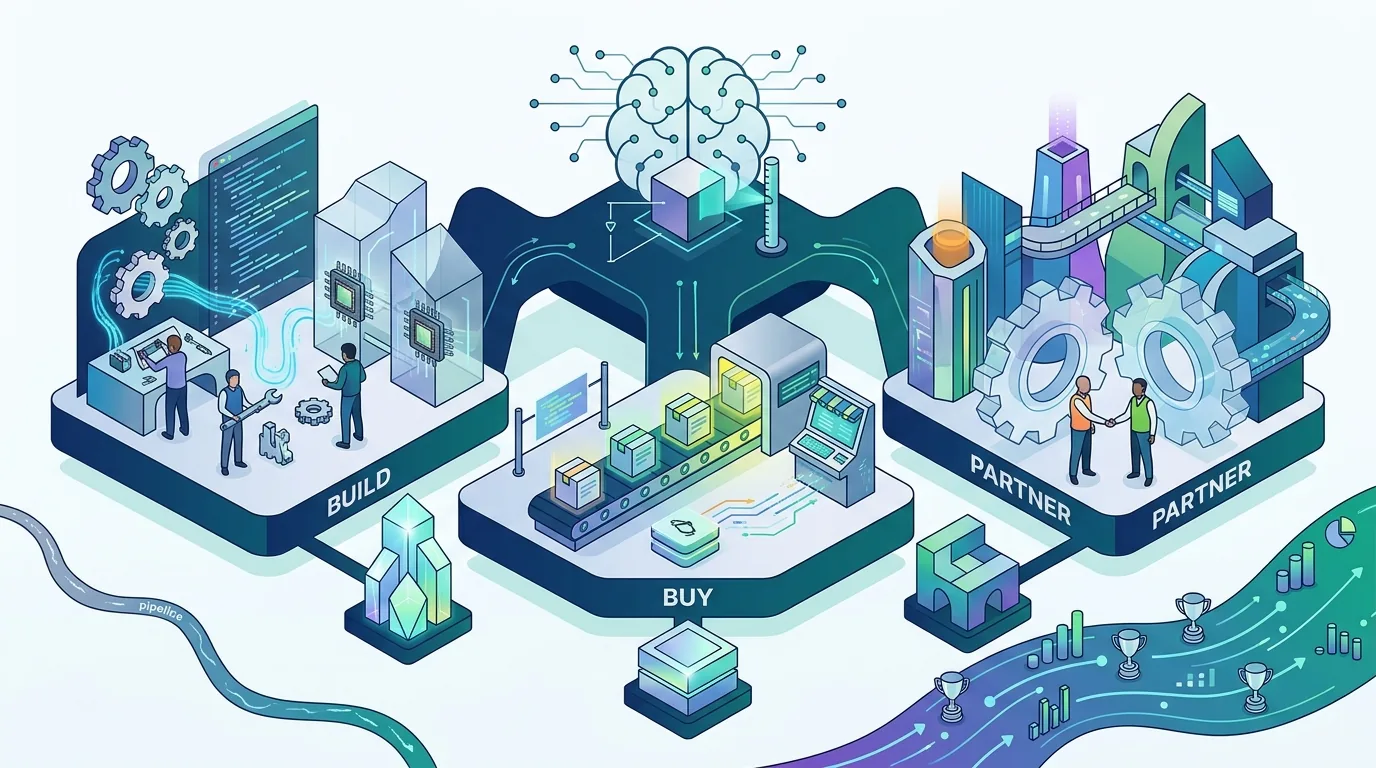
AI Marketing Tools in 2026: Build vs. Buy vs. Partner — illustrative featured image
A CMO I know spent $180,000 last year on AI marketing tools. Eleven subscriptions. A content generation platform, a predictive lead scoring add-on, a CDP that promised machine learning segmentation, plus eight others nobody on her team could name without checking the billing portal. Her team still missed pipeline targets by 22%. The tools were not broken. The problem was structural. Nobody owned the data pipeline feeding them. Nobody had mapped which model touched which stage of the funnel. And nobody had the internal bandwidth to tune anything beyond the default settings. That story repeats across B2B companies right now. The martech AI market has exploded, and the buying decision has become genuinely hard. Build it, buy it, or hand the problem to a partner? Each path has a real cost, and the wrong one compounds quietly for quarters before anyone notices. Here is how we think about the tradeoffs. ## The Three Paths, Priced Honestly Most build vs. buy conversations skip the part where you count the actual money. Let us fix that. | Path | Year One Cost (Typical B2B, $5M to $50M revenue) | Time to First Output | Who Owns Maintenance | |---|---|---|---| | Build in-house | $250K to $600K (2 to 4 hires plus infra) | 4 to 9 months | You, forever | | Buy tools | $40K to $200K in licenses | 2 to 8 weeks | Vendor, mostly | | Partner with agency | $60K to $300K retainer | 3 to 6 weeks | Shared, contractually defined | Those numbers are directional, not gospel. But they expose the real question. It is not which option is cheapest. It is which option matches the shape of your bottleneck. If your bottleneck is data infrastructure, buying another tool will not help. If your bottleneck is headcount, building will take too long. If your bottleneck is knowing what to do next, a partner earns their fee fast. ## When Building In-House Actually Makes Sense Building means hiring ML engineers, data engineers, or both, and giving them a problem worth solving. That is a high bar. We see build pay off in three situations. First, when your data is your moat. If you have proprietary behavioral data that no vendor can access, and that data drives your segmentation or scoring, owning the model matters. A SaaS company with five years of product usage logs can train something a generic tool will never replicate. Second, when your volume justifies it. If you are processing millions of customer interactions monthly, per-seat or per-event pricing on commercial tools gets ugly. At some threshold, a $400K internal build beats a $700K annual license. Third, when compliance forbids the alternative. Healthcare, financial services, and defense-adjacent companies often cannot send customer data to third-party inference endpoints. That constraint alone can force the build decision. What building does not fix: strategy. A team of talented engineers pointed at the wrong funnel stage will produce elegant models that move nothing. ### The Hidden Cost Nobody Budgets For Retention. ML engineers turn over. When your one person who understands the recommendation model leaves, you are not just hiring a replacement. You are paying six figures to reverse-engineer your own system. Budget 20 to 30 percent of your build cost annually for maintenance and knowledge continuity. If that number makes you flinch, build is probably wrong for you. ## When Buying Tools Wins Buying is the default for good reason. The marketing technology 2026 landscape has matured. Vendors like HubSpot, Jasper, and Clay now ship AI features that would have been separate products three years ago. Buy when you need speed and the problem is common. Lead scoring, content drafting, ad copy variation testing, basic attribution. These are solved problems. Building your own version is ego, not strategy. Buy when your team can actually adopt the tool. A $50K platform with 15 percent seat utilization is a $50K waste. We have watched companies buy enterprise tiers for teams of four because the sales rep bundled it with a discount. A useful rule: if you cannot name the person who will own the tool daily and the metric it moves, do not buy it yet. ### The Integration Tax Every tool you add creates connective tissue work. Data has to flow in. Outputs have to flow out. Someone has to maintain the API keys, the field mappings, the deduplication logic. Companies running more than 15 martech tools report significantly higher integration overhead and lower confidence in their own data, according to repeated [industry surveys](/dgtg/blog/martech-and-ai-tools-how-to-build-a-stack-that-scales-in-2026). The stack becomes a liability. Buy fewer tools. Configure them properly. That beats a broad, shallow stack every time. ## When a Partner Is the Right Call Agencies get a bad reputation in build vs. buy debates, often deservedly. But there is a specific version of this that works. Partner when you need capability before you need headcount. A good agency brings trained people, existing playbooks, and cross-client pattern recognition. They have seen your problem at 40 other companies. That is real leverage. Partner when the work is cyclical or experimental. Testing AI-driven creative at scale, standing up a new channel, running a six-month pilot before you commit to a permanent hire. Agencies absorb that volatility better than a full-time team can. Partner when you need someone to own the outcome, not just the tool. The distinction matters. A tool vendor sells software. An agency sells a result. If your team lacks the bandwidth to turn software into results, paying for the result directly is rational. The trap: using an agency as a permanent substitute for internal capability. That works for some companies. For most, it creates dependency and slowly erodes institutional knowledge. Set an exit ramp. Know what you want to own in 18 months. ## Our Take: What We Recommend We have watched enough of these decisions play out to have opinions. For most B2B companies between $5M and $50M in revenue: buy tools for execution, partner for strategy, and build only the one thing that is genuinely proprietary to you. Concretely, that looks like this. Buy HubSpot or a comparable CRM with native AI features for your core pipeline. Do not build a CRM. Buy Jasper or a similar platform for content operations if you produce more than 20 assets monthly. Buy Clay if your outbound motion depends on enrichment and personalization at scale. Partner for the layer above the tools. Funnel strategy, attribution modeling, AI-assisted creative testing programs. These require pattern recognition across companies, which is exactly what a good agency has and an internal team usually does not. Build only when you have proprietary data that drives competitive advantage and the volume to justify the engineering cost. For most companies, that is one thing, not five. Maybe it is your recommendation engine. Maybe it is your lead scoring model trained on five years of closed-won data. Pick one. Do it well. The companies winning with AI marketing tools in 2026 are not the ones with the biggest stacks or the biggest teams. They are the ones who matched their spending to their actual bottleneck and resisted the urge to do everything. ## FAQ ### How do we know if we should build or buy first? Look at your bottleneck, not your budget. If your team lacks the data infrastructure to feed AI tools, buying more tools will not help. If your team lacks strategic direction, building will not help either. Diagnose the constraint before you spend anything. ### What is a reasonable first-year budget for AI marketing tools? For a B2B company between $5M and $50M in revenue, $40K to $200K in licenses is typical, depending on how many functions you are automating. Add 20 to 30 percent for integration and internal adoption time. If you cannot name the metric each tool moves, cut it from the budget. ### When should we fire our agency and bring work in-house? When you have hired someone who can run the playbook the agency built, and when the marginal value of their cross-client pattern recognition drops below their retainer. That usually happens 12 to 24 months in. Plan the transition deliberately rather than letting the contract renew on autopilot. ## Related on this site - [10 Martech and AI Tools That Will Transform Your 2026 Marketing Strategy](/dgtg/blog/10-martech-and-ai-tools-that-will-transform-your-2026-marketing-strategy) - [Digital Marketing Trends 2026: What Brands Must Know](/dgtg/blog/digital-marketing-trends-2026-what-brands-must-know) - [AI in Marketing: How to Leverage AI Tools for Client Success](/dgtg/blog/ai-in-marketing-how-to-leverage-ai-tools-for-client-success)

Frequently asked questions

The Hidden Cost Nobody Budgets For Retention. ML engineers turn over. When your one person who understands the recommendation model leaves, you are not just hiring a replacement. You are paying six f

Look at your bottleneck, not your budget. If your team lacks the data infrastructure to feed AI tools, buying more tools will not help. If your team lacks strategic direction, building will not help either. Diagnose the constraint before you spend anything.

What is a reasonable first-year budget for AI marketing tools?

For a B2B company between $5M and $50M in revenue, $40K to $200K in licenses is typical, depending on how many functions you are automating. Add 20 to 30 percent for integration and internal adoption time. If you cannot name the metric each tool moves, cut it from the budget.

When should we fire our agency and bring work in-house?

When you have hired someone who can run the playbook the agency built, and when the marginal value of their cross-client pattern recognition drops below their retainer. That usually happens 12 to 24 months in. Plan the transition deliberately rather than letting the contract renew on autopilot.