
DGTG logo DGTG

AI Marketing Trends 2026: 9 Moves to Future-Proof Growth

Nine AI marketing trends for 2026, with a practical playbook on what to build in-house, what to hire out, and where to spend first. Includes tool picks.
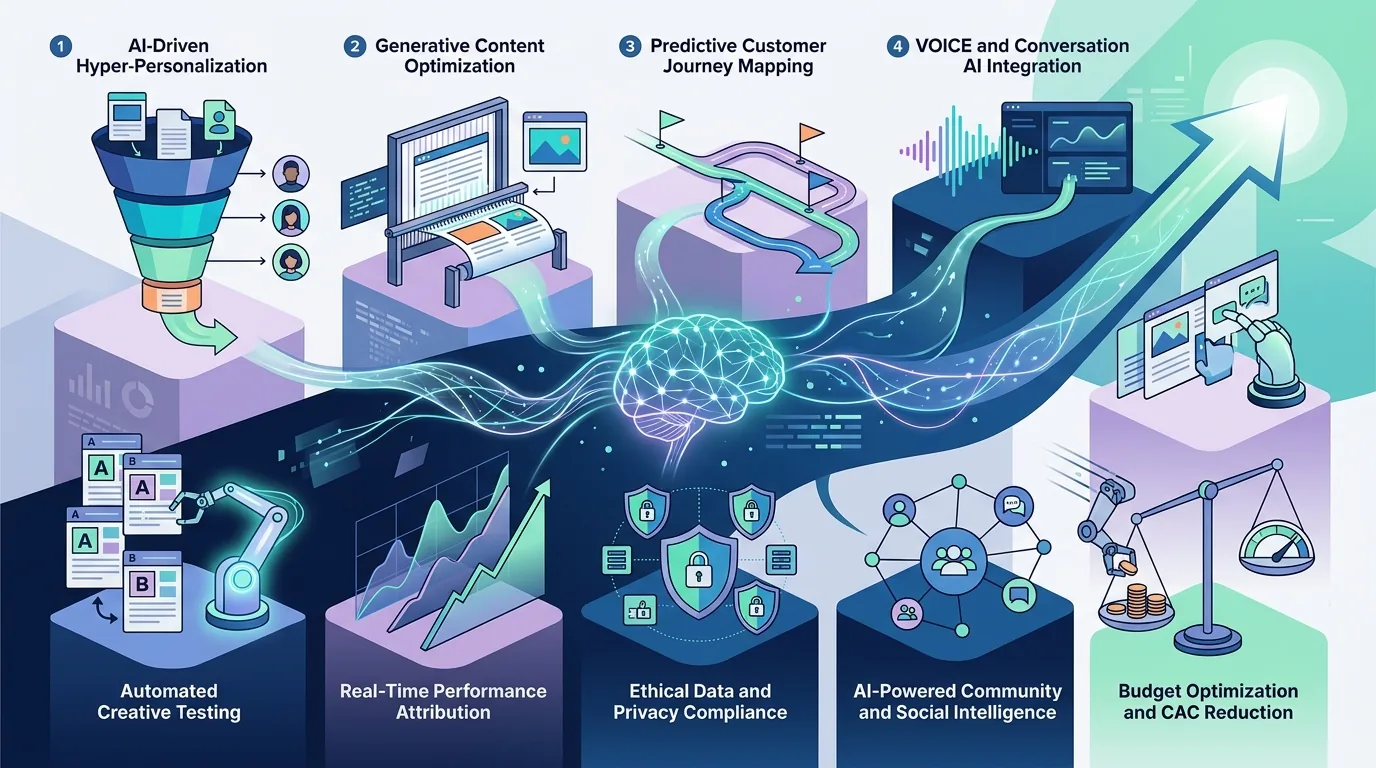
AI Marketing in 2026: 9 Trends to Future-Proof Your Strategy — illustrative featured image
Two weeks ago a B2B SaaS founder showed us her dashboard. Six months earlier, her team had shipped an AI-generated content program: 400 blog posts, 2,000 ad variants, a chatbot on every pricing page. Traffic was up 41%. Pipeline was flat. Cost per qualified demo had actually climbed, from $310 to $365, because the flood of generic content was attracting the wrong buyers and her SDRs were burning hours disqualifying them. That gap between activity and outcome is the whole story of AI marketing right now. The tools work. Most strategies around them do not. Coursera's recent roundup of 2026 marketing trends is a decent map of where the field is heading, though like most trend lists it stops short of telling you what to actually build. So we will do that part. Here are the nine trends that matter for a B2B growth plan in 2026, and how to integrate each one without lighting your CAC on fire. ## 1. Hyper-personalization moves from email subject lines to full journeys For years "personalization" meant first-name tokens and a geo-swap in the hero image. AI has pushed it much further: dynamic landing pages assembled per account, ad copy that shifts based on firmographic data, nurture sequences that rewrite themselves around engagement signals. The trap is complexity. A three-person marketing team cannot maintain 40 journey variants. Pick two segments where LTV justifies the effort (enterprise and mid-market, for example) and personalize hard there. Leave the long tail on a solid default path. ## 2. Predictive analytics finally becomes usable without a data team Predictive lead scoring used to require a data scientist and a six-month build. Modern platforms ship it as a feature. The practical win is not "who will buy" (that model is always noisier than the vendor claims) but "who is worth a sales call this week." A useful filter we apply with clients: if a predictive score cannot change an action within 48 hours, it is a vanity metric. Route high scores to sales, mid scores to automated nurture, low scores to a low-cost content track. That is the entire playbook. ## 3. Generative search reshapes how buyers find you Google's AI Overviews, [Perplexity](https://www.perplexity.ai/), and [ChatGPT](https://chat.openai.com/) search now answer a meaningful share of commercial queries before a user ever clicks a blue link. Your organic CTR on informational keywords is quietly eroding, and no amount of schema markup fully reverses it. What works instead: - **Win the citation, not just the click.** Structured, quotable, fact-dense content gets pulled into AI answers. Vague thought leadership does not. - **Track brand mentions in AI responses.** Tools like Profound and Peec AI now monitor how often models cite you. Treat it like a new ranking report. - **Double down on bottom-funnel pages.** Comparison and pricing pages still convert because buyers click those deliberately. ## 4. AI agents start handling the boring middle of the funnel The future of marketing AI is not a chatbot that says "I'm sorry, I didn't catch that." It is agents that qualify inbound leads, book meetings, answer technical pre-sales questions from a knowledge base, and hand off cleanly to a human. Early adopters report meaningful drops in speed-to-lead, which matters because response time is one of the strongest predictors of conversion in B2B. Set the boundary clearly. Agents handle routing, scheduling, and FAQ. Humans handle pricing negotiations, security reviews, and anything with legal exposure. ## 5. Creative production gets industrial, and differentiation gets harder When every competitor can generate 500 ad variants in an afternoon, creative volume stops being an advantage. The differentiator shifts to proprietary inputs: customer interviews, internal data, founder point of view, real product screenshots. AI cannot invent a story you never had. Our rule of thumb: use AI to produce 80% of the draft and 0% of the insight. ## 6. Budgets shift from channels to measurement Attribution was already messy. Add AI-mediated discovery and agent-driven touchpoints and last-click reporting becomes fiction. Expect more spend on incrementality testing, marketing mix modeling, and clean-room measurement in 2026. | Approach | Best for | Rough cost | |---|---|---| | Geo holdout tests | Mid-size budgets, clear regions | Low, mostly internal time | | Marketing mix modeling | $5M+ annual spend | $40k to $150k per year | | Clean rooms | Privacy-sensitive, multi-platform | Enterprise pricing | You do not need all three. You need one you actually trust. ## 7. First-party data becomes the moat Third-party signals keep degrading. The companies winning in 2026 are the ones with a real first-party asset: a newsletter people open, a community, a product usage feed, a podcast audience. AI makes this data more valuable because it can be segmented and activated faster. It does not make it easier to acquire. ## 8. Marketing ops absorbs AI governance Someone has to decide which tools touch customer data, what the disclosure policy is, and how outputs get reviewed. In most companies under 200 people, that lands on marketing ops. Build a one-page AI usage policy now, before a junior hire pastes a customer list into a random tool. ## 9. The talent bar rises, not falls AI did not remove the need for judgment. It removed the need for people whose only skill was producing volume. The marketers thriving in 2026 are editors, strategists, and analysts who happen to be fast. If you are hiring, test for taste and reasoning, not prompt library size. ## Our take: what to build in-house vs. hire out We see this split constantly, so here is where we land. **Do in-house:** content strategy and point of view, first-party data collection, sales and marketing alignment, AI governance, day-to-day campaign execution with AI tools. **Hire an agency for:** [measurement infrastructure](/dgtg/blog/martech-and-ai-tools-how-to-build-a-stack-that-scales-in-2026) (incrementality tests, MMM), generative search visibility programs, paid media experimentation at scale, and short-term capacity spikes like a product launch. Our picks if you are evaluating tools this quarter: **HubSpot** for the CRM and lifecycle base, **Jasper** or **Claude** for draft production with a human editor in the loop, **Profound** for tracking AI search citations, and **Mutiny** if you have the traffic to justify account-level personalization. None of these fix a broken offer. All of them compound a working one. The uncomfortable truth about AI marketing trends 2026 is that the technology has stopped being the constraint. Your positioning, your data, and your willingness to kill campaigns that do not move CAC are the constraints. The founder with 400 blog posts learned that the expensive way. ## FAQ ### Will AI replace marketing jobs in 2026? Not wholesale, but it will keep compressing roles built around production volume. Strategy, editing, data interpretation, and relationship-driven work are safer. If your job is mostly generating first drafts, start moving up the stack now. ### How much should a mid-size B2B company budget for AI marketing tools? Most companies spending $1M to $5M annually on marketing land between $3,000 and $8,000 per month across AI content, analytics, and personalization tools. Start with two or three, prove ROI on one channel, then expand. ### What is the fastest way to future-proof a 2026 marketing plan? Fix measurement first. Without trustworthy attribution, every AI investment is a guess. Then pick one high-LTV segment for personalization, build a generative search visibility program, and write your AI usage policy before procurement asks for one. ## Related on this site - [9 Marketing Trends for 2026: What Founders Must Know](/dgtg/blog/9-marketing-trends-for-2026-what-founders-must-know) - [Beyond Pageviews: The New Metrics That Matter for B2B Lead Generation](/dgtg/blog/beyond-pageviews-the-new-metrics-that-matter-for-b2b-lead-generation) - [2026 Social Media Rules: 3 Trends Marketers Need to Win](/dgtg/blog/2026-social-media-rules-3-trends-marketers-need-to-win)

Frequently asked questions

Will AI replace marketing jobs in 2026?

Not wholesale, but it will keep compressing roles built around production volume. Strategy, editing, data interpretation, and relationship-driven work are safer. If your job is mostly generating first drafts, start moving up the stack now.

How much should a mid-size B2B company budget for AI marketing tools?

Most companies spending $1M to $5M annually on marketing land between $3,000 and $8,000 per month across AI content, analytics, and personalization tools. Start with two or three, prove ROI on one channel, then expand.

What is the fastest way to future-proof a 2026 marketing plan?

Fix measurement first. Without trustworthy attribution, every AI investment is a guess. Then pick one high-LTV segment for personalization, build a generative search visibility program, and write your AI usage policy before procurement asks for one.