DGTG logo DGTG

2026 Digital Marketing Trends: AI, Search, Social Guide

Discover the top digital marketing trends for 2026. Learn how AI, search fragmentation, and social commerce reshape growth. Actionable strategies for CMOs and…
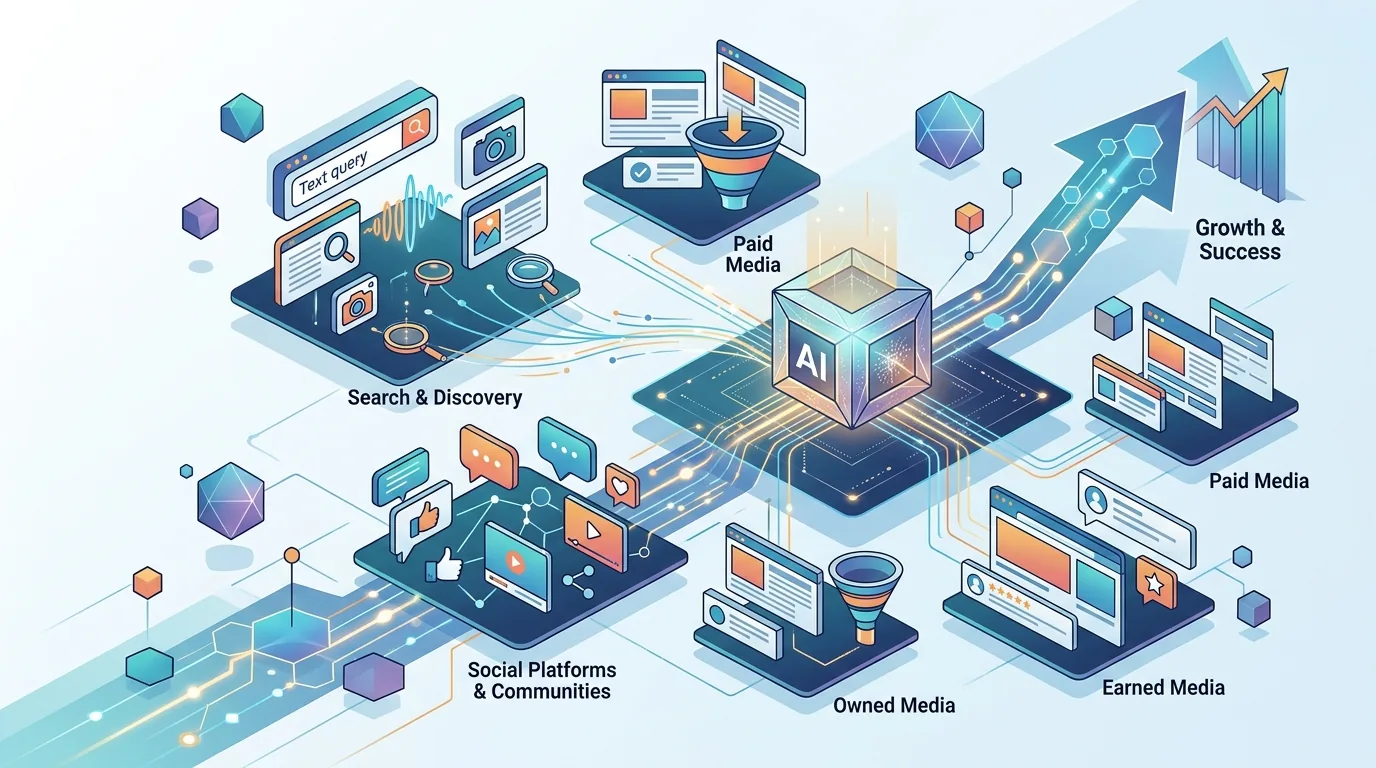
2026 Digital Marketing Trends: How AI, Search, and Social Will Reshape Growth — illustrative featured image
The last time we saw a shift this fundamental, it wasn’t a shift at all. It was a collapse. The death of third-party cookies forced every media buyer on the planet to relearn attribution overnight. In 2026, we aren’t waiting for a collapse. We are walking into a splintering. The monolithic search bar is giving way to a dozen different answer engines, and the social feed has mutated into a commerce floor where the line between content and checkout has officially evaporated. If you are a founder or a CMO, the reports landing on your desk right now are full of percentages and projections. But the real story is simpler: the cost of customer acquisition is rising because the pathways are fragmenting, and the only asset that retains value across all of them is proprietary data. Here is how we translate the noise into a roadmap. ## The End of the Search Engine as We Knew It For two decades, SEO meant one thing: ranking on Google. That era is over. Not because Google is dying, but because it is no longer the default starting point for a massive cohort of high-intent buyers. Gen Z and younger millennials are bypassing the traditional SERP entirely, opting for TikTok search and Reddit threads to validate purchase decisions. The 2026 trend reports confirm what we are seeing in client accounts. Search volume on traditional engines is plateauing, while "social search" queries are growing at a compound rate that makes legacy SEO metrics look static. This isn't a blip. It is a behavioral shift. What does this mean for your growth strategy? You need a presence where the answers are being sought. That means optimizing your content for TikTok's search algorithm and Reddit's community guidelines with the same rigor you once applied to Google's crawlers. Here is the hard truth: your beautiful, carefully crafted pillar page on "enterprise CRM solutions" is useless if a procurement manager is asking a niche subreddit for a workaround and your brand isn't in the thread. ### The New SEO Stack We are moving from a world of keywords to a world of entities and context. Google's AI Overviews have decimated click-through rates for informational queries. If you are ranking for "what is a CDP," you are now renting space for Google to scrape your answer and keep the user on the SERP. - **Contextual Authority:** You need to be cited as a source, not just ranked as a link. This means creating data-backed original research that AI models reference. - **Social Indexing:** Tools like Brandwatch and Sprout Social are now as important as Ahrefs. You need to track share of voice within specific conversational threads, not just backlinks. - **Video SEO:** YouTube is the second largest search engine, and it is becoming the first for "how-to" queries. Transcripts and structured data on video content are non-negotiable. The agencies that will win in this environment are those that treat search as a full-funnel content distribution problem, not a technical audit checklist. If your current agency is still sending you monthly reports dominated by keyword rankings for terms you already own, it is time to look elsewhere. For more on what to expect from your agency partner, see our guide on [how to choose a digital marketing agency](/dgtg/blog/how-to-choose-a-digital-marketing-agency-tips-for-founders-cmos). ## AI Marketing Trends: From Automation to Orchestration The first wave of AI marketing tools was about efficiency. We used them to write email subject lines and generate ad variations. That was 2024. In 2026, the AI marketing trends that matter are about orchestration, not automation. We are moving toward AI agents that can manage a budget across channels, adjust bidding in real time based on inventory levels, and even generate creative assets on the fly that are tailored to a specific user's emotional state. This is where the "what to hire an agency for vs. do in-house" question gets sharp. For a deeper look at the broader shifts shaping this decision, review our [2026 digital marketing trends playbook](/dgtg/blog/2026-digital-marketing-trends-a-playbook-for-agencies-and-their-clients). In-house teams are great at brand voice and strategy. They understand the product nuances. But building a proprietary AI pipeline that ingests your CRM data, your ad platform data, and your on-site behavior data to predict LTV is a heavy engineering lift. It requires data scientists, not just prompt engineers. As you evaluate these [AI tools](/tech/blog/ai-model-fatigue-how-to-choose-the-right-ai-tool-without-overthinking-2), keep in mind that the choice isn't just about features-it's about what fits your team's actual workflow. #### What to keep in-house: - Brand narrative and creative direction. - Customer relationship management and account management. - High-level strategic partnerships. #### What to hire an agency for in 2026: - **AI Workflow Integration:** Agencies have the cross-client experience to know which models (OpenAI, Anthropic, or open-source variants like Llama) are actually stable for production use cases, not just demos. - **Creative Testing at Scale:** The cost of creative production has plummeted. The bottleneck is now testing velocity. A good agency will have a system to spin up 50 variations of a hook, test them against specific lookalike audiences, and kill the losers within hours. - **Data Clean Rooms:** With the cookie fully gone, clean rooms are the only way to do secure data collaboration with retail media networks. Setting these up requires specific technical expertise. The biggest mistake we see? Brands buying "AI tools" and expecting them to replace strategy. A $500/month AI tool that writes blogs is not a marketing strategy. It is a typewriter with a better keyboard. The real ROI comes from using AI to compress the feedback loop between insight and action. ## Search and Social Trends 2026: The Blurring of Paid and Organic The search and social trends 2026 reports all point to one convergence: the death of the "last click" attribution model. We are seeing a rise in what the industry calls "omnichannel orchestration," but we prefer to call it "showing up everywhere without being creepy." Consumers are not loyal to platforms. They are loyal to convenience. They might see your product on LinkedIn, search for reviews on Reddit, watch a demo on YouTube, and finally purchase via an Instagram ad. If you are measuring ROAS on a per-platform basis, you are flying blind. We recommend a shift to a blended CAC and a focus on "assisted conversions." This requires a unified data layer. You need to know that a user who clicked your LinkedIn post is the same user who converted on the Instagram ad three days later. ### The Commerce Feed Social platforms have fully completed their transition from media companies to commerce infrastructure. TikTok Shop and Instagram Checkout are no longer experiments. They are primary revenue channels for D2C brands. For B2B, the shift is different but equally potent. LinkedIn is pushing harder into lead-gen forms and native events. The playbook for 2026 looks like this: - **Creative is the product.** High-production value is dead. Authentic, lo-fi, screen-recorded content is outperforming studio ads across every platform we manage. - **Community is the moat.** Brands that build private communities (Discord, Slack, or even WhatsApp broadcast lists) are seeing lower churn and higher LTV than those that rely solely on public feeds. - **Search feeds social feeds.** You need to monitor what questions are being asked about your category on social platforms and then answer them with content on your owned properties. ## What We Recommend We have looked at the budgets of our clients and the results they are seeing. Here is our pragmatic, opinionated take on where to put your money in Q3 and Q4 of 2026. - **Do not buy a "GenAI" chatbot for your website.** They are expensive, they hallucinate, and they rarely increase conversion rates. Instead, invest that budget into a robust "answer center" that leverages structured data and semantic search. Users want fast answers, not a conversation with a robot that has a 10% error rate. - **Hire a fractional CMO with a technical background.** The gap between marketing and engineering is shrinking. You need a leader who can sit in a room with your CTO and discuss API integrations for your CDP, not just someone who talks about "synergy." - **Invest in a proprietary data warehouse.** Whether it is Snowflake or BigQuery, you need a single source of truth. If you are relying on platform dashboards to tell you what is working, you are looking at a funhouse mirror. We have seen clients reduce CAC by 18% just by consolidating their data and turning off the channels that were getting credit they didn't deserve. - **For B2B specifically, double down on LinkedIn Ads.** Yes, the CPMs are high. But with the decline of Twitter/X as a B2B channel and the noise on other platforms, LinkedIn remains the only place where you can target by job title and company size without wasting impressions. Use it for retargeting, not just top-of-funnel awareness. ## FAQ **How long before AI-generated content hurts my SEO rankings?** It already is, if you are using it poorly. Google's spam policies target "scaled content abuse." If you are publishing AI text without human editing, fact-checking, and added insight, you are risking a manual action. Use AI for research and outlines, but the final voice needs human fingerprints. **Is SEO dead for B2B companies in 2026?** No, but the definition has changed. You still need to rank for high-commercial-intent keywords like "best [software] for [industry]." However, you need to pair that with a strong presence on review sites (G2, Capterra) and in communities where your buyers actually hang out. **Should we build our own AI agents or use off-the-shelf tools?** Start with off-the-shelf tools for content generation and ad optimization. Build custom agents only when you have a clear data advantage and a specific workflow that generic tools cannot handle. Most companies do not need a custom agent; they need better data hygiene.

Frequently asked questions

How long before AI-generated content hurts my SEO rankings?

It already is, if you are using it poorly. Google's spam policies target "scaled content abuse." If you are publishing AI text without human editing, fact-checking, and added insight, you are risking a manual action. Use AI for research and outlines, but the final voice needs human fingerprints.

Is SEO dead for B2B companies in 2026?

No, but the definition has changed. You still need to rank for high-commercial-intent keywords like "best [software] for [industry]." However, you need to pair that with a strong presence on review sites (G2, Capterra) and in communities where your buyers actually hang out.

Should we build our own AI agents or use off-the-shelf tools?

Start with off-the-shelf tools for content generation and ad optimization. Build custom agents only when you have a clear data advantage and a specific workflow that generic tools cannot handle. Most companies do not need a custom agent; they need better data hygiene.